
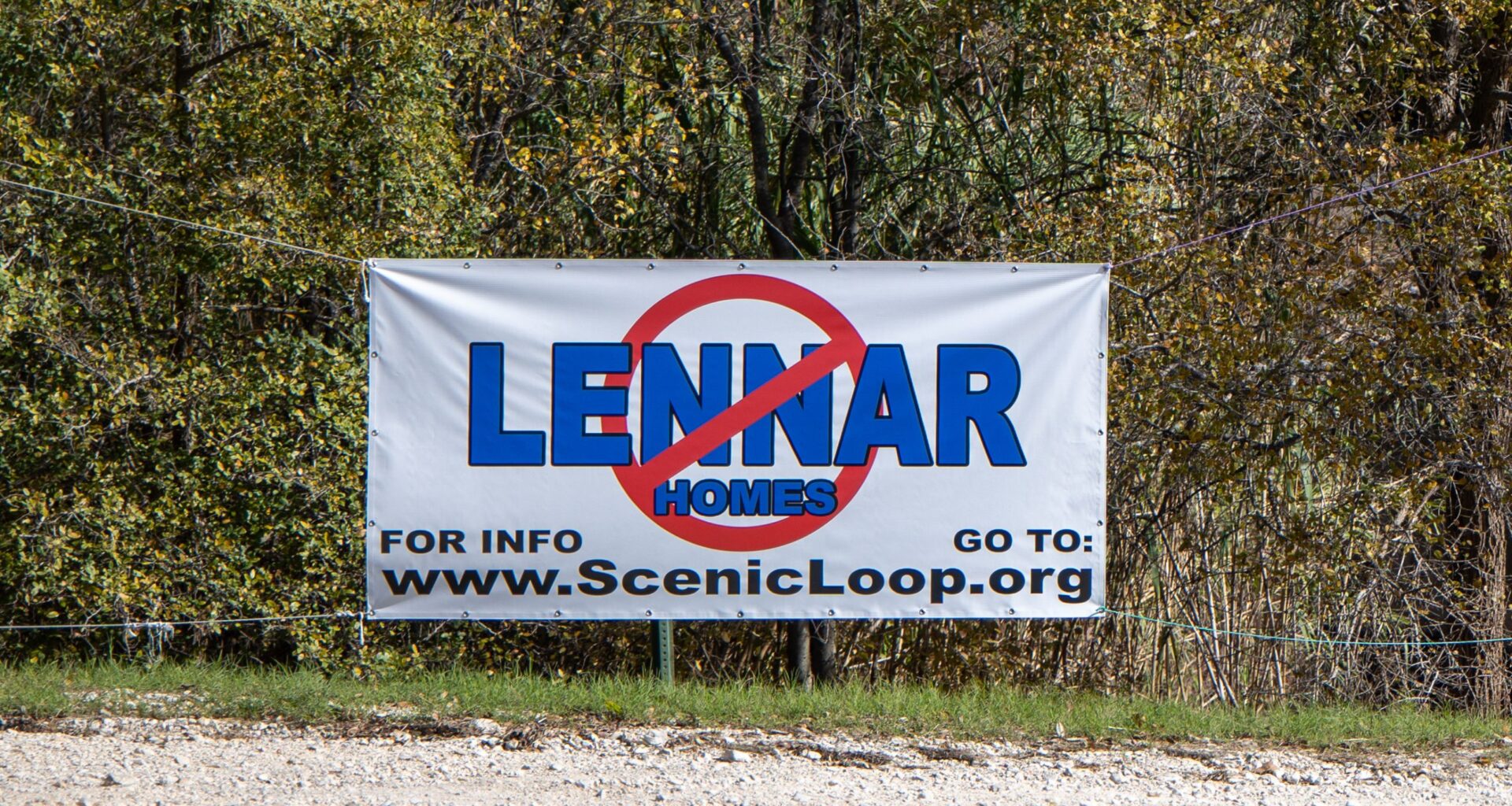
San Antonio City Council unanimously voted Thursday to deny a request for consent for the creation of a municipal utility district tied to the proposed Guajolote Ranch Development in northwest Bexar County, blocking a financial mechanism that would have funded infrastructure — including an on-site wastewater treatment plant — for nearly 3,000 homes near the Edwards Aquifer contributing zone.
All 10 council members and Mayor Gina Ortiz Jones voted no following an hour of public comment and discussion centered on water quality risks, long-term tax implications and doubts over safeguards proposed by the developer and San Antonio Water System.
The proposed Bexar County Municipal Utility District No. 2 would have financed roughly $150 million in infrastructure improvements for the 1,160-acre project near Scenic Loop Road and Babcock Road. Those costs would have been repaid through property taxes, assessments and bonds paid by future homeowners within the district.
City staff emphasized during a presentation that denying the MUD would not halt the development.
At a Jan. 16 Planning Commission hearing on the request, a representative for Lennar Corp. said the company would move forward with the project even if the MUD was denied by the city.
With the request for consent now rejected, the developer can petition for a wastewater service agreement through SAWS. If no agreement is reached within 120 days, the developer may seek approval from the Texas Commission on Environmental Quality to create a district independently.
City staff noted that in roughly 20 years, TCEQ has denied only one municipal utility district application — due to an issue with the application itself, not environmental concerns.
Council members said the potential risks to San Antonio’s primary drinking water source outweighed the city’s limited control under a TCEQ-approved MUD structure.
“We know that this is a threat to our water quality. As folks have also mentioned we cannot make more water,” said District 5 Councilwoman Teri Castillo. ”So when we talk about forever chemicals and the impact that’s going to have on our overall health it is something that we should be taking into account today.”
Several council members also criticized the structure of municipal utility districts, which function as separate taxing entities initially governed by developer-appointed boards.
District 9 Councilwoman Misty Spears said the MUD raises concerns about creating a separate government with little city oversight.
Although Guajolote Ranch lies outside of San Antonio’s city limits, the project is located within the city’s extraterritorial jurisdiction, or ETJ, which is the unincorporated land surrounding the city where San Antonio has limited authority over development that could affect public services, infrastructure and environmental quality within city boundaries.
“The fact remains that this creates a separate government with its own permanent tax rate. It is taxing future homeowners without their consent and their input, and it’s managed by a board that is not us and is not elected,” she said. “It’s a false sense of security and control to think that we would gain anything in developing this MUD at the city.”
Castillo echoed concerns surrounding taxing entities that lack representation through elected officials.
“The Texas Comptroller has identified MUDs are a large growing special taxing district, totaling over $12.7 billion being diverted from the state of Texas into these specific districts again with no elected representation determining where those dollars get allocated and how they can impact the overall state,” she said. “These are dollars that can otherwise be going towards public safety, education, and public health.”
The vote follows years of dispute over the Guajolote Ranch project and a wastewater discharge permit approved by TCEQ in October.
That permit allows the project’s wastewater operator to discharge up to 1 million gallons of treated effluent per day into a normally dry creek bed upstream of Helotes Creek — with up to 4 million gallons allowed on peak days.
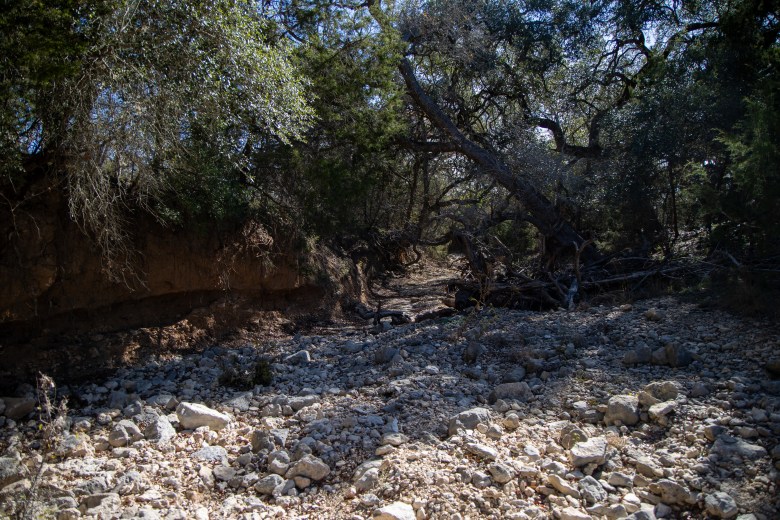 A dry creek bed downstream from the Guajolote Ranch property, where a proposed wastewater treatment plant would discharge up to 1 million gallons of treated effluent per day — and up to 4 million gallons on peak days — on land owned by the Toepperwein family in northwest Bexar County. Credit: Diego Medel / San Antonio Report
Opponents argue the Helotes Creek watershed sits atop fractured karst limestone, where water — and anything dissolved in it — can move rapidly underground into both the Trinity and Edwards aquifers.
Because Texas law evaluates wastewater permits under surface-water standards, the TCEQ review did not require an analysis of groundwater flow.
That permitting decision is currently being challenged in Travis County District Court by the Scenic Loop–Helotes Creek Alliance after an unsuccessful rehearing request through TCEQ.
Among the most notable speakers during public comment was Dr. Ronald Green, a groundwater hydrologist and senior author of a 2020 Southwest Research Institute study commissioned by the city to evaluate the impact of wastewater systems in the Helotes Creek watershed.
Green told council no new research has refuted those findings despite SAWS discrediting the study’s finding on connectivity in public hearings.
“To my understanding, there have been no additional studies conducted that refute these findings,” Green said. ”SAWS claims that the project would not risk the safety of the Edwards aquifer. Its argument is based on opinions, not science. SAWS’ claims are not backed by any studies or data information, either informal or peer-reviewed.”
SAWS Senior Vice President Donovan Burton briefly addressed concerns during council discussion, saying the utility takes no position on the creation of the MUD itself and remains focused on water quality.
Before the vote, the mayor pressed city staff on what additional protections the city would gain by approving the MUD alongside a development agreement.
Staff confirmed that many environmental safeguards — including advanced wastewater treatment standards, open space requirements and impervious cover limits — would remain in place regardless under SAWS’ 2022 utility service agreement and a 2024 settlement agreement.
Some development controls, such as bond caps, conservation easements and annexation terms, would only apply if the MUD and development agreement were approved.
Staff also disclosed that the developer had not signed the development agreement — a separate contract that would have imposed additional environmental safeguards and development controls beyond existing requirements. Staff added that the developer indicated it would not sign the agreement.
Thursday’s vote adds to growing political and community opposition surrounding the Guajolote Ranch development as state regulators and courts continue to weigh its future.