
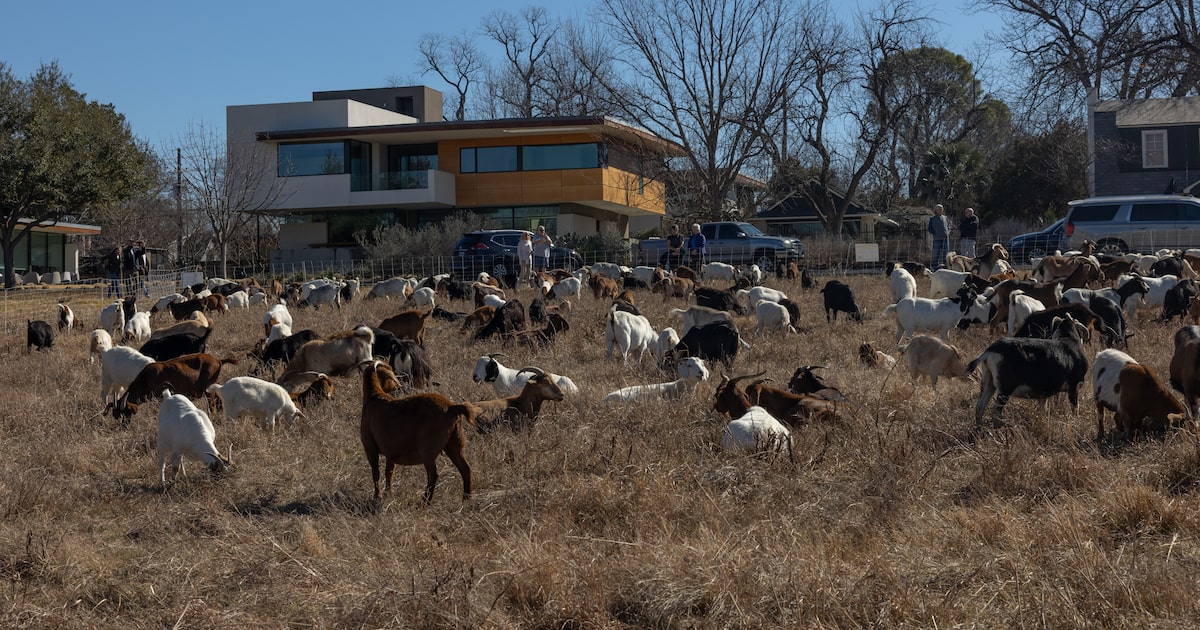
Bells jingled across White Rock Lake as hundreds of goats started doing what they do best: eating weeds and stealing hearts.
For the next week and a half, consider this your invitation to watch Dallas’ most unexpected employees earn their keep.
About 300 goats were deployed Thursday by the city to White Rock Lake to take on their newest assignment: eating invasive plants near the Bath House Cultural Center.
Gloria Martinez and Miguel Hernandez, along with their 2-year-old granddaughter, were among the regular walkers who got to see the goats being unloaded.
Breaking News
“We plan on coming back with other grandchildren,” Martinez said. “It’s beautiful seeing these animals around the lake.”

Goats can be seen grazing just across the street from the Bath House Cultural Center Feb. 5, 2026 in Dallas. Their main task is to eat privet, an invasive plant that chokes out native species.
Azul Sordo / Staff Photographer
The herd of goats also surprised those who were driving around the area. A few parked and got out of their cars to snap a photo.
Related

As part of the Dallas Park and Recreation Department’s new eco-friendly vegetation management project, the city is using goats from Fort Worth and Weatherford along with a few sheep to clear roughly 11.5 acres of prairie and wooded land on the lake’s east side.
The city is paying about $1,300 per acre, or about $15,000 total, for the project.
The goats will get to work immediately, grazing about 1 to 1.5 acres per day over roughly 10 to 11 days. An electric mesh fence will be moved daily to guide them through new sections, while a shepherd remains on-site 24/7 to keep everyone safe and on task.
Think of it as rotating salad bars, except the guests have hooves.
Why goats?
The mission targets invasive privet, a fast-growing shrub that crowds out native plants and spreads quickly. Winter is the perfect time for goat duty because most of the seasonal green vegetation is invasive and the goats are happy to help, said Brett Johnson, superintendent of environmental quality and conservation manager with the city of Dallas.
“They’ll basically eat anything woody that’s green,” Johnson said, including shrubs, saplings and low branches up to about five feet high.
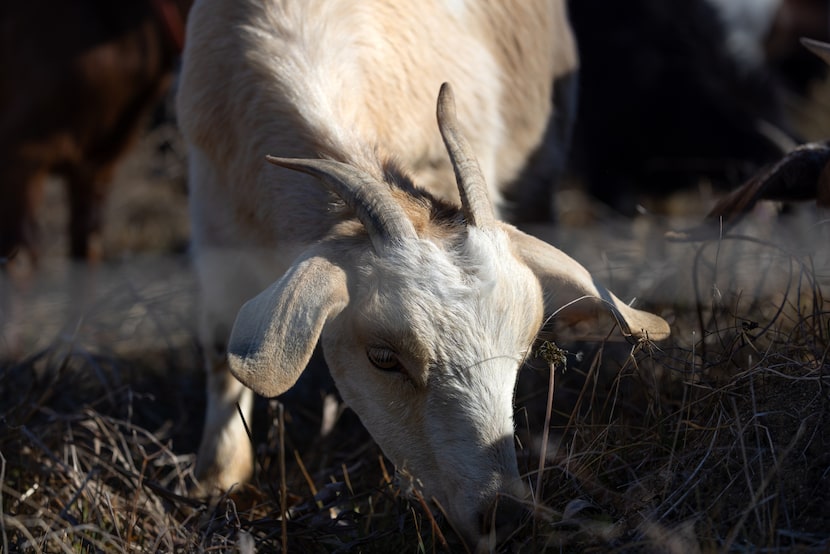
Goats can be seen grazing just across the street from the Bath House Cultural Center Feb. 5, 2026 in Dallas. Their main task is to eat privet, an invasive plant that chokes out native species.
Azul Sordo / Staff Photographer
And privet berries? Those are a favorite. Officials say the goats will practically climb over each other to reach them, turning bush-trimming into a competitive sport.
While goats handle shrubs and trees, five to 10 sheep may graze grass. Together, they form a balanced landscaping team: goats for the broadleaf plants and sheep for the turf.
More than just adorable
As entertaining as goat-watching may be, the project serves serious goals: reducing wildfire risk, improving visibility near trails and restoring prairie health.
Their hooves help break up thick layers of dead grass, allowing native wildflowers a better chance to bloom in spring. Unlike heavy machinery, goats selectively target problem plants and naturally return nutrients to the soil.
The practice is also gentler on sensitive areas near water, Johnson said, making it a more environmentally-friendly than mulchers and mechanical clearing.
Each fenced section is stripped clean before the goats are moved, a process that can take as little as a minute once the herd decides it’s time for fresh snacks.
“They’re usually already lined up at the fence, like, ‘OK, what’s next?’” said Johnson.
Irresistible workers
Dallas has used grazing goats before in other parts of the city, but this project is expected to draw plenty of attention with its high-traffic location and irresistible cast.
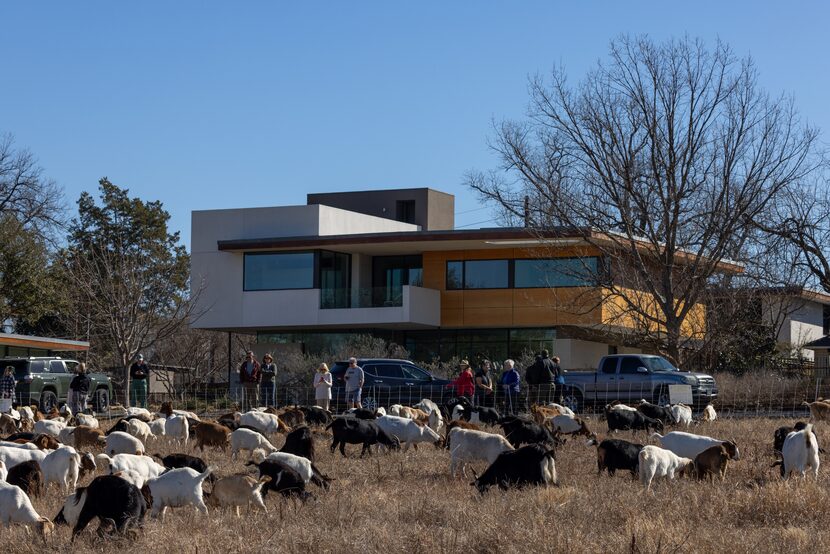
Goats can be seen grazing just across the street from the Bath House Cultural Center Feb. 5, 2026 in Dallas. Their main task is to eat privet, an invasive plant that chokes out native species.
Azul Sordo / Staff Photographer
Officials remind visitors that these goats are working professionals, not petting zoo pals, but snapping photos from a distance is encouraged. They also urge people to park on the side of the Bath House Cultural Center, not next to the area’s homes.
After all, who knew invasive plant removal could be this baaa-rilliant?