
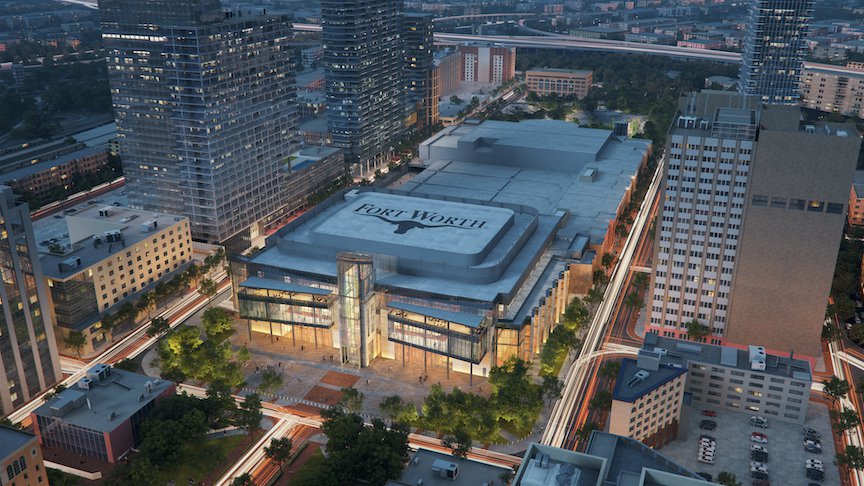
With designs on biting off a bigger piece of the meetings-and-events market while staying relevant and competitive in the convention arms race, the city of Fort Worth will soon begin construction on Phase 2 of a more than $700 million convention center renovation.
City officials also believe there may be another viable revenue source: selling the naming rights to the building. That’s right — the builders’ convention in Fort Worth at the, say, the Fort Worth Inc. Convention Center. It has a nice ring to it, if you were to ask me, though don’t hold your breath on that.
Outgoing Public Events Director Mike Crum briefed City Council this week on what that might look like. The city has partnered with the Superlative Group, a firm specializing in naming-rights and sponsorship valuation, sales, and consulting.
Superlative Group, Crum said, estimates the Fort Worth Convention Center’s naming rights currently is worth between $450,000 and $500,000 annually.
“When you add that to what the current revenues are for the convention center, it’s not insignificant,” Crum said. “Every new dollar we generate allows us to invest a dollar from the culture and tourism fund into capital projects. And as we’ve discussed, we have significant capital needs, particularly at the Will Rogers complex. You can connect the dots from generating revenue at the center to improvements showing up on Lancaster.”
Convention centers, however, are typically harder to monetize through naming-rights deals than arenas or performing arts centers. Unlike sports venues, they do not sell tickets, host regular season schedules, or generate nightly broadcasts that repeatedly place a sponsor’s name in front of television audiences and social media feeds. Attendance is event-driven and, as a result, irregular and often closed to the general public, limiting the frequency and predictability of brand impressions.
In addition, convention business tends to be transactional rather than emotional. Fans form attachments to teams and performers, not exhibit halls, which makes it more difficult for sponsors to translate naming rights into brand affinity or loyalty. While conventions can deliver high-value audiences — corporate decision-makers, trade professionals, and industry leaders — that exposure is largely confined within the building and lacks the broad, repeated visibility naming-rights partners typically seek.
As a result, cities often structure convention center naming agreements around subtler benefits, including wayfinding signage, digital mentions, hospitality opportunities, and integration into convention marketing materials, rather than the headline visibility that comes with arenas and theaters.
While academic literature has historically focused on naming rights at sports venues, a growing body of research now treats naming rights as a measurable sponsorship asset, with valuation frameworks that extend beyond ticketed arenas to facilities such as convention centers.
Over the past decade, cities including Cincinnati, Cleveland, Detroit, Houston, Las Vegas (naturally), Milwaukee, Memphis, Omaha, and Tulsa have secured naming sponsors for their convention centers — reflecting a shift toward business-to-business partnerships aimed at convention audiences rather than mass consumer branding.
Huntington National Bank, notably, holds naming-rights deals in both Cleveland and Detroit. That’s something, Crum said, Fort Worth would prefer to avoid.
There are no nibbles on the line just yet. The redesigned Fort Worth Convention Center is not scheduled to open until 2030. By then, the valuation is expected to only increase.
“We’ll engage an agency to help us start spreading the word,” Crum said. “Once we have something we feel good about bringing back [to City Council], then we’ll start to talk about it.”