
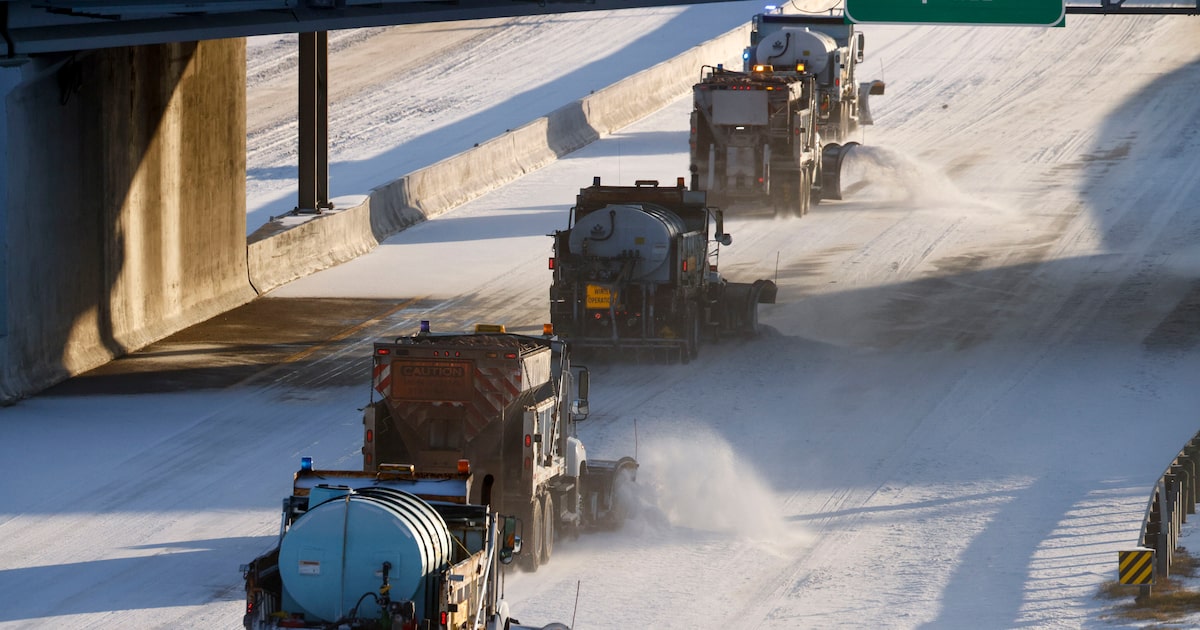
During the recent winter storm, most North Texas residents were stuck at home for almost a week while they waited for the roads to thaw.
A reader of The Dallas Morning News asked Curious Texas, “If the roads were pre-treated before the ice storm, why did they still freeze over?”
Here’s a look at the science of salting roads and what local officials did to clear them during the winter storm.
Efficacy can be limited by wintry conditions
Curious Texas
Adding salt to water lowers the temperature at which it freezes, also known as the freezing point. Exactly how far below 32 degrees the salt can prevent freezing depends on the concentration of salt in the solution, according to the American Chemical Society. While it depends on the type of salt and the concentration, road salt loses its effectiveness between 15 and 20 degrees, according to an article produced by asphalt maintenance company Brody Chemical.
The efficacy of pre-treating roads with salt can also be limited by how much wintry precipitation falls. With enough snow and sleet, the salt is diluted and cannot inhibit freezing.
Local officials referenced the amount of snow that fell when asked about the effectiveness of their pretreatment strategies. Tony Hartzel, a spokesperson for the Texas Department of Transportation, said travel conditions worsened as more sleet fell. Crews worked in rotating 12-hour shifts to continue applying salt, brine and granular materials like sand.
“That initial application of brine was just the first step in an ongoing process to keep lanes passable,” Hartzel said in an emailed statement.
He also noted the amount of winter precipitation and the duration of temperatures below freezing made this winter storm challenging.
All roads under the management of the North Texas Tollway Authority were repeatedly treated throughout the storm, according to spokesperson Michael Rey.
City of Dallas has only eight snow plows
The city of Dallas has only eight snow plows and about 100 sanding trucks for 11,700 lane miles of roads, forcing it to prioritize. Many roads were never treated, before or during the storm.
The city focuses its efforts on bridges and overpasses, major thoroughfares and high-traffic corridors. Neighborhood streets and residential areas are not treated unless first responders need access. Tina Richardson, assistant director for the Department of Transportation and Public Works, said during this storm, sleet and ice quickly covered sand on the roads in the first few days.
“People thought we didn’t do anything because they couldn’t see the sand,” she said.
The city chose not to use a brine pretreatment because of concerns around the rain washing it away before snowfall.
Adding additional snow plows could cost $1 million to $4 million, which city leaders noted was likely not feasible. Dallas’ storms are enough to disrupt, just not frequent enough for a bigger plow fleet under current resources.
Staff writer Everton Bailey contributed to this report.