
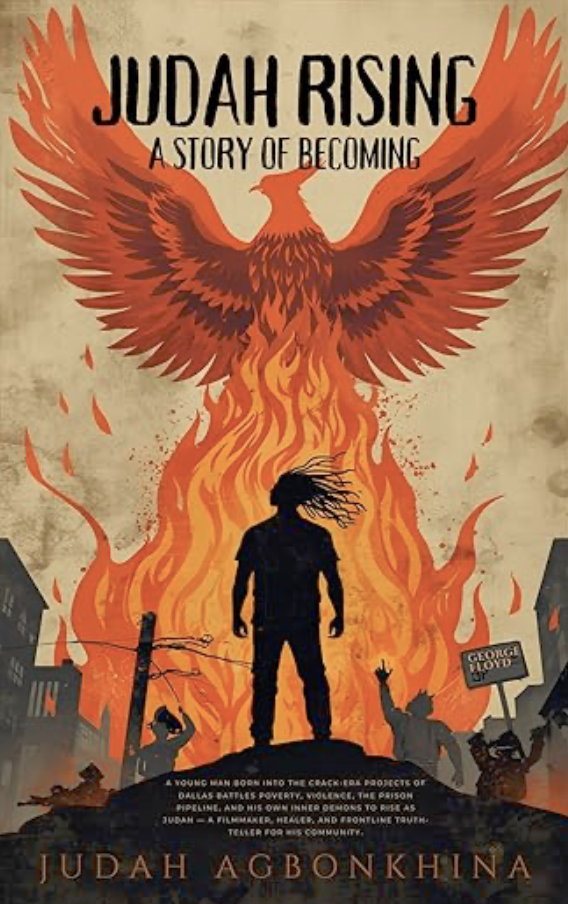
Overview:
Judah Agbonkhina’s memoir, Judah Rising: A Story of Becoming, is a powerful reflection on growing up in the projects of Dallas during the crack era. The book explores the themes of poverty, violence, and generational trauma, but also focuses on healing and transformation. Agbonkhina found himself confronting the psychological grip of his environment after escaping the hood, and through trauma-informed yoga, he learned to recognize and release the pain he was still holding onto. The book is a message to young Black kids in Dallas, urging them to reject the idea that they are defined by their surroundings and to focus on changing their mindset and self-perception.
From the Crack Era to Clarity
Judah Agbonkhina’s Judah Rising: A Story of Becoming is more than a memoir. It is a mirror held up to South Dallas, to a generation raised in the aftermath of the crack era, and to young people still navigating systems never built for their survival.
Born and raised in the projects of Dallas in the 1980s, Agbonkhina writes from lived experience. Poverty, violence, the prison pipeline, and the quiet normalization of crime as family legacy are all poignantly authentic themes in his novel. In Judah Rising, he does not sensationalize that harsh reality. Instead, he documents it honestly, grounding his story in place, time, and truth.
“This is a story about Dallas,” Agbonkhina says plainly. “And it’s about change.”
The book traces his life from childhood through adulthood, mapping how generational trauma shaped not only his environment, but his mindset. Unlearning that mindset, he shares, became the real work of freedom.
Honoring Family While Telling the Truth
One of the book’s most striking tensions is its commitment to honesty while still honoring family. Agbonkhina openly writes about realizing, as a young man, that he had been born into a crime family, and groomed into that life long before he could name it.
“It was the family business,” he explains. “I didn’t know until it was too late.”
Writing those truths was not easy. But for Agbonkhina, truth-telling was an act of love, particularly toward his mother. Her own illness became the catalyst for the book, he shared. When he realized she would never get the chance to write her story, he knew he had to write his.
In that way, Judah Rising becomes intergenerational: a record, a reckoning, and a refusal to let stories from South Dallas disappear untold.
Healing the Body, Rewriting the Mind
Unlike many coming-of-age memoirs rooted in urban struggle, Judah Rising takes an unexpected and deeply necessary turn toward healing.
Following divorce, military service, and personal collapse, Agbonkhina found himself confronting a hard truth: escaping the hood did not mean escaping its psychological grip. Transformation required more than distance; it required healing.
That healing came, unexpectedly, through trauma-informed yoga, which was introduced to him in South Dallas itself.
The book explores how trauma lives not only in memory but in the body, shaping posture, reactions, and self-perception long after danger has passed. Through yoga, Agbonkhina learned to recognize where he was still holding pain and how to release it.
This holistic approach to healing becomes one of the book’s quiet revolutions: a challenge to rigid ideas of masculinity, strength, and what recovery can look like for Black men.
A Letter to Dallas Youth
“You are worthy. Stay on your path.”
judah agbonkhina, Author of judah rising
At its core, Judah Rising is written for young Black kids in Dallas. It’s especially for those who’ve been told, directly or indirectly, that they are defined by their surroundings.
“You are not your environment,” Agbonkhina insists.
The book rejects the lie that people cannot change. Instead, it argues that change begins internally—through mindset, self-awareness, and intentional decisions. Education matters, but so does vision. Discipline. Self-worth.
“You are worthy,” he would tell his younger self. “And stay on your path.”
For readers navigating poverty, violence, or generational expectations, Judah Rising offers neither false hope nor easy answers, but it does offer proof. Proof that cycles can be broken. That identity can be reclaimed. That destiny is not fixed at birth.
Becoming, On Purpose
Written over nine months during a period of unemployment and uncertainty, Judah Rising is as much about becoming a writer as it is about becoming a man. Told through stories, poems, and reflection, the book reads like a conversation: raw, searching, and human.
Agbonkhina’s journey ultimately leads him to journalism, to storytelling as purpose, and to Dallas Weekly itself, where documenting hard truths became an extension of his own healing.
In a city and a moment still grappling with unaddressed trauma, Judah Rising stands as both personal testimony and public offering.
It asks readers, especially the youth of South Dallas, not just who they’ve been told they are, but who they are willing to become.
Book Details & Community Events
Judah Rising: A Story of Becoming is available now on Amazon in Kindle and paperback formats. Book Signing:
February 7 | 1:00–3:30 p.m.
Pan African Connection, Dallas
Related