
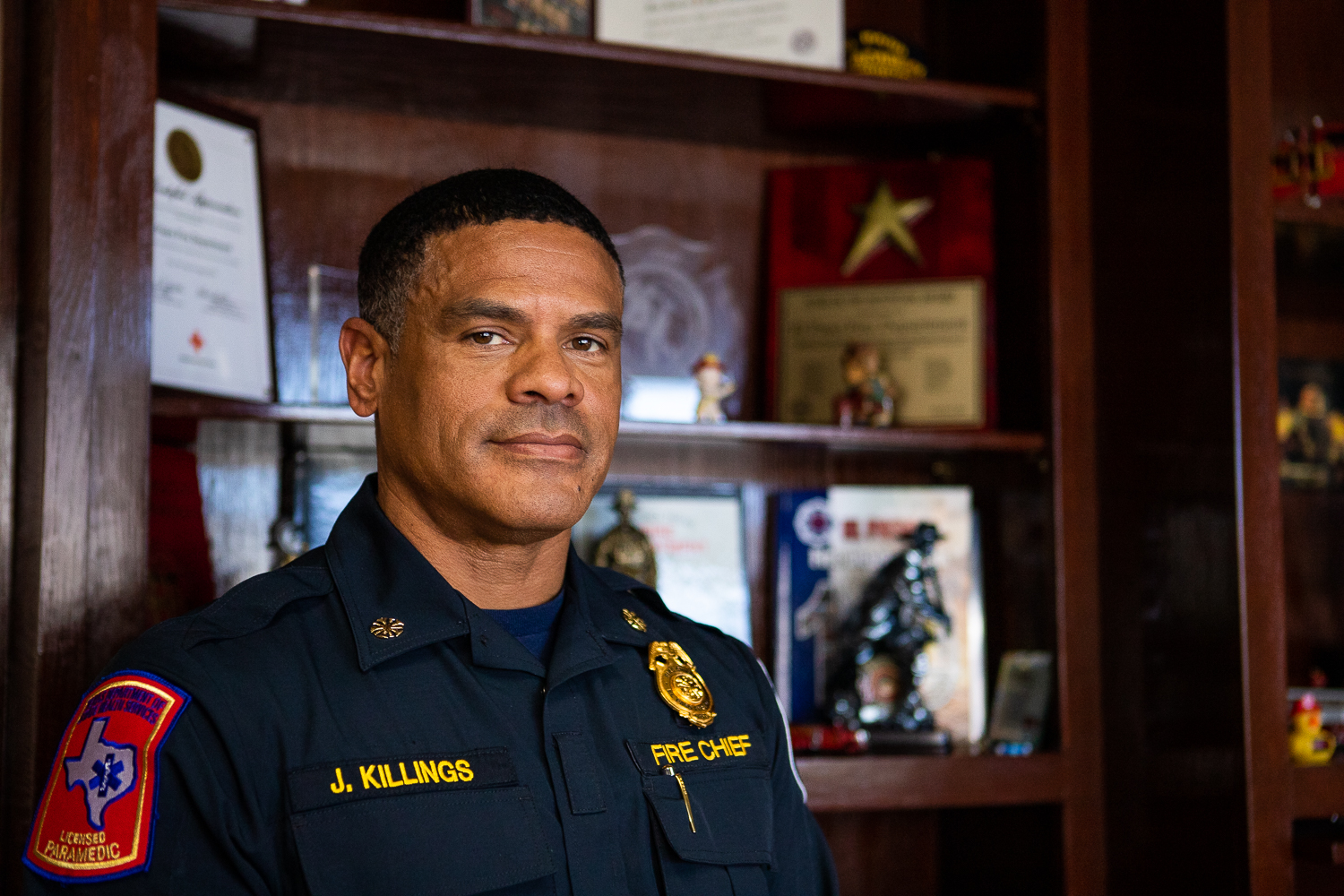
On Jonathan Killings’ first day as a rookie firefighter in 1998, he walked into Station 23 in Northeast El Paso carrying everything he thought he’d need — his gear, his lunch, his nerves. He didn’t even have time to set them down.
“As soon as I walked through the door, the tones go off,” Killings recalled. “And (the firehouse chief) looks at me, and he goes, ‘Are you gonna take the call, or are you just gonna stand around?’”
Killings didn’t hesitate. He never really has.
From stepping into responsibility after his father died when he was 20, to accepting leadership roles he didn’t seek but felt compelled to fill, Killings said his career has been shaped by responding when something — or someone — needed him. That instinct has carried him through nearly three decades with the El Paso Fire Department, where he has served as chief since December 2022, and now to a moment of recognition from the community he has served.
This weekend, Killings, 50, will receive the Lifetime Achievement Award as part of the El Paso Black Hall of Fame’s Class of 2026, during the organization’s second annual induction ceremony and gala. The event, scheduled from 6 to 9:30 p.m. Saturday, Feb. 7, at the Starlight Event Center, honors 15 individuals and one organization whose work reflects sustained leadership and impact in El Paso’s Black community.
READ MORE: Black History Month events honor El Paso’s Black legacy
A moment rooted in a longer history
The recognition comes during a Black History Month in El Paso focused on documenting local legacy — not just national milestones. Historians have traced the city’s Black presence back more than a century, shaped by Buffalo Soldiers stationed at Fort Bliss, Black railroad workers, and families who built institutions during segregation, including Douglass School and the McCall neighborhood. For much of the 20th century, El Paso’s Black community carved out space and stability despite exclusion from housing, schools and civic power, laying groundwork that later generations would build upon.
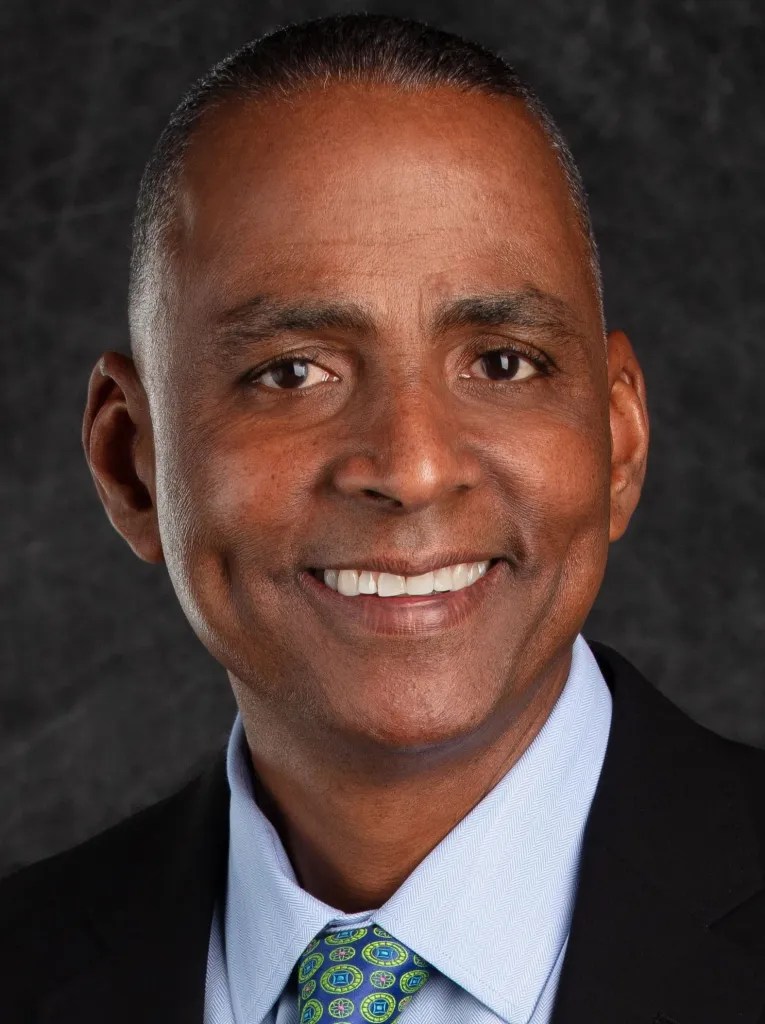 Renard Johnson
Against that backdrop, Killings’ rise carries particular weight. He is the first Black fire chief in the department’s 140-year history — a role that places him among a growing number of Black leaders — including Mayor Renard Johnson and City Manager Dionne Mack — now serving at the highest levels of city government.
“Chief Jonathan Killings embodies what it means to serve with purpose and heart,” Johnson said. “His leadership, mentorship and commitment to our community have made El Paso safer and stronger. It’s an honor to celebrate his lifetime of service during Black History Month and to see him recognized by the El Paso Black Hall of Fame.”
 Dionne Mack
Mack said Killings’ career reflects a standard of leadership that extends beyond his department.
“Chief Jonathan Killings has built a career defined by integrity, mentorship, and an unwavering commitment to public service,” Mack said. “His leadership has strengthened the El Paso Fire Department and helped set a standard of excellence that will continue to benefit our community for generations. This recognition is a fitting tribute to a lifetime devoted to service.”
From loss to purpose
Killings said his family moved to El Paso when he was 2 years old. His father, who served in the Army, decided to stay.
“He just loved the community. He loved the weather. He loved everything about the area,” Killings said.
After graduating from Hanks High School in 1993, his life shifted abruptly. His parents had separated, and his father died when Killings had just turned 20, leaving him trying to steady life for himself and his younger brother.
“So, you know, that kind of left me without a lot of structure and a lot of direction,” he said.
The decision to pursue the Fire Department wasn’t driven by legacy or long-term ambition. It was, he said, a search for stability and a way to contribute.
“I just, at one point, I was like, ‘You know what, I need to find some structure, and I need to find a good job,’” Killings said. “I knew I wanted to do something and, you know, be able to serve the community.”
The idea took hold in a simple way.
“I really think it was just one of those moments where you see a fire truck going by and going, ‘Yeah, I could probably do that,’” he said.
 Fire Chief Jonathan Killings works in his office on Feb. 2, 2026. Killings joined the El Paso Fire Department in 1998 and was appointed chief in 2022. (Corrie Boudreaux/El Paso Matters)
Learning the job — and the responsibility
The El Paso Fire Department Training Academy, Killings said, was culture shock. He wasn’t a legacy firefighter and had no roadmap for what the work would demand.
“I didn’t know anything about firefighting,” he said.
What he found instead was structure — and mentors who filled a void left by his father’s death.
“These guys really show you what you need to do to be an adult, to be a man, to be a good father,” Killings said.
Over time, he joined specialized teams including urban search and rescue, mountain rescue and hazmat, and steadily promoted through every rank in the department. He returned to the academy as an officer, helping train new recruits, and later moved into administrative leadership roles in emergency management and communications.
He became a battalion chief in 2016 and was named interim chief in May 2022. Killings earned a master’s degree in public administration from Sam Houston State University and a bachelor’s degree in management from the University of Phoenix.
From the beginning, he said, the goal wasn’t advancement for its own sake.
“It was always about leaving it better than you found it.”
When leadership called — again
Killings’ path into the department’s top role sharpened during the COVID-19 pandemic. He had just been promoted to deputy chief and was serving as training chief when then-Fire Chief Mario D’Agostino reassigned him into a broader leadership role.
“He calls me and he says, ‘Hey, we’re gonna bring you up into an assistant chief role. And I need you to help us manage this pandemic that’s hitting the city,’” Killings said.
Killings oversaw major operational components of the city’s response, including testing and vaccination sites.
“There wasn’t really an option,” he said.
Even then, he said, becoming fire chief wasn’t a personal goal.
“I was happy in that assistant chief’s role.”
D’Agostino later told him he was retiring and moving into a role at City Hall. He urged Killings to step forward. Killings pushed back.
“There’s gotta be somebody else,” he recalled.
But, as he had before, Killings accepted the responsibility.
 Fire Chief Jonathan Killings works in his office on Feb. 2, 2026. Killings joined the El Paso Fire Department in 1998 and was appointed chief in 2022. (Corrie Boudreaux/El Paso Matters)
Building a department — and a future
As fire chief, Killings points to initiatives designed to raise the department’s level of service as El Paso’s needs evolve, including the Fire STAR helicopter program and a mobile integrated health team aimed at reducing repeat non-emergency 911 calls by connecting residents to long-term resources.
“One of the unique things about El Paso is there’s a rather large population of underinsured or non-insured people within the community,” Killings said.
He has also focused on updating facilities, equipment and policies to better reflect the workforce and the community it serves, including efforts to make the department more accessible and supportive for women firefighters.
“We’ve made a lot of updates to our station and our equipment, so that the equipment better fits everybody,” he said.
Retirement security remains an ongoing concern, particularly access to health care and insurance for former firefighters.
“One thing that we kind of have a hard time doing is making all these services available to our retirees,” Killings said.
Tyler Grossman, executive director of the El Paso Firemen and Policemen’s Pension Fund, said Killings has played a key role in strengthening that system.
“Chief Killings has consistently supported the fire trustees as they execute their responsibilities in maintaining a strong pension fund,” Grossman said. “By doing so, the fund has become one of the best in Texas, a factor which works to attract and retain firefighters. His cooperation in this effort has been professional, steady and respectful of the fund’s independent role.”
What the honor represents
Monica Tucker, founder and CEO of Black El Paso Voice and founder of the El Paso Black Hall of Fame, said Killings’ selection reflects both individual achievement and broader significance.
“Chief Jonathan Killings was selected for the El Paso Black Hall of Fame’s Lifetime Achievement Award because his career reflects what lifetime achievement truly is: sustained service, trusted leadership and impact that outlives a title,” Tucker said. “In roles where decisions carry real weight for families and neighborhoods, he has led with steadiness, professionalism, and a clear commitment to people.”
She added that his leadership resonates beyond the Fire Department.
“For many in El Paso’s Black community, especially our youth, his journey is proof that you can serve at the highest levels while staying grounded in purpose,” Tucker said.
Still answering the call
Killings, who lives on the Eastside with his wife, Amanda, and their two children, said he has no plans to step away from the chief’s role. He described the challenge ahead as meeting growing expectations with limited resources.
“The community is expecting more and more from their Fire Department,” he said. “And it’s up to us to be able to meet those challenges.”
For Killings, the throughline remains clear. From a young man searching for structure to a fire chief entrusted with one of the city’s most visible institutions, the work has followed a familiar pattern: a need emerges, responsibility presents itself — and he answers.
El Paso Black Hall of Fame: Class of 2026
Below is the list of this year’s inductees into the El Paso Black Hall of Fame:
Jonathan P. Killings: First Black chief in El Paso Fire Department history; Lifetime Achievement Award.
Dana Harley Boyd: El Paso Independent School District executive principal; Texas Elementary Principals and Supervisors Association president.
Dr. Sandra Braham: Former University of Texas at El Paso and YWCA El Paso del Norte Region leader; nonprofit executive.
Emmerson Buie Jr.: Walmart global security director; former FBI special agent in charge.
Karen Cooper Linen: Registered nurse; civic advocate; NAACP member focused on youth engagement.
Reginald Daniel Sr.: U.S. Army command sergeant major (retired); mentor and motivational speaker.
Dr. Patricia Hills Davis: Retired OB-GYN; fourth-generation El Pasoan; longtime physician.
Pastor Michael E. Grady: El Paso pastor; former NAACP El Paso president; gun-violence advocate.
Anna M. Harris Howell: U.S. Army veteran; longtime volunteer; president, El Paso Commission for Women.
Marc L. Perry: “DJ Marc X”; radio personality and mentor in El Paso’s music scene.
Dr. Bernard F. Samuel: Martial arts grandmaster; U.S. Army veteran; youth mentor.
Ron Stallworth: Retired detective; author of “Black Klansman” and “The Gangs of Zion: A Black Cop’s Crusade in Mormon Country”
Stephen Twitty: Retired U.S. Army lieutenant general; strategic planning executive.
Donald L. Williams: Attorney; first Black judge in El Paso; former NAACP El Paso president.
McCall Neighborhood Center: Historic center preserving Black heritage and community programs in El Paso.
Related