
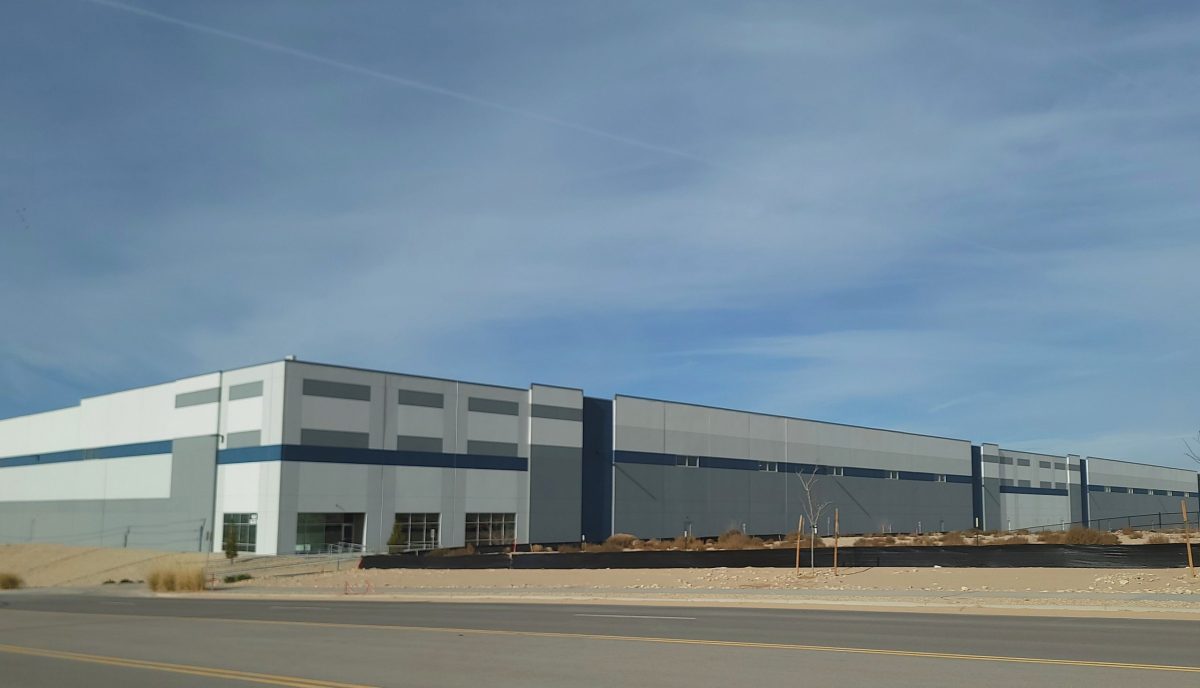
The federal government has purchased industrial park warehouses in Far East El Paso County for nearly $123 million to be used as a massive ICE detention center, according to newly filed deeds. The purchase comes as hundreds of residents speak out against the project and city and county leaders question what authority, if any, they have to intervene.
A general warranty deed filed with the county this week shows the property transfer from El Paso Logistics II LLC in Delaware to the U.S. Department of Homeland Security was executed Jan. 17. Immigration and Customs Enforcement plans a 8,500-capacity mega detention facility off Gateway Boulevard East near Clint. The property falls within the boundaries of the city of Socorro.
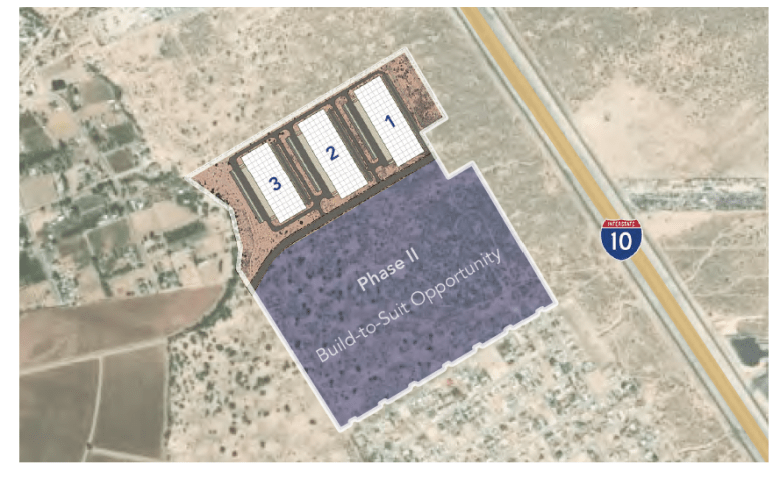 The three-warehouse Eastwind Logistics Center in Far East El Paso County was recently purchased by the Department of Homeland Security for an ICE detention facility. (CBRE commercial development brochure)
The property in an industrial zone – Eastwind Logistics Center – comprises three reinforced concrete warehouses of about 296,000 square feet each, with an adjacent plot of land available for expansion, a commercial real estate brochure indicates. The park was previously available for rent, but disappeared off real estate and developer websites the past month.
A second deed filed with the county this week sets up long-term drainage and stormwater obligations for the same property, with an effective date reversing back to Jan. 1. That includes shared stormwater detention ponds for multiple parcels – including future development. The effective date indicates the infrastructure work likely began before the land sale was complete. The facility falls within the Lower Valley Water District service area, raising questions about the availability of water to the facility housing thousands of people. Officials with the water district didn’t return calls for comment.
State Rep. Vincent Perez on Friday also warned about potential fires at the planned mega center, saying lack of water pressure and infrastructure. He urged the El Paso County Emergency Services District No. 2 that serves the area to deny a permit for the center. He cited the 2023 fire at a migrant detention center in Ciudad Juárez that killed 40 detainees and injured 27 others.
“It’s one thing to have these facilities as they currently exist as industrial warehouses for that purpose, but it’s a whole other ball game if you have intentions of housing thousands of detainees,” Perez said.
Because federal facilities are largely exempt from local zoning and building rules, cities have limited leverage over detention centers — a concern echoed by community leaders in Oklahoma City, Kansas City and Orange County, New York. But certificates of occupancy are often required from local planning and fire departments, though it’s unclear how or if the federal government would seek those out.
 A detailed rendering of an Eastwind Logistics Center warehouse purchased by the Department of Homeland Security for an ICE detention facility i El Paso. (CBRE commercial development brochure)
The El Paso property is one of several recent warehouse purchases by the DHS under the Trump administration’s latest efforts to expand immigration enforcement and deportations. The plan includes creating a fast-moving pipeline where detainees would be shuffled from processing centers that hold about 1,500 people to the mega facilities of up to 10,000 people that would serve as deportation staging sites.
DHS has reportedly spent $120 million for a Maryland facility and $70 million for one in Arizona. The purchases don’t include the costs of converting the warehouses into detention centers complete with sleeping quarters, kitchens, restrooms, showers and other amenities.
DHS officials didn’t respond to El Paso Matters’ request for comment, but in a statement last month said “it should not come as news that ICE will be making arrests in states across the U.S. and is actively working to expand detention space.”
El Paso is a strategic location for the Trump administration because of Biggs Army Airfield, where deportation flights have increasingly taken place.
More than 1,130 immigration enforcement departure flights, including removal and shuffle flights, took place in El Paso all of last year, according to the Human Rights First immigration flight monitor. Only Alexandria, Louisiana, and Harlingen, Texas, recorded more flights – about 2,430 and 2,430, respectively. Shuffle flights refer to those between detention facilities. El Paso was also among the top three immigration enforcement destination cities last year, recording more than 1,030 arrivals.
The detention expansion comes as calls grow louder for the closure of Camp East Montana – a tent complex that opened on Fort Bliss property in El Paso in August. The facility has been inundated with allegations of human rights violations, and has recorded three detainee deaths in two months. The facility holds the largest number of ICE detainees in the nation, averaging nearly 3,000 a day as of January. About 70,780 people were being held in ICE detention centers nationwide – about 18,700 in Texas alone.
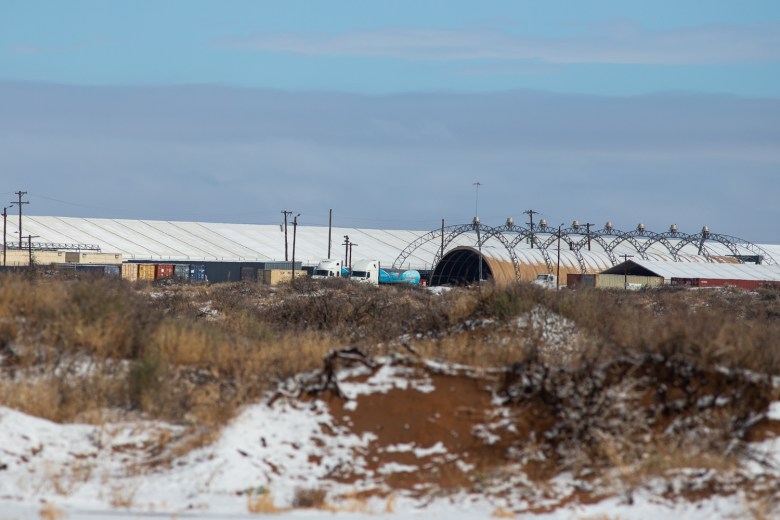 The Camp East Montana migrant detention facility, shown Jan. 25, holds thousands of detainees from across the country. (Corrie Boudreaux/El Paso Matters)
U.S. Rep. Veronica Escobar, D-El Paso, who visited Camp East Montana for the sixth time Friday, said there’s no need to build additional detention sites that are only making private contractors richer.
“Not only have things not improved, but everything we have flagged over and over again persists,” Escobar said. “The level of dysfunction inside the facility is shocking and the services DHS is paying for are not being delivered – and that’s fraud.”
In a letter to DHS Secretary Kristi Noem and ICE Acting Director Todd Lyons this week, Escobar said El Pasoans do not want more detention centers in their community and urged the agency to suspend any and all plans to build new ones.
El Paso city and county leaders this week formally opposed a proposed mega detention center, acknowledging their limited authority over federal immigration matters.
On Monday, the El Paso County Commissioners Court directed the County Attorney’s Office to review the legal framework surrounding detention facilities and report back within 30 days, while also calling for a stakeholder task force to address future proposals. The court will also send a formal letter opposing the facility.
A day later, the El Paso City Council asked city attorneys to develop a plan to block ICE detention centers within city limits, including protocols requiring judicial warrants for federal enforcement actions in city or county facilities. The city will also explore a moratorium on permitting, zoning and licensing for ICE facilities.
“El Paso must stand firm. There will be no concentration camps here. We want ICE out now. Make no mistake, ICE is prepared to expand in El Paso, and if they are successful, it will mean more civil rights violations, more human rights violations, more violence and more death,” Tonya Hall said during the meeting.
Hall is with Indivisible the 915, a grassroots group with a mission to elect progressive leaders, have been leading protests and vigils and setting up campaigns for residents to call and write lawmakers at every level.
Ruben Garcia, founder and executive director of the Annunciation House network of migrant shelters in the region, said he applauds the local government’s response and people being vocal about their stance. But he warns that even if the Trump administration decided not to open the facility in El Paso, it would do so elsewhere.
“Even if that were to happen that it’s not built here, it’s not going to be something that you celebrate because it won’t be about one less detention center, just one less detention center here,” Garcia said. “I think we’re saying, or should be saying, don’t build these. Don’t build these at all. We’re saying if Camp East Montana is your poster child for detention facilities, it’s woefully, woefully inadequate, so, don’t build them at all.”
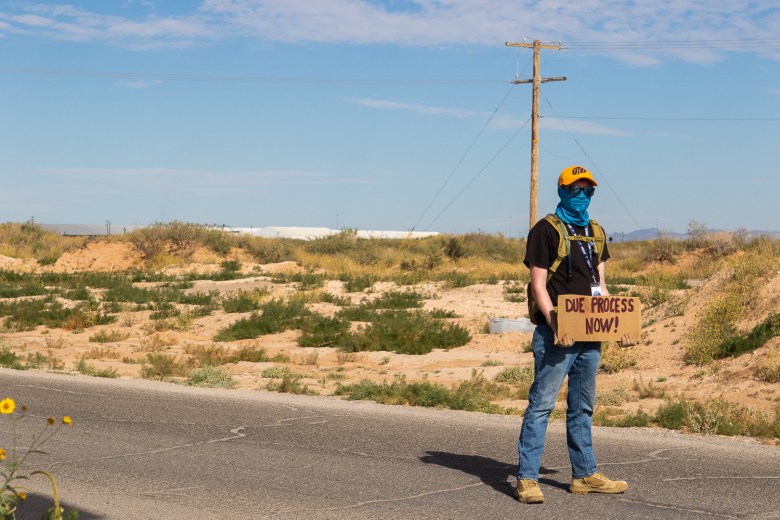 A protester who wishes to remain anonymous stands at the entrance to Camp East Montana, a migrant detention facility on Fort Bliss property, Nov. 15, 2025. (Corrie Boudreaux/El Paso Matters)
Nonprofits such as Annunciation House are extending help to migrants stranded in the city after being released from Camp East Montana with only the clothes on their backs. The vast majority don’t get back their cell phones or documentation – IDs, passports, birth certificates, work authorizations – and are left stranded, Garcia said.
Many of them are immigrants arrested in Minneapolis, one of a handful of cities where thousands of ICE and Border Patrol agents have been deployed. More than 3,000 people have been arrested by immigration officers there. Federal officials this week said they were withdrawing hundreds of agents following growing protests over violent enforcement tactics and the deaths of two U.S. citizens by federal agents.
“This – the release of migrants from the facility – has been going on even before all the activity in Minneapolis. We’ve been getting those releases, but yes, we’ve seen a lot more recently,” Garcia said, noting that Annunciation House received 15 people released from Camp East Montana on Thursday alone. In January, Annunciation House took in more than 180 migrants – about 50 who were arrested in Minneapolis.
Garcia said he has been working with organizations in Minneapolis and other cities to help people released from El Paso detention centers get back to their families.
But, he said, it’s important to note that the vast majority of those migrants who are released have support systems – family, friends, coworkers – who are able to gather funds to pay for attorneys and bonds.
“When people are fortunate enough to have a lawyer to be able to petition a judge to set a bond, those are the releases we are getting,” Garcia said. “So, the question becomes, what about all those who can’t get attorneys? Who can’t get bonds? … So, if you’re feeling like you want to help, that’s one way – one meaningful and significant way – to help.”
Related