
The fourth graders in D’Andrea Creighton’s classroom at Brashear Elementary are diving into earth science.
“Water vapor it’s going up into the sky, but we are scientists, we don’t use words like sky, do we?” Creighton asked her students.
It’s the big words like condensation, evaporation and insulation that can be a lot for these little minds to keep straight.
“I just try to usually just remember the word, and then if I can remember the word, I try to remember the definition,” said student Brooklynn Cooper.
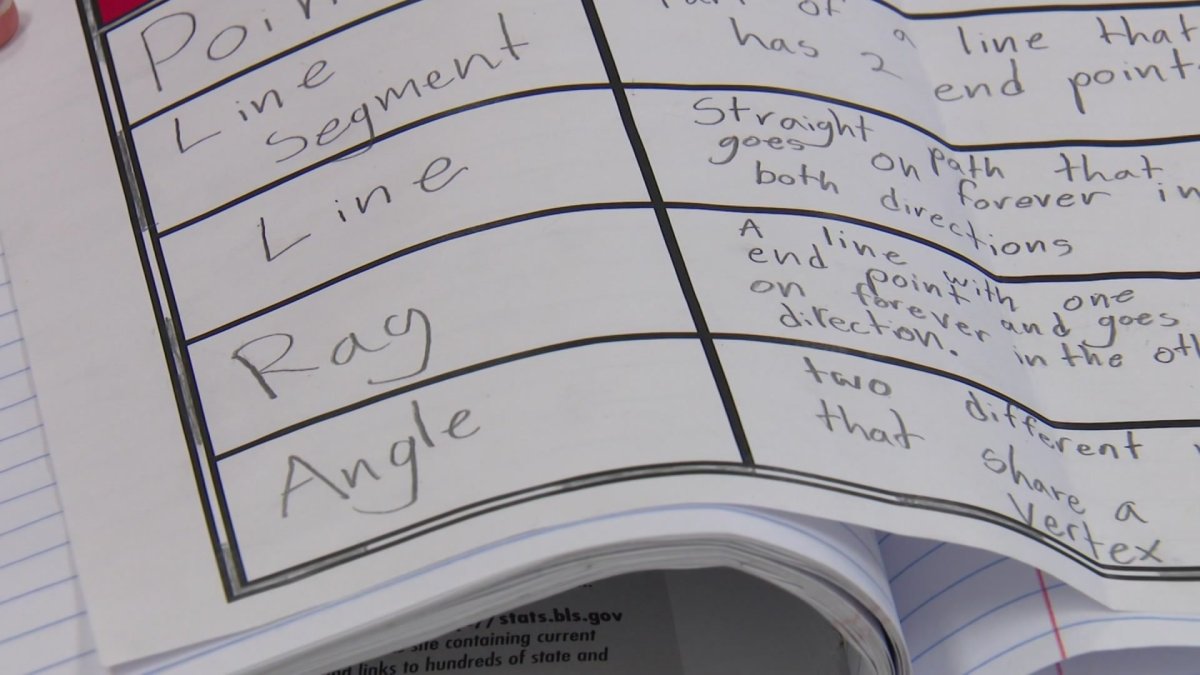
Ms. Creighton remembered something her principal learned at a conference: the tip chart.
“Our tip chart is where we just write down the term, and then we do a definition and a picture,” said Creighton.
Basically, you toss out the fancy definition, the kids make their own, and draw a picture too. It’s all planting seeds in their brain to help them not memorize but know the material.
“It gives them something that they can hold on to because they’re owning it,” said Creighton.
The kids keep their own definitions and photos in their folder to refer to if they get lost, but most say they rarely need it; it stays in their head, and it’s not just science.
“I remember we did one about angles,” said Cooper. “I wrote the word angle here, and right here, I remember I wrote two rays that have a common vertex.”
The tip charts are subject to subject, classroom to classroom.
There’s been a 7-point gain in academic achievement at Brashear Elementary and a nearly perfect score in closing the gaps for bilingual students.
“It helps you memorize, and when it helps you comprehend all the information because you’re writing it in your own words and making pictures,” said studnet Aaradyn Pouncil.
Dallas ISD is trying it at other campuses as well. The idea came from a campus leadership conference put on by The Holdsworth Center, an educational arm of H-E-B. They’re helping to improve education across the state.