
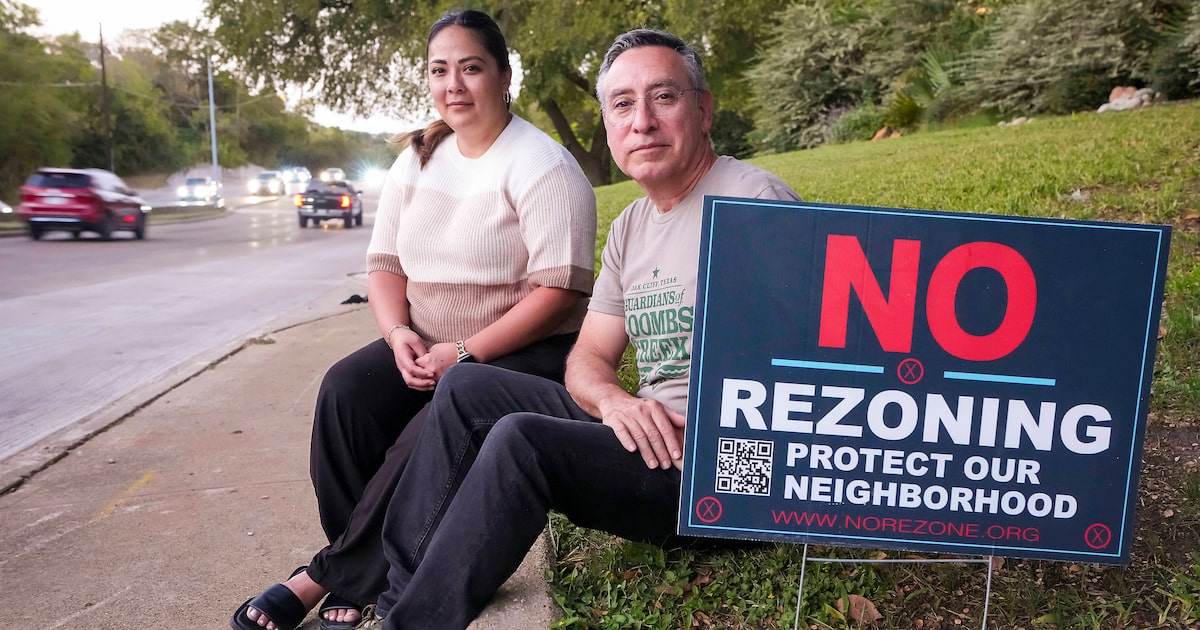
At the end of a quiet road in West Oak Cliff, surrounded by homes and duplexes near Coombs Creek, a parcel of land sits at the center of a long-running divide between a developer and nearby residents.
Dallas city plan commissioners approved Thursday, 12-2, a zoning request to convert 3.2 acres on North Boulevard Terrace in District 1 from single-family to multifamily.
Nearby residents who oppose the project say the lack of enforceable details has fueled distrust and raised the alarm about the long-term effects of increased density. Environmental advocates say they are worried about the potential impact of development near Coombs Creek.
Related

“My biggest concern with the multifamily is the lack of understanding of what ultimately would get built there,” said Eugene Johnson, a resident who spoke in opposition. “For me, just the level of uncertainty leads me to the place where I can’t really support the [request] at this point.”
Political Points
The developer, Christian Chernock, said the zoning is intended to help solve the housing shortage in Dallas. He said a multifamily project would minimize the environmental footprint, preserve open space and manage stormwater responsibly.
“It’s about choosing two buildings and more trees instead of dozens of roofs and more pavements in hundreds of linear feet of drive aisles and driveways,” Chernock said at the commission meeting.
Commissioners who supported the rezoning acknowledged that many neighbors would prefer no development, but argued that some form of development is inevitable. They said compared to the single‑family or townhome pattern, the approved approach better protects the creek and limits impervious surface.
The site has become a test case for how Dallas balances the interests of housing development, community trust and environmental risk.
Community, developer conflict
Chernock, a longtime District 1 resident, was appointed by City Council member Chad West to serve as city planning commissioner for his district from 2023 to 2025.
When he took the position, neighbors raised concerns about a conflict of interest, given his role as a developer and his role on the board that decides what gets built where.
The City Plan Commission is a recommendation body for the Dallas City Council, and a quasi-judicial body with authority to make zoning decisions. There are 15 members, each representing a district with one appointed by the mayor.
Chernock told The Dallas Morning News he had disclosed he had zoning cases pending before his appointment. He said the Office of Ethics and Compliance told him there were no conflicts of interest so long as he didn’t speak with plan commissioners, city staff or city council about his cases.
The News reached out to the Office of Ethics and Compliance to verify Chernock’s statement. The office did not immediately respond.
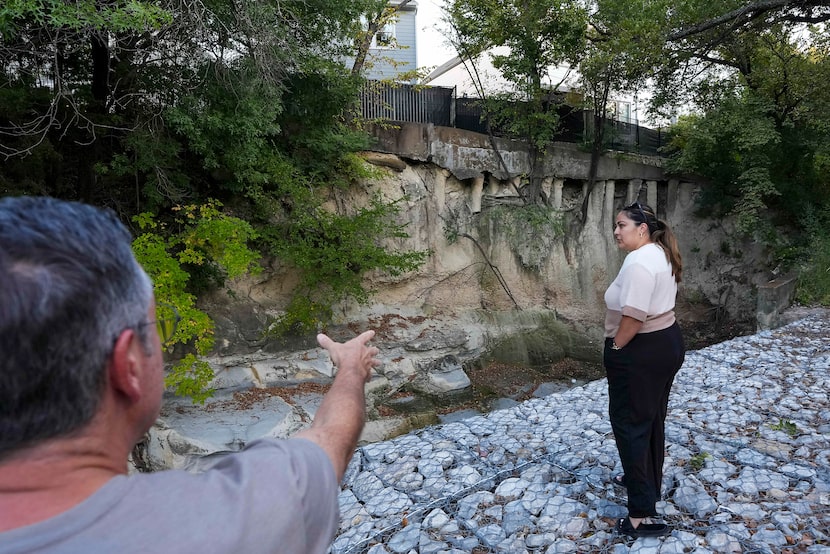
Joseph Beckham and Yesenia Serrano pause on the banks of Coombs Creek as they view erosion beneath the Echelon at Reverchon Bluffs townhomes in north Oak Cliff on Monday, Oct. 20, 2025, in Dallas.
Smiley N. Pool / Staff Photographer
The rezoning case was submitted in 2024, but Chernock later withdrew the application. After his term ended in June 2025, Chernock submitted the rezoning application again.
During the meeting, Commissioner Melissa Kingston for District 14, who voted in support, said much of the opposition from the community had become personalized toward the developer rather than focused on the merits of the zoning case.
Commissioner Tipton Housewright for District 10, who also voted in support, said the commission’s job is to evaluate the land‑use and zoning issues, not to judge an applicant’s character or prior disputes with residents.
Multifamily development
The zoning case comes as the city of Dallas and the state are trying to provide more affordable housing to accommodate the growing population.
Senate Bill 840, the law of the land since Sept. 1, 2025, allows apartments and mixed-use residential in all zoning districts that allow office, commercial, retail or warehouse uses without a need for rezoning. The bill was passed to help address Texas’ housing shortage. SB 840 limits cities’ ability to regulate height, density, setbacks and transitions for certain multifamily developments.
Related

Residents who opposed the rezoning argued that SB 840 makes granting multifamily zoning dangerous because it allows maximum development while sharply limiting the city’s ability to use tools such as setbacks, height limits and compatibility standards.
Joseph Beckham, a District 1 resident, said this zoning means the commission would provide the applicant permanent, high‑intensity entitlements with minimal ongoing city control.
“Dallas does have a housing crisis, but it’s primarily a home ownership crisis,” Beckham said. “There’s no shortage of apartments.”
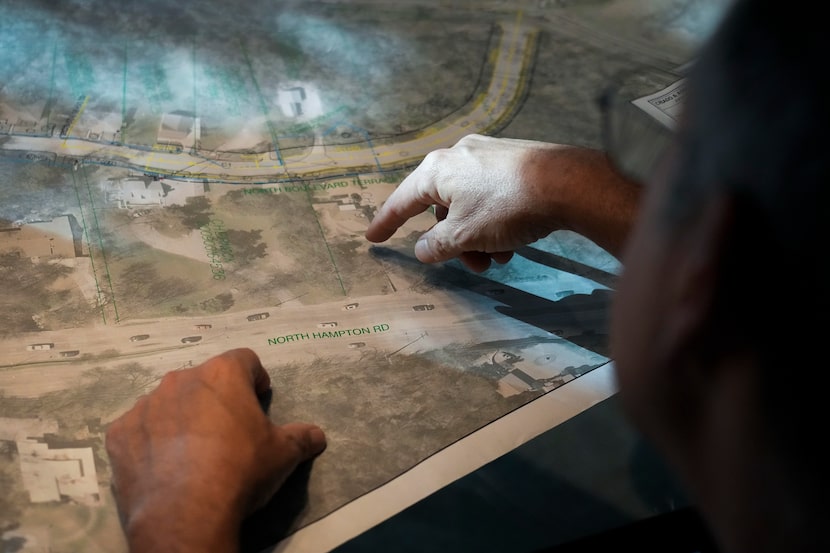
Joseph Beckham points to land proposed for rezoning as a multifamily district on a map of the area near his home in north Oak Cliff on Monday, Oct. 20, 2025, in Dallas.
Smiley N. Pool / Staff Photographer
Commissioner Kathy Coffman for District 12, who voted against, also felt it grants overly broad multifamily entitlements under SB 840 without a binding site plan and does not show a compelling public benefit to justify a discretionary upzoning on a sensitive creek‑adjacent, single‑family street.
“I think there’s also a clear conflict with the Forward Dallas 2.0,” Coffman said.
Forward Dallas 2.0 was approved in 2024. The land use plan is the city’s guide for growth, development and infrastructure. Focusing on five key themes, environmental justice, transit-oriented development, housing choice, economic development and urban design, it aims to manage the increased population.
“Multifamily development is not supported in community residential place types unless there’s a compelling public benefit,” Coffman said. “I haven’t seen that compelling public benefit yet.”
Chernock said his proposal is not out of place, just a small, well‑designed multifamily project in a mixed context. He pointed out that the street already has a mix of zoning, from townhomes and multifamily, to commercial nearby.
North Boulevard Terrace, the street adjacent to Chernock’s property, is composed of owners and renters of single-family homes and duplexes. The site is also close to Louise Wolff Kahn Elementary School and several retail options, including restaurants and grocery stores, along West Davis Street.
Commissioner Mike Sims for District 1, made the motion not to follow the city staff recommendation to rezone to a townhouse district and instead approve multifamily, as Chernock requested. Sims said a restricted multifamily plan was safer and less damaging for Coombs Creek.
Compromise
Residents who oppose the development share the concern over Coombs Creek. They said it is an environmentally fragile, flood‑prone corridor. They argued that more intensive development on this site could worsen runoff, erosion and flooding, threatening nearby homes and public infrastructure downstream.
Related

Chernock offered public deed restrictions to narrow what could be built and provide environmental relief. Public deed restrictions give the City of Dallas authority to limit future changes to the land, requiring public notice and hearings before a change.
The key deed restrictions include:
Thirty percent maximum lot coverage, which cuts in half what multifamily could theoretically allow and limits how much of the site can be covered by buildings and paving.A 20‑foot setback from the Federal Emergency Management Agency floodplain line, within which there can be no buildings and no paving, to protect Coombs Creek and create a clear environmental buffer.A parking standard of one space per unit, which tightens parking compared to what the code might otherwise allow. A prohibition on short‑term rentals on this property, responding directly to concerns about the applicant’s other projects operating like hotels.Commitments tied to walkways and a nature trail, with the exact linear footage and layout to be worked out at the civil design stage.
Despite the compromise, residents said they do not trust deed restrictions as a long‑term safeguard. They said that they felt the commissioners had not listened to their concerns and had ignored their feedback.
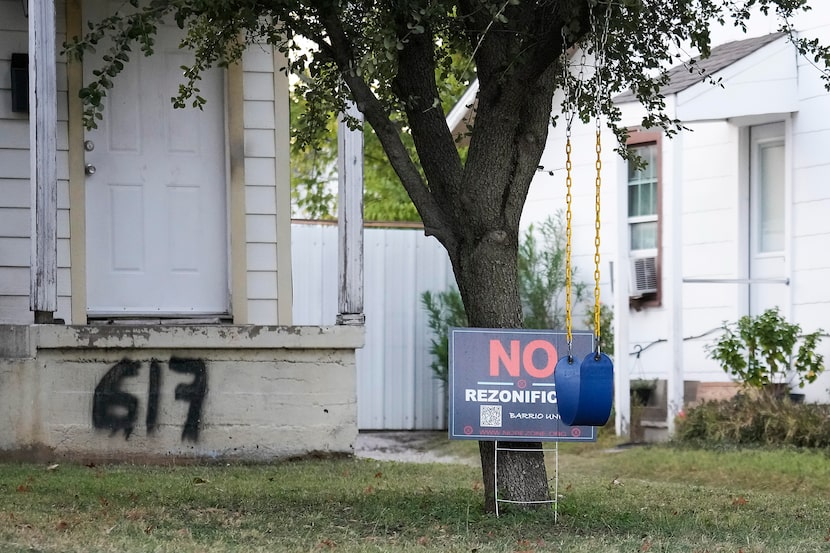
A sign in opposition to a nearby proposed rezoning as a multifamily district near is seen in the front yard of a home on North Boulevard Terrace in north Oak Cliff on Monday, Oct. 20, 2025, in Dallas.
Smiley N. Pool / Staff Photographer
“Community input is not an inconvenience. It matters, and it should be a real part of decisions about zoning and land use,” said Yesenia Serrano, president of the North Boulevard Terrace Neighborhood Association. “In this case, when the neighbors have spoken up, our concerns have sometimes been brushed off or labeled instead of actually being addressed.”
The zoning case awaits Dallas City Council’s final vote.
“They are saying there is one more hearing and those things, but what’s the point of talking?” said Serrano. “On the other hand, our community became more united. We now have leadership, and our neighbors have come to support us. We will continue to advocate for our community.”
At the final vote meeting, residents and the developer will be given another opportunity to state their cases.
Dallas hires 300 goats to clean up White Rock Lake and yes, they’re very baaa-syIn Dallas vs. winter weather, expansion of snow-fighting tools isn’t cheap