
AUSTIN, Texas — Two years ago, an Austin startup set out to prove a radical idea: that a 3D printer could build an entire neighborhood.
Not one home. Not a prototype. A whole community.
They pulled it off, 100 homes, fully printed.
That experiment, led by Austin-based ICON, is now growing into a global movement that could redefine the way we build. From luxury homes overlooking Lake Travis to resort communities in West Texas and even infrastructure planned for the Moon, ICON is pushing the boundaries of construction technology.
A Home That Looks Like Tomorrow
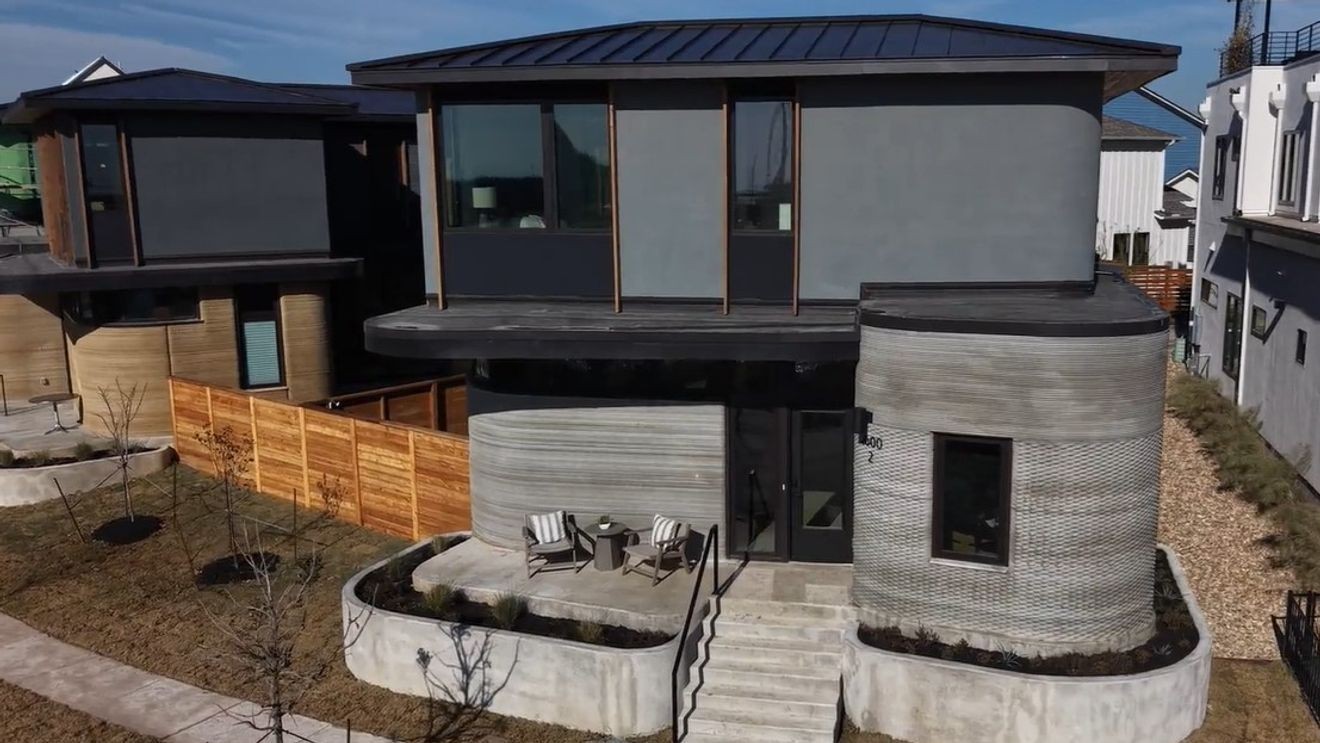
At first glance, the ICON home on Lake Travis looks more like a piece of modern art than a traditional house. It has curved walls, smooth transitions, and clean lines.
But it wasn’t built, it was printed.
At the Canyon Club in Spicewood, ICON is taking 3D printing beyond early prototypes and into high-end, livable design. The company is combining robotics, software, and materials science to change how homes take shape, one printed layer at a time.
“With 3D printing, we can completely change the design environment we live in,” said Jared Kuhn, ICON’s Vice President of Real Estate and Sales.
Breaking Free From Straight Lines
ICON’s signature printer, called Vulcan, operates with millimeter precision. That control allows builders to move past the boxy constraints of traditional architecture and create flowing, organic curves instead.
The printer uses ICON’s proprietary concrete blend, Carbon X, a material engineered for both durability and speed while offering the freedom to shape textures and finishes.
ALSO| Tech This Out: Inside Lenovo’s AI Ecosystem
What Makes It Different
Carbon X can be tinted, textured, and adjusted for a variety of looks. It’s designed to withstand winds up to 200 miles per hour and has a three-hour fire rating.
The walls of a 2,000-square-foot home can be printed in about seven days. The rest of the build still takes months, but ICON says its process cuts the overall timeline significantly while improving efficiency.
At Canyon Club, five luxury resort homes are under construction, with more planned for the coming year.
“It’s still amazing that we’re standing here talking about a 3D-printed home at a luxury resort,” Troy Cohen, a Canyon Club Developer, said.
From Lake Travis to the High Desert
ICON’s innovation doesn’t stop in the Hill Country. In Marfa, Texas, the company collaborated on El Cosmico, a desert retreat blending art, architecture, and technology.
Developers say future projects could expand beyond Texas, possibly to places like Scottsdale.
The First Big Test: Georgetown’s Wolf Ranch
ICON’s large-scale test came in Georgetown, where it partnered with homebuilder Lennar to print 100 homes in the Wolf Ranch community.
Today, 98 of those homes have sold, making it the largest 3D-printed neighborhood ever built. It also proved that this technology can scale from a single project to an entire community.
Building Smarter in Austin
Closer to downtown, ICON is finishing a new set of printed homes in Austin’s Mueller neighborhood. The goal is to show that 3D-printed homes can be both sustainable and livable.
The results so far are promising. For a 1,800-square-foot printed home, ICON reports summer electric bills averaging about $40 a month. That energy efficiency, combined with the speed and design flexibility of printing, is central to ICON’s pitch as it targets global expansion.
The Next Generation: Titan
So far, ICON has printed more than 220 structures worldwide, including homes, schools, and military buildings. The company’s current printer, Vulcan, tops out at 12 feet tall, which limits designs to single-story builds.
That will change with the release of its new printer, Titan, which can print structures up to 27 feet high. The upgrade opens the door to multi-story buildings and commercial projects.
ICON also plans to begin selling Titan printers directly to builders, expanding access to its technology and accelerating wider adoption of 3D-printed construction.
Beyond Earth
The company has even partnered with NASA to explore building technologies beyond our planet. ICON is testing how 3D printing could be used to create roads, launch pads, and other infrastructure on the Moon using local materials.
It’s an ambitious project, but for ICON, space is just one step toward a much larger mission.
Printing a Better Future
“Our mantra is build better, faster, and cheaper,” said Kuhn. “But it started with solving homelessness and housing shortages in disaster areas.”
That mission remains the driving force behind ICON’s strategy — to equip builders everywhere with affordable, efficient construction tools capable of tackling the global housing crisis.
Because the next chapter in construction won’t be assembled piece by piece.
It will be printed.