

Music wasn’t his only lane. Durst was a multitalented force.
In the 1940s, he became an announcer for the Austin Black Senators, a Negro League baseball team. His work caught the attention of future Texas governor John Connally, then the manager of KVET, who hired him in 1948 as a baseball commentator and DJ — making Durst the first Black radio DJ in Texas.
KUTX
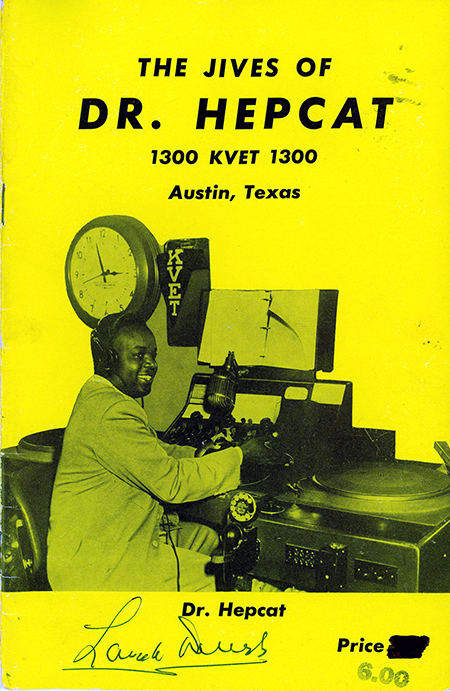
Broadcasting under the name Dr. Hepcat, he hosted “The Rosewood Scramble,” becoming known for his jive talk and his ability to bridge Black and white audiences at a time when shared listening spaces were rare. He even published “The Jives of Dr. Hepcat,” a book that served as both a dictionary and cultural guide to jive language.
Durst was also a major promoter, bringing nationally recognized Black performers to the historic Doris Miller Auditorium in East Austin. At the same time, he worked as director of athletics at the Rosewood Recreation Center, a role he held from the mid-1940s until his retirement.
Though his career took many turns, music never left him. In 1949, Lavada Durst, recording as Dr. Hepcat, released the singles “Hattie Green” and “Hepcat’s Boogie” for Uptown Records, an Austin-based label owned by KVET program director Fred Caldwell.
In the 1950s, Durst shifted his focus to gospel music. He stepped away from secular performance, managed a group called the Charlottes, and became deeply involved in church life, eventually serving as associate pastor at Olivet Baptist Church in East Austin. During this period, he helped write the influential song “Let’s Talk About Jesus” for the Austin Singers of Bells of Joy.