
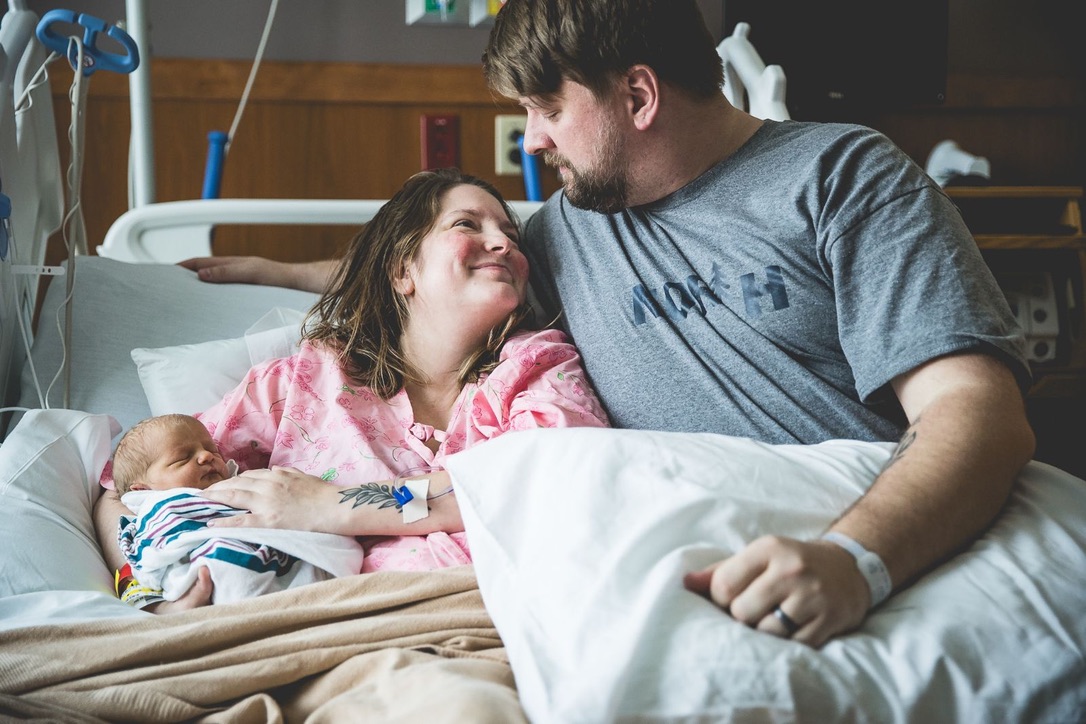
Samantha and Gary Wallin had their first son in March 2024 after she participated in a study that predicted she was at risk for preterm labor and provided interventions to avoid that. Oliver was born at 38 weeks, only two weeks early.
Provided by Samantha Wallin
Imagine if you could predict which mothers would give birth prematurely. Then imagine there was some easy interventions to prevent that.

A new national study of more than 5,000 pregnant women in 19 locations did just that by using a blood test to identify certain biomarkers in the mother.
Article continues below this ad
The Women’s Center of Texas at St. David’s North Austin Medical Center was one of the locations. The hospital has the largest labor and delivery department in Austin, with more than 10,000 babies born last year, and treats mothers at the highest risk for pregnancy complications, including premature birth.
The study enrolled women in 2022 and 2023 but ended early because of the definitive results achieved.
Compared with the study’s control group, the women who received interventions had 56% fewer babies born before 32 weeks and 32% fewer babies born before 35 weeks. Full-term is 40 weeks.
The interventions also affected the babies. The intervention group had 20% fewer babies admitted to the neonatal intensive care unit along with 20% fewer complications for the baby. Babies in that group also spent less time in the NICU — 6.93 days compared with 8.12 days.
Article continues below this ad
“Every day less in the NICU is one that you get to spend at home,” said Dr. Molly McDonald, a maternal-fetal medicine doctor who led the study locally. “That’s huge.”
Samantha Wallin and her husband Gary get ready for the birth of their son Henry after she participated in a study looking at biomarkers as a way to predict preterm birth.
Provided by Samantha Wallin
How the study worked
During the study, women who were between 18 weeks and 21 weeks gestation had their blood drawn. A screening test looked for biomarkers, specifically the ratio of circulating maternal insulin-like growth factor-binding protein 4 to sex hormone-binding globulin.
Article continues below this ad
That ratio is thought to indicate how well the placenta is functioning, McDonald said.
If the placenta is not functioning well, women could have early labor, preeclampsia or other complications that could cause premature birth. Preeclampsia happens when a mother’s blood pressure rises to an unsafe level.
About 15% of participants screened positively for biomarker levels that could put them at risk. Half of those women got traditional care, and they and their doctors were not told about the positive test.
The other half who had a positive test were told and their doctors started them on a regimen of low-dose aspirin, a vaginal suppository of progesterone and weekly check-in calls with a nurse.
Article continues below this ad
The progesterone helps stabilize the tissue of the cervix to prevent early labor. The low-dose aspirin helps reduce inflammation, which lowers the risk of preeclampsia, blood clots and other problems that could cause early labor.
Unless a woman has had a preterm labor previously, preterm labor is difficult to predict, McDonald said. Even if they have had a preterm labor, every pregnancy is different because every placenta is different, she said.
Austinite Samantha Wallin was part of the study when she was pregnant with her first son and was randomly selected for the intervention group after her positive test. The interventions weren’t hard to do and the weekly calls with the nurse were reassuring, she said.
Her son Oliver was born in March 2024 at 38 weeks. Wallin recently delivered her second son, Henry, who was born at 39 weeks.
Article continues below this ad
Doing the test with her first pregnancy and doing the treatments, she said was “low effort and low risk.”
Samantha Wallin’s first son was born in March 2024 after participating in a study that predicted she was at risk for preterm labor and provided interventions to avoid that. She made it to 38 weeks.
Provided by Samantha Wallin
Not available for everyone
The screening test used in the study is available for $750 but is not covered by insurance.Because of this study, there has been a push to get the Centers for Medicare and Medicaid Services to cover the testing. Usually once CMS covers something, insurance companies often follow.
Article continues below this ad
With her second pregnancy, Wallin did not have access to the test through a study and it wasn’t covered by insurance. She did take low-dose aspirin to prevent inflammation, but after assessing her cervix, she and McDonald determined the progesterone probably wasn’t needed for this pregnancy.
If the test had been available through her insurance for Henry’s pregnancy, Wallin would have done it. “It would be great if it was available to more people,” she said.
If this biomarker test becomes the standard of care, McDonald said more babies would need less intervention, free up NICU beds and have better outcomes.
Article continues below this ad
Although the study did not focus on preeclampsia, McDonald said the regimen’s potential to reduce that risk could also lower maternal deaths and complications. A large national study on preeclampsia is underway.