
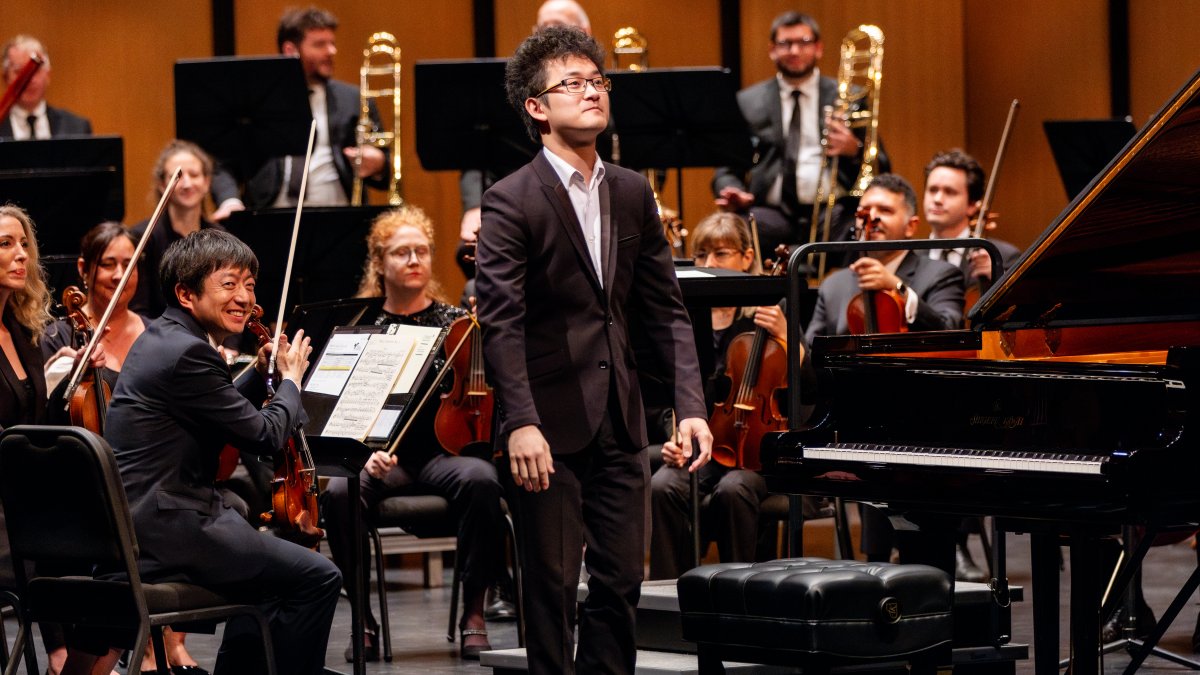
When Yi-Chen Feng performs Beethoven’s Piano Concerto No. 1 with the Dallas Chamber Symphony on Feb. 17, he will be revisiting a piece he learned to play when he was young. How young? He was 7 years old when he started playing piano.
The award-winning pianist, born in Taiwan, first became interested in the instrument when he saw his older sister start taking piano lessons.
“I’m curious of everything, so I just wanted to learn how to play the piano,” Feng said.
His first piano teacher used hula hoops and games to train him on rhythm and music theory, inspiring a love for an instrument that can do everything.
“I can get just all the colors and harmonies,” Feng said. “I like to hear the richness from the harmony. It’s so powerful. It can create so many moods, scenarios in one instrument.”
He moved to the United States to continue his piano studies, earning his bachelor’s degree at the Peabody Conservatory, a master of music and an artist diploma at the Yale School of Music, where he studied with Boris Slutsky. He recently completed a second artist diploma at the San Francisco Conservatory of Music under the guidance of Yoshikazu Nagai, and he returned to Peabody in the fall of 2025 to pursue his doctor of musical arts with Boris Slutsky.
“There are so many opportunities, so many resources that the U.S. has that Taiwan is lacking,” Feng said.
One of his teachers studied in the United States and encouraged Feng to make the move early so he could adapt to the culture and take advantage of everything the country has to offer. His first two American roommates helped Feng understand cultural differences and learn the language. He appreciated their kindness.
“The U.S. is very open to everyone, every person from other cultures,” Feng said.
One of the most striking cultural differences between Taiwan and the U.S. was the relationship between professors and students in the classroom. Students were expected to speak up and express their thoughts rather than just absorb what the professors said.
“They really have the spirit of not being afraid of making mistakes when they say something in the classroom,” Feng said.
As a soloist, Feng has performed at the Weill Recital Hall at Carnegie Hall, Saint John’s Cathedral in Denver, the National Recital Hall and Weiwuying National Kaohsiung Center for the Arts in Taiwan, the Hangzhou Grand Theater in China and the Galerie dorée de la Banque de France in Paris.
“I like to perform, although it can sometimes be nerve-wracking. It can be great to see people who either hear something they’ve never heard before, or they are just so happy after hearing you play,” Feng said. “To be able to share the beauty from those hidden gems to a lot of people, I really feel a lot of satisfaction.”
Feng has won several prizes at competitions such as the New York Liszt International Piano Competition, the Grand Canal International Piano Art Festival, the San Jose International Piano Competition, and the Virginia Waring International Piano Competition.
Mitch LazorkoMitch Lazorko
Feng appreciated the collaborative tone of the 2024 Dallas International Piano Competition.
In 2024, he was the second prize winner of the Dallas International Piano Competition, a competition hosted by the Dallas Chamber Symphony. For Feng, the general tone of the competition made it stand out from other competition experiences.
“It was a really welcoming environment,” Feng said. “It really feels like a friendly reunion. I didn’t feel a lot of hostility, a lot of competitiveness, a lot of negativity, just a great environment to share our thoughts with the judges and the audiences. The hall for the final is fantastic, and the orchestra is lovely to work with.”
Feng appreciated the collaborative relationship with the conductor as he prepared for the finals.
“The conductor, Jim Stopher, and I discussed the piece we were going to perform in the final round, which is typically a normal thing to do before the first rehearsal with the orchestra. But what made it special to me was that he paid very close attention to all the details, instead of just going through the whole piece. Even after the rehearsal, he was trying to double-check with me to make sure that what we did in the rehearsal was what we had discussed. That made me feel very comfortable and easy to work with him. I think that’s why a good conductor can really bring the whole piece to another level,” Feng said.
That collaborative spirit will be important when he plays the Beethoven concerto with the Dallas Chamber Symphony because the soloist and orchestra share musical responsibility throughout the work. This will also be the first time Feng works with Richard McKay, the orchestra’s conductor and Artistic and Music Director.
“Playing this Beethoven piano concerto feels like playing chamber music with the orchestra, especially with DCS, since it is a chamber orchestra, so each member is equally important,” Feng said.
As Feng returns to this piece, he sees something different in it than when he first played it.
“It’s a really bright, really energetic, really lovely piece. The second movement is kind of melancholy and shows a different side of Beethoven,” Feng said. “We can hear a little of his later, kind of mid-period style hint in this concerto.”
Mitch LazorkoMitch Lazorko
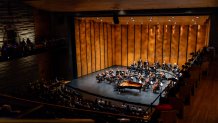
Feng is looking forward to playing at Moody Performance Hall in the Dallas Arts District again.
Major pianists have recorded this concerto, and Feng notices that each one draws out a different aspect of the piece. He hopes to bring a fresh perspective to the piece.
“In order to maintain the kind of youthfulness and also the energy at the same time to spot and express and convey those subtle nuances is challenging.”
Learn more: Dallas Chamber Symphony