
By Rachel N. Madison
Reporting Texas
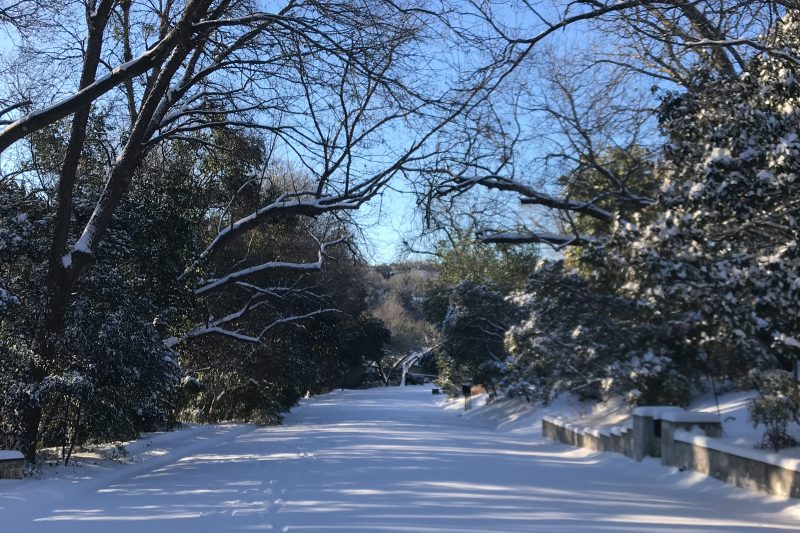
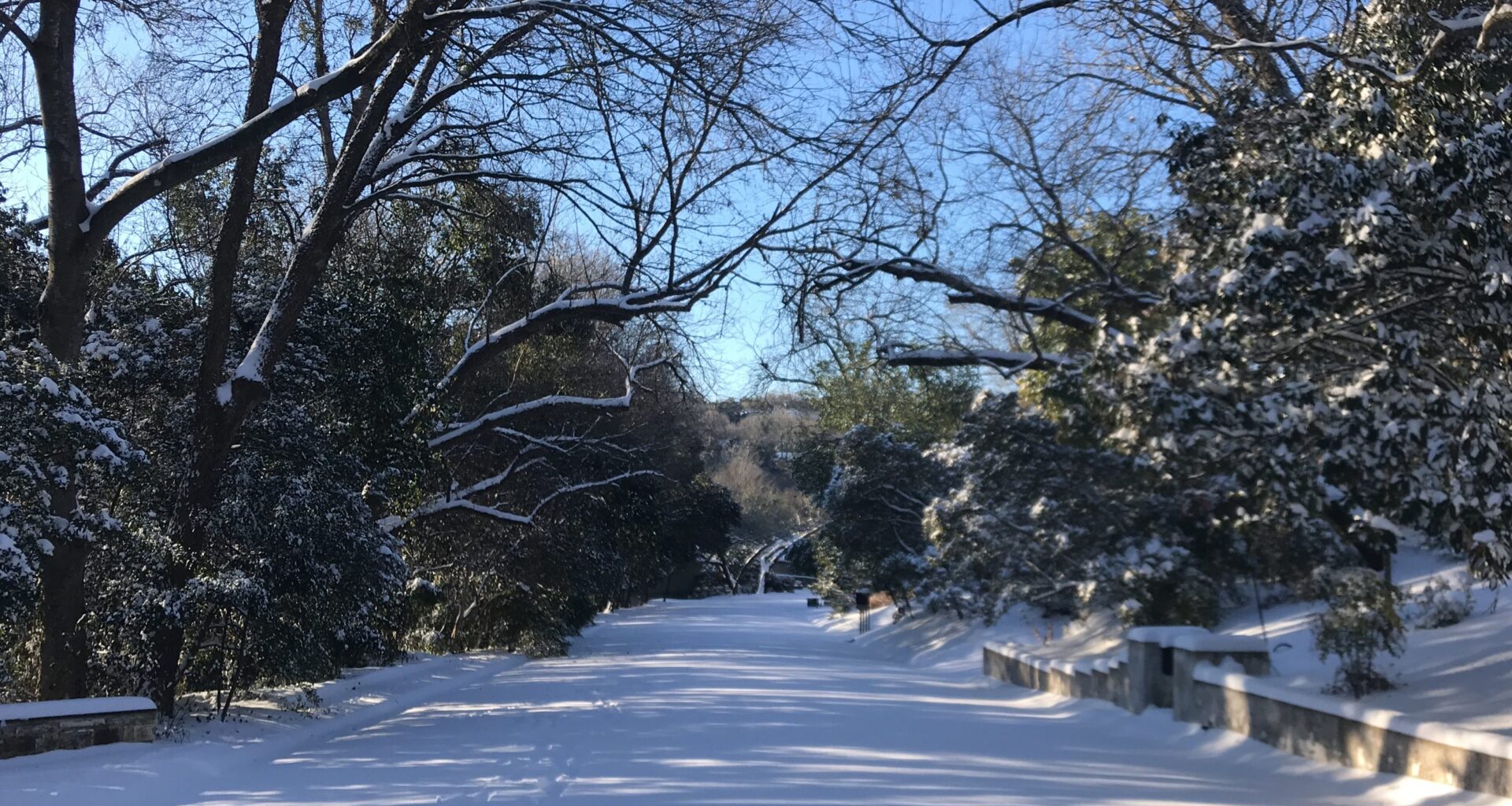
Though Austin’s Northwest Hills was covered in ice, residents say they didn’t lose power in the January storm unlike previous crippling storms. Rachel N. Madison/Reporting Texas
The morning of Sunday, January 24, 2026, looked much like that of January 31, 2023, and February 15, 2021. Snow coated fields. Ice buried streets. People shut their doors. Businesses closed.
Yet, most Texans noticed one key difference.
“We had power the entire time,” Northwest Hills resident Holly Eaton said.
Eaton lost power for four days during the Winter Storm Uri in 2021. A resident of one of Austin’s hilliest and tree-laden neighborhoods for nearly 30 years, she said that outages are common due to the number of trees and old power lines. However, long-term power loss is not.
Five years ago, the Eatons relied on their fireplace and gas stove to stay warm and keep their house at an even 35 degrees. She recognized many residents had it far worse.
“Snowmaggedon is exactly the right word to describe that type; it felt apocalyptic,” she said.
Eaton blamed government leaders for lack of assistance and preparation.
“My shock and awe was about the full lack of a safety net between a fully functioning system and complete failure,” she said. “There was nothing in between.”
For Eaton and other Texans, this winter’s ice storm felt like a relief. The lights and heat stayed on, people stayed off the roads, and the storm came and went.
“It was nothing compared to 2021 and 2023,” Eaton said. “It wasn’t even in the realm of comparison.”
This year, the state’s power grid remained intact with no systemwide blackouts, unlike in Winter Storm Uri which left 4.5 million homes without power and resulted in over 200 deaths across the state.
Some localized outages caused by tree limbs falling on lines were reported during January’s statewide ice storm, but they “were not related to issues on the ERCOT grid,” the Electric Reliability of Council of Texas, responsible for managing the state’s power production, said in an email last month.
In a post-storm report, ERCOT said it had worked with Texas lawmakers, the Public Utilities Commission of Texas and local providers to “strengthen the grid’s “reliability and resiliency” in hopes of avoiding winter weather catastrophe. During the storm of February 2021, ERCOT was forced to initiate blackouts around the state as poorly winterized natural gas plants and other power sources failed.
The new protocols include new generation and transmission planning to make sure the grid can meet increased demand in times of emergency need, mandates to power plant weatherization and routine inspections, increased backup generation sources and battery storage reserves.
“The biggest difference between 2021 and the last freeze is the amount of battery storage we have available,” said Patricia Zavala, executive director of the Texas Energy & Climate Caucus, a bipartisan group of Texas legislators.
In 2021, the ERCOT grid had 220 megawatts of battery storage capacity. Last month, it had 17,000, she said.
This had a big impact on how the grid responded to peak demand in emergency situations and also helped affordability.
“We saw huge price spikes after Winter Storm Uri,” Zavala said. “Texans had to pay a higher price for electricity; this time was different in the aftermath of the storm.”
Zavala said this was a “huge win” for Texas consumers.
Since its founding in 2021, just weeks before Winter Storm Uri hit Central Texas, the caucus has grown to over 60 legislators that work to educate lawmakers and enhance energy policy with a specific goal in mind: “To fix the grid and make sure another event never happens again and never see the horrible loss of life we saw in 2021,” Zavala said.
The group helped Texas legislators pass several grid reform bills in the wake of Uri, including Senate Bill 3, focused on grid weatherization and electricity mapping and House Bill 3648, designating certain natural gas facilities as critical customers during energy emergencies.
The Public Utilities Commission of Texas and Railroad Commission also issued a series of policies and penalties for failure to weatherize or inspect plants, said Carey King of the University of Texas Energy Institute.
Austin Energy made improvements after previous winter ice storms and has $735 million in initiatives planned to safeguard the city’s power system. Rachel N. Madison/Reporting Texas
While many believe the ERCOT grid remains vulnerable because it is separate from the rest of the U.S. power grids, King said that independence can be beneficial in making quick fixes to the grid since Texas doesn’t have to negotiate interstate communications like other grid regions.
Recent legislation and protocol also helped inform Austin Energy’s newly released Electric System Reliability Plan, Austin Energy employee Matt Mitchell said.
Austin Energy recorded around 4,000 customer outages at the peak of Winter Storm Fern in January, Mitchell said. In 2023’s Winter Storm Mari, outages numbered 170,000 at their peak, and 220,000 customers lost power throughout Uri in 2021, according to after-action reports.
Mitchell believes Austin Energy’s recent efforts — including equipment replacements, circuit hardening, vegetation management and pole inspections — made a difference.
“We used a holistic approach to strengthen the grid as a whole rather than one solution,” Mitchell said. “This will make it more reliable not only in terms of outages, but also more resilient, getting the lights back on faster.”
“Relative to the last two winter events we’ve had, these outages were very short in duration,” Mitchell said, and were mostly due to lightning strikes causing downed limbs on power lines, not systemic failures.
Austin Energy plans to invest $735 million into continuing this work through 2035.
In 2026, Austin Energy plans to replace 40 underground cable lines, inspect 8,000 high-risk poles, develop a routine vegetation trim cycle and install 1,000 automatic switches across its service areas in Travis and Williamson County.
Eaton said she’s already seen crews trimming trees and replacing old poles in her neighborhood over the past several years, and hopes that their efforts will continue into the future.
“The effort that Austin Energy made this time around in terms of prevention seems to have paid off,” Zavala said.
While both Mitchell and Zavala believe that statewide and local efforts have hardened grid security, they also acknowledged that luck had a role to play this year.
Winter Storm Fern mostly brought sleet, which doesn’t stick to above-ground power lines like the freezing rain experienced during Uri, Mitchell explained, thus reducing the likelihood of outages.
“Had it been freezing rain (instead of sleet), we would have seen many more outages,” like in 2021, he said.
Going into this storm, it wasn’t clear what type of precipitation Texas was going to get, Austin meteorologist Troy Kimmell Jr. said.
Thanks to a thick layer of subfreezing air in the atmosphere, freezing rain turned to sleet before hitting the ground, preventing the ice accumulation on poles and power lines seen in prior winter weather events.
On a severity scale of one to 10 where Uri was a 10, Kimmel believes this storm wouldn’t rank higher than a five.
“It was the luck of the draw,” Kimmell said. “And it kept us away from a lot of infrastructure problems.”
While policymakers and energy experts believe both statewide efforts and chemistry accounted for the mild outcome of the January storm, they believe we still need to prepare for increasingly unpredictable weather to come.
Zavala believes that reducing consumer demand is crucial.
“Every megawatt you don’t consume is a megawatt you don’t have to produce,” she said.
Eaton said she has received alerts in the past urging consumers to reduce usage during peak times, mostly during summer heat waves, and believes it is a good idea to reduce demand.
Early communication and information was a crucial factor that gave her more trust in the grid this time around. However, she says the impact of Uri will forever be “emblazoned” in her mind.
“I hope that the lessons from that complete government failure will not be forgotten,” she said.
She believes Texas has learned from the past and hopes that plans will get updated regularly as weather patterns become more erratic and events more unpredictable.
“There’s a lot of attention to it now, but that focus and energy has to be maintained,” she said.