
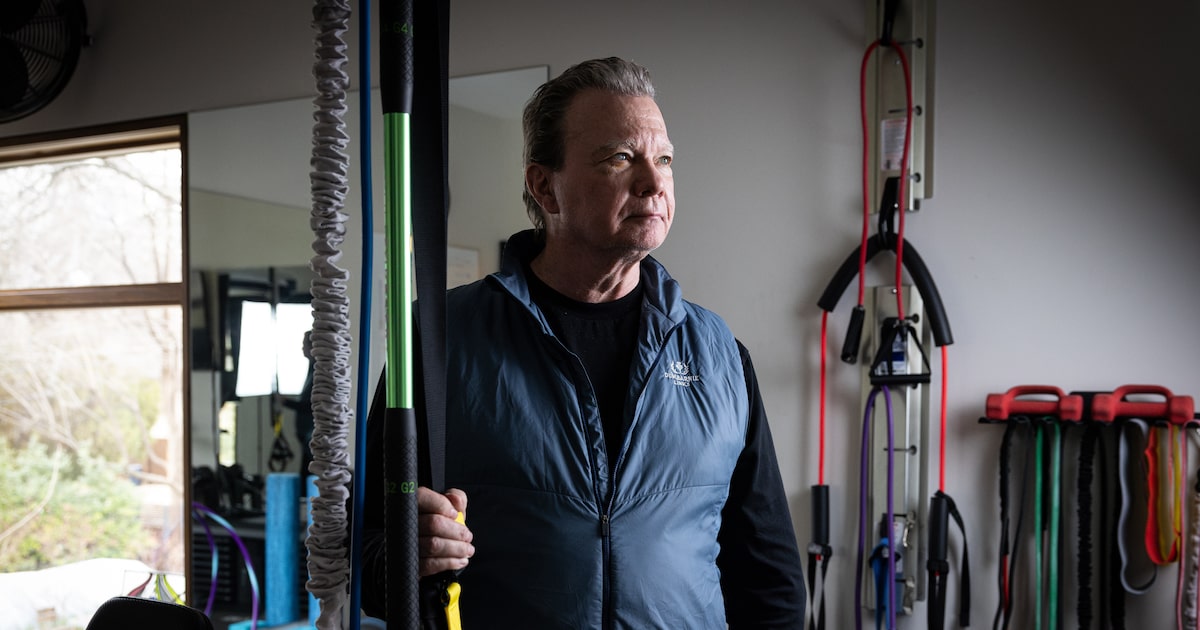
Dan Noble has hit the reset button on life.
In December, Noble, 67, turned over the stewardship as CEO of Dallas-based HKS Inc., having called the shots for a dozen years.
During that time, Noble strategically transformed the Dallas-centric architecture firm into one of the largest and most respected architecture and design firms in the world with 1,700 employees in 30 offices around the globe.
“Our firm moved from 100% Dallas based to 30% Dallas based,” Noble said over coffee recently. “Our composition shifted from 90% male to equally male/female. We did this because it’s not just the right thing to do, but it’s also better for business and results in stronger outcomes.”
Doubt that?
Related

The privately held company, owned by about 90 senior HKS executives, had record profits last year. Noble was among those stakeholders, but he turned 67 in November, and according to the firm’s bylaws, he had to sell his stock by the end of 2025.
Business Briefing
HKS was a perennial winner in The Dallas Morning News’ Top 100 Places to Work competition, based on anonymous employee feedback.
“Life is short, so we try to make work fun.” Noble said. “To keep it fun, you need to let people be authentic. We have health rooms where you can take 15, 20 minute naps. The idea that you have to be at your desk 8-to-5? I don’t believe that. Last year, we had 35,000 applicants for 300 positions. We’re really good at zeroing in on talent.”
A week ago, Dan and his architect wife, Ann, returned from a 10-day trip to Dubai, the last of HKS’ outposts for him to visit and his CEO swan song.
He’s more than ready to be Dan Noble 2.0.
“My job became 800 things before noon — a mile wide and an inch deep,” he said. “I want to go deeper. I want to do less, but do more. My brain has been rewired to not be in the moment, and I want to be in the moment.”
Push-button phones, hand-drawn designs
Ironically, Noble longs for the mom-and-pop-shop days at Harwood K. Smith in Dallas, when, as a 25-year-old, he and two other designers shared a studio pod with a single-line, push-button phone answered by an assistant.
There were no computers. Noble hand drew his designs.
“I was focused, totally connected to doing just one thing — maybe a floor design or sections of elevations,” Noble recalled. “It was a complete immersion to find a solution, and I loved it.”
Noble reveled in leading the firm when it involved communication, strategy and contemplating the future of the industry. “That was creative problem solving. But the peripheral bulls— got in the way more and more.
“People would ask ‘What’s HKS’ opinion?’ on things like Roe vs. Wade. And I’d say, ‘We don’t have one. We have 1,800 employees, and thankfully, they’re allowed to think what they want to think.’
“The mental exercise that you go through with pleasing people, I’m kinda done with that,” he said. “I want to chill and get that brain reset.”
‘Beginning of a good transition’
Noble is six weeks into his mind and soul reboot — too early to gauge how the transition is going.
He still answers his HKS emails, but they might sit in his inbox for a day or two.
Ann, who retired as a vice president at HKS when Dan became CEO in January 2014, was instrumental in setting up Citizen HKS, the firm’s non-profit philanthropic initiative. She still sits on its steering committee.
She already sees that he’s more relaxed.
“I’ve told him it takes time to figure things out, but this is the beginning of a good transition. I’m looking forward to traveling and enjoying a whole new world of shared adventures.”
Their lives have been entwined for decades, having met each other in architecture school at North Dakota State University in 1979.
They live on an acre in Forest Hills, adjacent to the Dallas Arboretum and are active in its reforestation — replacing invasive trees with ones that are native and climate resilient.
They meditate in the mornings and take 20-minute saunas. He spends 10 minutes in his cold-plunge tank. She’s not into that.
A resistance trainer comes to their home bright and early on Tuesday and Thursday mornings. It’s aerobic exercise on Mondays, Wednesdays and Saturdays. They don’t work out on Fridays and usually golf on Sundays.
Both do intermittent fasting, only eating between noon and 6 p.m., and then it’s protein-packed. He tries to consume the equivalent of a 46-ounce steak, which he admits is a challenge, drinks a gallon and a half of water and now gets at least 8 hours of sleep.
Travel is definitely on their to-do list with Istanbul, Bucharest, Budapest and Dubrovnik in Eastern Europe on their upcoming itinerary — along with playing the famed Pinehurst golf course in North Carolina and courses in southern Ireland.
Dan is writing a book about how creativity gets beaten out of us by life, but can be rekindled to the benefit of both our mental health and careers. The working title is “Fearless by Design.”
There are plans to restock their abandoned coop that once had three chickens and replant an herb and vegetable garden when things thaw out.
He’s on the Dallas Arboretum building committee and the Forest Hills reforestation board. They’re contemplating an addition to their Forest Hills home and a renovation of a 100-year-old barn at their 2.5-acre lake home in Nisswa, Minn. Think ungodly cold in the winter.
Spending money is profitable
Dan 2.0 has had time to reflect on Dan 1.0.
“When I took over, we were a strong, well-managed architectural firm with 950 employees who did good, accurate design. We were go-go-get-things-done and unapologetically business-focused. But I wanted to create a firm that gave more thought to how the buildings performed and was less concerned with profits.”
Noble said the end has justified the means.
“I felt that if we did great projects, pumped some of our profits into research and development and spent more time up front, we’d be successful,” Noble said.
“Like Einstein said, ‘If you have an hour to solve a problem, spend 55 minutes defining it and then 5 minutes to solve it.’
“We’ve morphed into that and, by the way, our percentage of profits is still what it was when I took over. We’re having a record year. We shoot for 20% of our net revenue, which was about $450 million in 2025 — so about $85-$90 million.”
Stunning projects, Shingle Mountain
It’s hard for Noble to single out his favorite projects.
“Iconic projects such as AT&T Stadium, the Dallas Victory W Hotel, M.D. Anderson Cancer Center, the new NPC Children’s Hospital, Halperin Park, Klyde Warren Park and Forest Theater in South Dallas are impactful and beautiful spaces to experience, and we’re very proud of them. But we’re equally proud and get as much satisfaction out of some of our smaller employee-directed pro bono projects that fly under the radar.”
Those include restoring the landmark Forest Theater in South Dallas, creating a vision to turn Shingle Mountain into a park for the Floral Farms neighborhood in southeast Dallas; True Worth Place, a community resource center for the unhoused in Fort Worth; The 24 Hour Club, an addiction recovery program in Dallas; Halperin Park, the Southern Gateway deck park, and The Place at Honey Springs, a multipurpose center for the Joppa community in South Dallas.
HKS 2.0
Noble initiated HKS’ change in command seven years ago, when he hired Slalom to look at 80 promising internal candidates.
The consulting firm created four cohorts of 20 employees who went through Slalom’s leadership program.
“Through that we identified seven people who we thought had the chops to be the next CEO,” Noble said.
That was winnowed down to four, then two. HKS’ board of directors confirmed Noble’s personal choice, Heath May.
Why him?
“Heath and I share a philosophical foundation with our favorite car book: Zen and the Art of Motorcycle Maintenance: An Inquiry into Values.” That’s the seminal 1974 novel that blends a cross-country motorcycle trip with a deep dive into what is “quality” and how to live a meaningful life.
“Heath had the goods: an insatiable curious mind to explore, experiment and discover.” Noble said. “He’s whip smart and knows technology.”
That skill set is mandatory as HKS navigates AI, which is already reshaping the architecture and design world as well as the needs of its clients.
“We’re on the right trajectory,” Noble said. “And with the leadership in place the future looks bright for the firm as it navigates uncharted waters.”
HKS Inc.
Founded: 1939 by Harwood K. Smith
Headquarters: One Dallas Center
CEO: Heath May
Ownership: privately held by about 90 HKS shareholders
What it is: Global architecture firm offering planning and interior design for health care, sports and hospitality commercial mixed-use, education and senior living facilities
2025 revenue: $770 million, ranked nation’s third-largest architectural firm by Architectural Record.
Employees: 1,800 employees in 30 offices in North America, Latin America, Europe, Asia, and the Middle East.
Local marquee projects: Scottish Rite for Children Orthopedic and Sports Medicine Center, Frisco; HALL Arts Residences, Park District; The Village Town Center in East Dallas, Moody Outpatient Center at Parkland Hospital.
Signature sports venues: AT&T Stadium, Globe Life Field, SoFi Stadium, U.S. Bank Stadium.
Projects in the pipeline: Halperin [deck] Park in South Dallas, Children’s Health–UT Southwestern Pediatric Health Campus, Washington Commanders stadium, Cleveland Browns stadium, Dallas Police Training Academy proposed at UNT-Dallas campus, 8300 Douglas in Preston Center
SOURCES HKS Inc., The Dallas Morning News research
Meet Dan Noble
Title: Chairman emeritus, HKS Inc.
Age: 67
Born: Chicago, Ill.
Grew up: Aberdeen, S.D.
Resides: Forest Hills near the Dallas Arboretum and a summer lake house in Nisswa, Minn.
Education: Bachelor of Science and a Bachelor of Arts in Architecture from North Dakota State University, 1982
Personal: Married to Ann Skjerven Noble for 39 years. Their son, Riley, is an engineer in Austin and is expecting a child in July. Their daughter, Jennie, is a sustainable urban planner in Los Angeles.
SOURCE: Dan Noble
 Sports arenas: The thrill of aesthetics, the agony of taxpayer support
We all love live sports, but are expensive stadiums worth the money?
 Health costs are fueling voter stress and powering Democratic campaigns
Democrats are focusing on health care in the November elections and making it a key issue.