
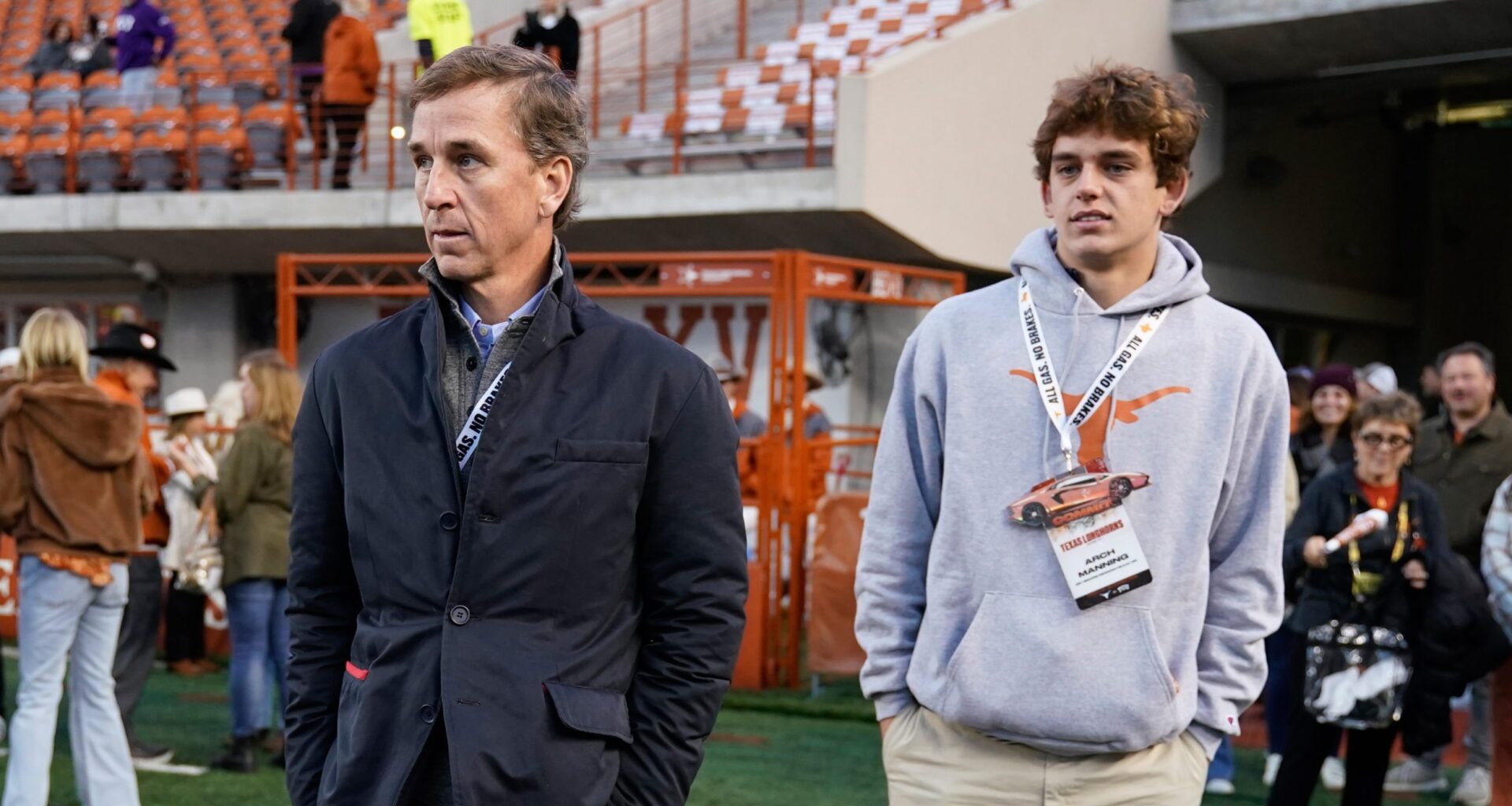
Cooper Manning has watched the media cycle around his son Arch play out exactly as he expected. The hype was absurd. The backlash was inevitable. And now the hype is building again for next season, which means the backlash will return when Arch has a bad game.
Cooper spoke with Bruce Feldman of The Athletic about what it’s been like to watch Arch’s first season as Texas’s starting quarterback unfold under a microscope that no college player has faced in the social media era.
“I think being a parent of someone who’s being critiqued on every little move is definitely a challenging spot,” Cooper said. “There’s a lot of people in this sports world that have opinions, and there’s only a small portion of them that are qualified to have them or that I would respect listening to, so you gotta pick your spots carefully. And that goes both ways when they’re saying nice things, you know that can flip on a day or a dime.”
The criticism of Arch reached a fever pitch in October when The Athletic published a column asking, “Is Arch Manning college football’s first flop?” The New York Times shared it on social media with even harsher framing, calling Arch “a man synonymous with failure” just five games into his first season as a starter.
Cooper understands where the criticism came from. Texas entered the season ranked No. 1 with Arch as the Heisman favorite and projected top pick in the 2026 NFL Draft. When the Longhorns lost to Ohio State in Week 1 and then struggled against UTEP and Florida, the media that built Arch up spent weeks tearing him down.
“If they were the 20th-ranked team, which they probably should’ve been, and they got beat by seven at Ohio State, it wouldn’t be the end of the world,” Cooper said. “But all the fluff and the nonsense that comes with it, and it adds to the useless banter that goes on. I’ve learned to limit what I read and listen to. It’s actually quite liberating.”
Texas finished 10-3 and missed the College Football Playoff. Arch threw 26 touchdowns and seven interceptions on the season. In the three losses, he threw four touchdowns and four interceptions. The numbers weren’t catastrophic. They were fine for a first-year starter behind a rebuilt offensive line. But they weren’t Heisman-worthy, and that’s what made them a disappointment in the eyes of people who decided before the season that Arch needed to be the story.
Paul Finebaum called Arch “the best player we have seen from every aspect since Tim Tebow” before he’d even started a game. The Wall Street Journal crowned him “the Biggest College Quarterback Prospect Ever” before he’d thrown a meaningful pass. ESPN had him projected as the No. 1 pick in the 2026 draft before he’d faced real adversity.
Then, Arch struggled at Ohio State, and the same outlets that manufactured those expectations spent weeks analyzing whether he was mentally broken. ESPN announcers Sean McDonough and Greg McElroy relaunched his Heisman campaign during a win over Vanderbilt in November, proving Cooper’s point about the cycle repeating itself.
“People would try to downgrade the whole thing in one little week or two, it’s kinda silly,” Cooper said. “It’ll start all over again, and then he’ll be hyped up again this offseason — it’s coming, and he’ll have some bad games next year, and here it comes again.”
Cooper knows exactly how this works. He’s watched it happen to his brothers Peyton and Eli, though neither of them faced the scrutiny Arch does because social media didn’t exist when they were in college. Peyton had years to develop at Tennessee. Eli had time to figure things out at Ole Miss. Both got to fail when no one was watching.
Arch doesn’t get that luxury. Every incompletion gets analyzed. Every interception becomes evidence of some deeper flaw. And the media treats his success or failure as a reflection of whether he deserves the Manning name.
Cooper’s solution is to limit what he reads and listens to. He doesn’t pay attention to most of the noise because most of the people making it aren’t qualified to have opinions worth respecting, at least that’s what Arch Manning’s father believes. That applies when they’re saying nice things, too, because those same people will turn on Arch the moment he throws a bad interception.
“The coverage of sports is over the top, and there are too many people doing it,” Cooper told The Athletic. “It’s no different than when they were saying he was the greatest thing since sliced bread early in the season before he’d ever played.”