
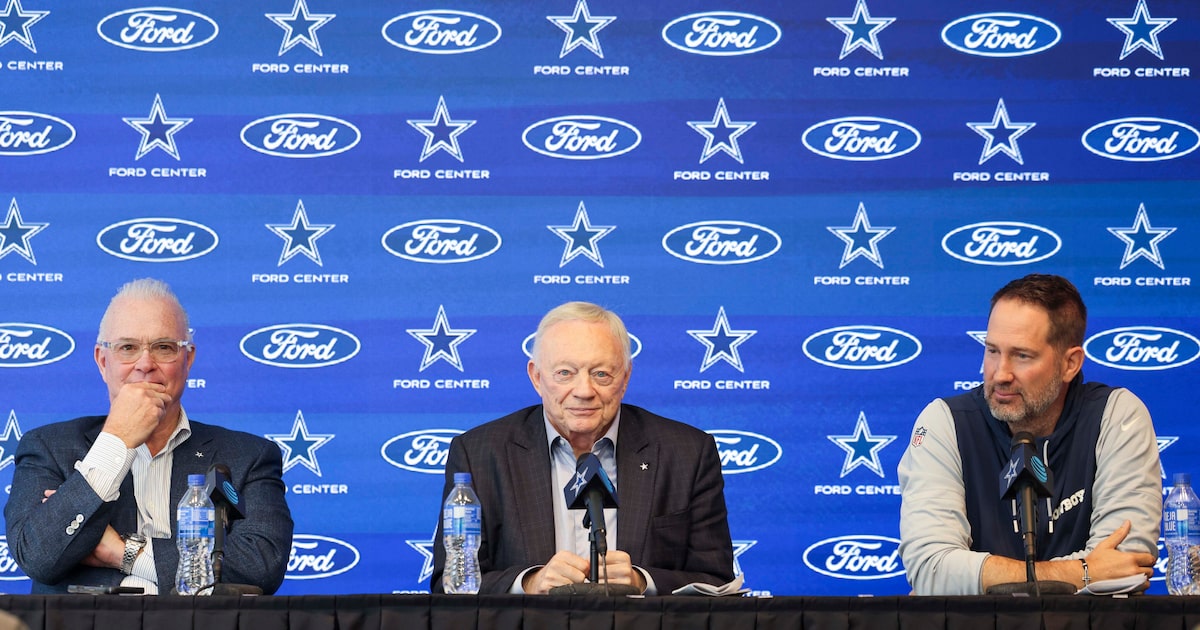
SAN FRANCISCO — The bar was bustling, the conversations were loud, and the questions to Cowboys owner Jerry Jones on the Thursday before the Super Bowl were all over the map — even from a literal sense, if you include questions about the team’s game in Brazil next season. Jones, sitting with a few local reporters at a corner table inside the Four Seasons’ bar overlooking Market Street in downtown San Francisco, answered them all in a roughly 30-minute session.
But time was running out. Jones had to attend the NFL Honors ceremony set to take place in short time. That’s when one reporter from The Dallas Morning News slipped in one more question — perhaps the most important one of all: how do Jones and the Cowboys get back to the Super Bowl after a hiatus that has now reached 30 years?
“I didn’t expect necessarily these teams to be in this game,” Jones said. “But I saw how they got there.”
Seeing is one thing; emulating is another.
Cowboys
With this year’s Super Bowl done and slates wiped clean across the league, let’s look at five things the Cowboys — even after a seven-win season — must accomplish if they want to make it back to the Super Bowl.
Win big, spend big
Last year, the New England Patriots and Seattle Seahawks signed a combined 29 players in free agency with guaranteed money for those free agents eclipsing $333 million, according to CBS Sports. They hunted in free agency. The Patriots landed key players in wide receiver Stefon Diggs and defensive tackle Milton Williams, among others. The Seahawks acquired a missing piece in former Cowboys defensive end DeMarcus Lawrence.
The Cowboys, from a volume perspective, actually signed a good amount of external free agents, including starting running back Javonte Williams. They weren’t exactly big-game hunting like the two teams in the Super Bowl, however.
The Cowboys will have some limitations. They’re starting out with roughly negative $30 million in cap space, though they have the ability to open up roughly $100 million, if they choose, by restructuring deals.
Jones said earlier this offseason that he might be willing to “bust the budget” to take advantage of the way quarterback Dak Prescott has played. When asked by The Dallas Morning News on Thursday about how that would look, Jones said it would be doing more than they did last year. Could that mean signing a big-money defensive free agent this offseason? If they want to make it back to the Super Bowl, that would be a start.
Cut and shoot
That’s a phrase Jones has used often the last year to explain his willingness to trade. One avenue for a trade could be using one of their two first-round picks. Currently, the Cowboys don’t have a second- or third-round pick after they’re scheduled to pick 20th overall. Jones indicated Thursday they could be willing to move up or down in the draft because of that extra first-round capital.
But what about the third option? Jones was asked specifically if they would be open to trading one of their first-round picks for a veteran. One name that was popular during Super Bowl week in San Francisco was Las Vegas Raiders defensive end Maxx Crosby, who could reportedly be a potential trade target this offseason. Crosby, a Colleyville Heritage alum, would instantly provide pass rush that the Cowboys lost when they traded Micah Parsons before last season.
Jones said he’s aware that player values are different before the draft and after the draft, suggesting that trading for other picks is more likely before the draft than trading for players.
“But if I saw something that was just tremendous value that fit us,” he said of potentially trading a pick for a veteran, “I could picture taking it away.”
Jones and the Cowboys should pursue that, especially with a lot of holes on defense.
Find CP’s new CB project
New Cowboys defensive coordinator Christian Parker had Pat Surtain in Denver. He had Quinyon Mitchell and Cooper DeJean in Philadelphia. This offseason, the Cowboys should find his next cornerback project.
For the Cowboys, that likely means using either their 12th or 20th overall pick in the first round to find a talented player with potential that could be that project. LSU’s Mansoor Delane, Tennessee’s Jermod McCoy and a few others would fit that bill.
The Cowboys have at least one young project on the roster already in cornerback Shavon Revel, who was limited last year after starting the year late because of injury. Parker will have him for a full offseason. It’ll be interesting to see what magic he can work on Revel.
Regardless, adding more young talent in the secondary should be a necessity.
Don’t hold out
Cowboys wide receiver CeeDee Lamb missed the entirety of training camp in Oxnard while he negotiated a new deal. Later on, he would say the absence affected his on-field chemistry with Prescott, creating a slow start to that season.
History should be a lesson for how the Cowboys and George Pickens, their other star receiver, handle their negotiation. The Cowboys are expected — as they have been — to franchise tag Pickens when the window opens on Feb. 17. That’s because the Cowboys don’t want their star receiver to even hit the market, where his value could grow beyond the tag price, which would be just over $28 million, according to projections. The tag should serve as a placeholder through mid-July, which would be the deadline for a tagged player to sign a long-term deal.
By that point, there should be a resolution on whether Pickens will show up to Oxnard for training camp. Or at least you would think. My one recommendation for the Cowboys: if you want to seriously contend next season, make sure Pickens shows up to camp and doesn’t hold out. The offense should be expected to lead them again, and they can’t afford a slow start from a receiver who had the third-most receiving yards in the NFL last season.
Keep the running game great
Cowboys head coach Brian Schottenheimer has made it known from the moment he was hired that his offense will be built on the running game. Last year, with Williams leading the way, it proved to simultaneously be a stabilizer and a spark when the Cowboys’ offense needed it. That’s why the Cowboys need to ensure they have an answer for their running game again next year.
Williams is a free agent. And while he’s been considered a priority by the Cowboys, there’s also a chance he wants to see what the market looks like at an all-time high for him. The Cowboys should be prepared, just in case, to find another running back if need be.
The Cowboys also have two rookies from last year in Jaydon Blue and Phil Mafah. Blue was inactive for most of last season but impressed in the season finale. Mafah missed the whole year after he was placed on injured reserve.
Whoever is the lead running back next season has to carry the flag of keeping the Cowboys’ running game firing on all cylinders.
Find more Cowboys coverage from The Dallas Morning News here.