
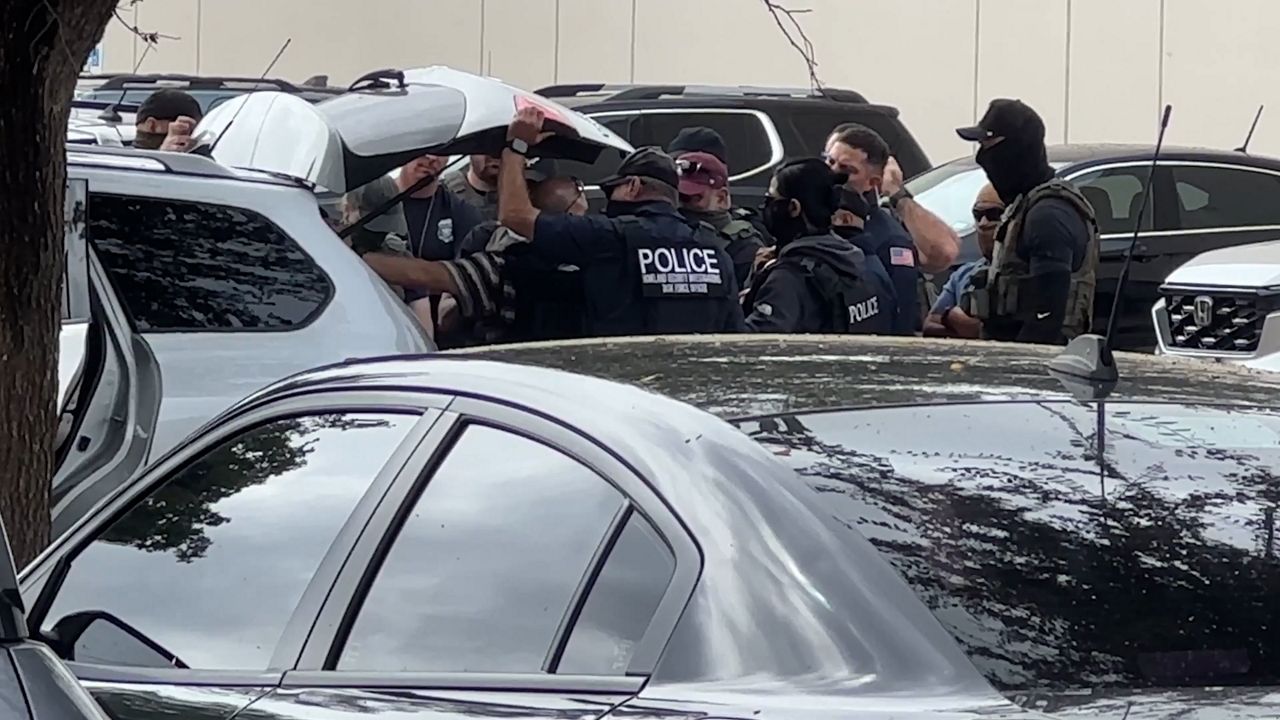
TEXAS — City officials across the state are feeling the heat as some residents voice their concerns over the handling of immigration enforcement efforts.
From San Antonio to Houston to Austin, many of those voices were heard during public comments at city council meetings throughout January.
“If they have declared that they will not follow the law, we cannot treat them as a law enforcement agency,” said one resident at a San Antonio City Council meeting.
Residents urged their respective cities to stop all collaboration between police and Immigration and Customs Enforcement (ICE).
“ICE is in our streets, our stores, our schools, and they are terrorizing people, abducting children and then losing them, and murdering them with impunity,” said a resident during an Austin City Council meeting.
A Houston resident demanded action from the city, accusing ICE of killing and kidnapping neighbors in the community.
“You are our community leaders, and yet, you weaken our community by allowing ICE to operate in it,” he said. “How are we to trust you?”
Effective Jan. 1, Texas law requires county sheriffs to partner with ICE. Dr. Alex del Carmen, a criminologist and law enforcement expert, said there are big consequences for counties that don’t comply.
“What that means is they’re not subject to receiving grant money from the state, and they’re likely going to be flagged by the state as not being cooperative,” del Carmen said.
That cooperation is optional for local police departments, but it could be lucrative.
“A lot of the local agencies, obviously, are being incentivized by giving them money to reimburse them for their time that officers would be spending on ICE-related operations,” del Carmen said.
Dallas Police Chief Daniel Comeaux rejected a $25 million federal incentive late last year.
“We have a lane, being local police department, and the federal has a federal lane, being federal law enforcement,” Comeaux said during a November Dallas City Council meeting.
These state conversations come amid campus walkouts and ongoing protests from Texas to Minneapolis.
“Their primary concern is violent crime… not necessarily crime related to all immigration-related violations, and so, by virtue of that, local law enforcement has been resistant to that,” del Carmen said.
“What really threatens our safety is unchecked power,” said a San Antonio resident. “What we’re seeing across the country is abhorrent, and we have an obligation to stand up for our neighbors.”
As the debate rages in Texas city halls, del Carmen said police agencies are walking a fine line of upholding the law in the court of public opinion.
“What’s likely going to happen is this is going to end up in the courts, and the courts, if you have a reasonable judge that follows the Constitution, will likely side with the individual,” del Carmen said.