
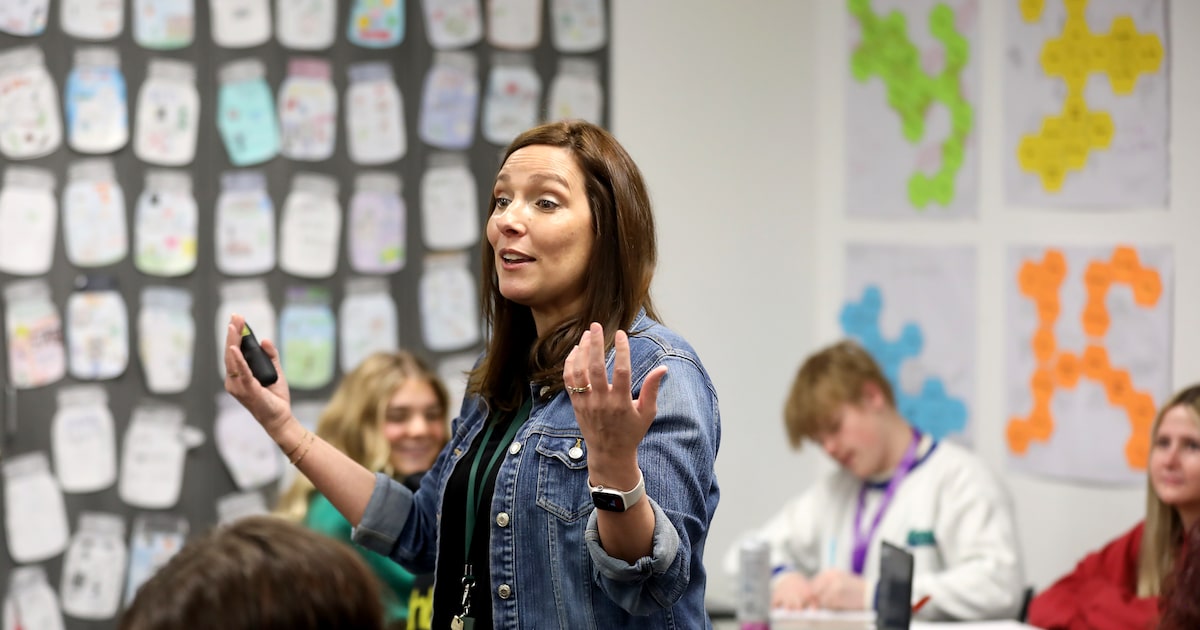
A few minutes before 8:45 a.m. Tuesday, Shelley McClellan was in the hallway at Allen High School, greeting students as they straggled into her first period English class.
As students settled into their seats, McClellan talked them through the writing prompt for a short assignment they’d be working on for the first five minutes of class. The class had been talking for several days about the concept of the American dream. Today, they’d be writing about their own dreams — in particular, what they hoped their careers and family lives would look like in 10 years.
Districts across Texas are working to get all their teachers in core subjects certified, and some will have trouble hitting the deadline. The change was needed after a new Texas law restricted the use of uncertified teachers.
It’s something McClellan has been thinking about in her own life, as well. McClellan is in the midst of a career change. In 2024, McClellan, then an administrative assistant at Allen High School, joined a program designed to get district support staff members trained and certified as teachers. After spending more than a decade working in other roles in the district, she’s a little more than halfway through her first year as a teacher, and a few months from earning her teaching certificate.
The program is one of several creative solutions districts across Texas have had to adopt recently. Five years ago, school districts across Texas, struggling to find enough educators to staff their classrooms, began hiring candidates with no teaching certificates — and often little training or classroom experience — to teach their students.
The Education Lab
Now, faced with an upcoming state deadline for teachers in math, reading, science and social studies to be certified, district leaders are working on plans to get their uncertified teachers credentialed. Last year, about 42,000 teachers across the state lacked a teaching certificate, according to the Texas Education Agency. Along with the new requirement, the state is offering districts financial incentives to get uncertified teachers credentialed. For example, districts can receive up to $12,000 per teacher to pay for up to 40 teacher candidates like McClellan to get certified to teach.
For those teachers, that means finding a way to balance the long hours they’re expected to spend in the classroom with staying on top of their own coursework. Last year, McClellan had to juggle online courses to complete her teaching certificate, district-run classes where she learned skills like classroom management and classroom observation time, where she watched experienced teachers at work.
“It was definitely a challenge, but it’s been well worth it,” McClellan said. “The rewards have been great.”
Teacher certification requirements
Education researchers say the move to require all core subject teachers to be certified could be beneficial to the students those teachers work with, since teachers who are certified tend to be more effective than those who aren’t.
The new requirement will be a tall order for some districts, such as DeSoto and Cedar Hill ISDs, where more than 30% of teachers are uncertified.
Until recently, school districts that received a District of Innovation designation from the state — a category that includes the majority of Texas school districts — were able to opt out of certain rules, including teacher certification requirements. Lawmakers created that designation in 2015 with the intention of allowing districts to hire industry experts to teach career and technical classes like welding and culinary arts.
As post-pandemic teacher shortages made it harder for them to staff their classrooms, districts across the state began using the District of Innovation designation to hire more uncertified teachers in all subjects. In the 2023-24 school year, more than half of the roughly 30,000 new teachers statewide were uncertified, according to the Texas Education Agency. Researchers and education policymakers say that’s a problem because uncertified teachers are less effective and less likely to stay in the classroom long-term than those who have a teaching credential.
Last year, state lawmakers passed a bill tightening restrictions on uncertified teachers. Traditional school districts must have no uncertified teachers teaching math, science, reading or social studies by the beginning of the 2027-28 school year, although districts may apply for a two-year extension. That means districts must get all their uncertified teachers who are working in core subject areas certified or move them out of the classroom by the 2029-30 school year. The bill also includes money to help districts build programs to get those teachers certified.
Creating pathways to certification
With the teacher certification deadline just a few months away, districts across the state are working on plans for how they’ll meet the new requirements — and preparing to ask for the deadline to be pushed back. Across the state, 85 districts have received state approval to push the deadline back. That list includes Dallas, Mesquite, Weatherford and Mineral Wells ISDs in North Texas. Districts have until March 2 to apply.
In Allen ISD, board members voted in January to seek a waiver from the state allowing the district to keep using uncertified teachers until the beginning of the 2029-30 school year. Allen ISD has relatively few uncertified teachers. Last year, just 64 of the district’s teachers were uncertified, a little less than 5% of its teacher workforce, according to data from the Texas Education Agency. This year, that number is down to about 30. By comparison 1,238, just under 15%, of Dallas ISD’s teachers were uncertified during the same year.
Related
David Hicks, a spokesperson for Allen ISD, said the district is working to get its uncertified teachers certified, and giving them the support they need to do well in the classroom in the meantime. Principals meet with those teachers monthly to see how they’re faring in the classroom, and also how the certification process is going. The district’s human resources department checks in three times a year to see which tests they’ve completed and how far they are from certification.
School districts have a number of avenues for getting their uncertified teachers credentialed, including fast-track, online-only programs that allow teachers to get certified in as little as three months to longer training programs that include classroom experience and mentorship. Like many districts, Allen ISD has a Grow Your Own program that supports uncertified staff and high school students who are interested in becoming teachers. The district also has a program called Allen ACT, which helps selected classroom support staff members work toward earning their college degrees and their teaching certificates concurrently.
Lauren Cypert, the district’s director of human services, said Allen ACT — which stands for Academy to Certify Teachers — allows the district to make better use of the experience of its top-tier classroom aides. Those staffers have generally been working in classrooms for some time, so they’re already familiar with the district’s curriculum and expectations for its students. By getting those staffers certified to teach, the district can move toward compliance with the state law and put effective teachers in classrooms, she said. Cypert said it’s the district’s goal to have all its teachers certified by the deadline.
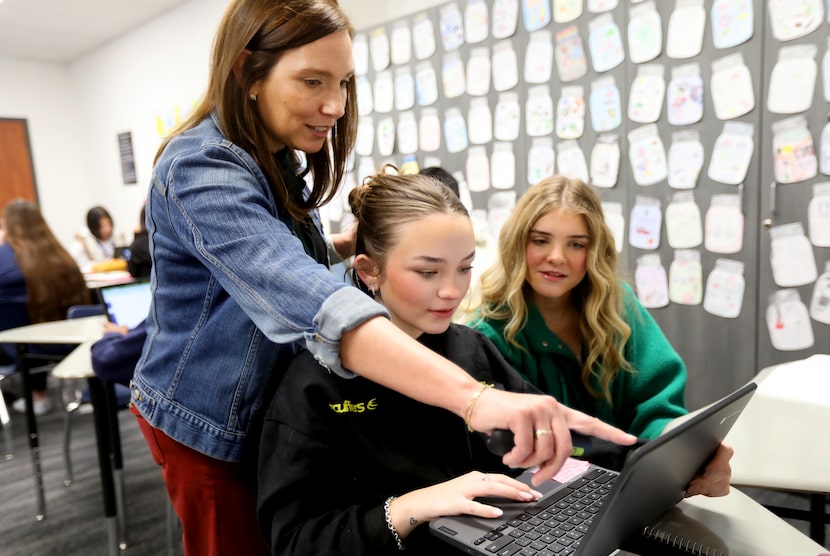
Shelley McClellan, an English teacher at Allen High School helps juniors Emerson Bowdish, left, and Caroline Ruby with a lesson on the American Dream at Allen High School, in Allen, Texas, Tuesday, February 3, 2026.
Anja Schlein / Special Contributor
McClellan, the Allen High School teacher, is part of the first cohort of new teachers to come through the Allen ACT program. McClellan, a former administrative assistant at the high school, expects to finish her certification in May.
McClellan said the program gave her a way back into a career path she’d left years earlier. McClellan started college with plans to be a teacher. But she left school early to work to support her husband while he finished his degree.
When district leaders launched the Allen ACT program in 2024, she hoped it would be a good fit. So she applied and was accepted. Over the next two years, she finished her bachelor’s degree through Indiana Wesleyan University and began working toward her teaching certificate through Teach Worthy, a College Station-based alternative certification provider. As a part of that process, she spent dozens of hours observing star teachers in her school and learning what effective instruction looks like.
At the beginning of this school year, McClellan started work as an English teacher. It was a new experience, she said — although she’d worked in Allen ISD for 16 years when she started the program, she’d never worked in a classroom. Her first day as a classroom teacher felt overwhelming, she said, but the fact that she stepped into the role on the same campus where she’d been working for years made the change more manageable.
“It felt like home, because I’ve been here for the last 10 years, and the faces were all familiar and friendly,” she said.
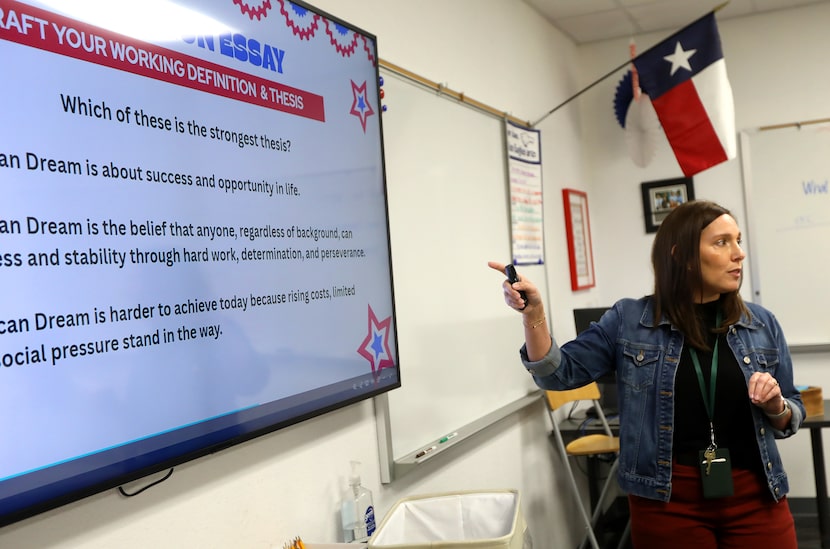
Shelley McClellan, an English teacher at Allen High School leads a talk on the American Dream to juniors at Allen High School, in Allen, Texas, Tuesday, February 3, 2026.
Anja Schlein / Special Contributor
Why teachers certification matters
Research suggests students can suffer academically when they have an uncertified teacher. In a paper published in 2024, researchers at Texas Tech University compared STAAR scores for students with teachers who were uncertified, teachers who got their certifications through an online-only program and teachers who went through more rigorous programs that include classroom experience.
Compared with students whose teachers went through high-quality training programs, students with uncertified teachers tended to gain three to four fewer months of learning per year, and those whose teachers went through a fully-online program gained one to two fewer months of learning per year, researchers found.
But Jason Kirksey, a professor in Texas Tech University’s College of Education and the lead author of the study, said it seems to matter whether an uncertified teacher had experience working in a classroom before they were hired. When districts hire teachers who don’t have a teaching certificate but have some experience working as a classroom aide, students tend not to see the same kinds of learning declines, he said.
While classroom aides may not have experience teaching themselves, they’ve generally worked alongside teachers long enough to learn what good instruction looks like, as well as classroom management techniques, Kirksey said. Often, they also end up working as teachers in the same districts where they previously worked as aides, he said, so they’re already familiar with school procedures and they may already have relationships with some of their students. That gives those teachers an obvious advantage over other teachers with no experience and no teaching certificate.
Related

But that doesn’t mean certification doesn’t matter, Kirksey said. A high-quality teacher certification program offers mentorship and high-quality coursework that connects the theory they learn in their classes to real-world practice, he said. Even novice teachers with years of experience working in classrooms can benefit from that preparation, he said.
That’s why it’s important that districts invest in high-quality training programs for teachers who are working toward certification. Even if those programs involve a bigger investment of time and money, they put new teachers in a better position to succeed in the classroom, he said.
“It’s worth that effort, because at the end of the day, three years from when you put in that effort, you’re going to have more qualified people in classrooms, but you’re also going to have less vacancies,” he said.
Hard work, determination and perseverance
Tuesday morning, after her students finished up their writing assignments, McClellan began talking them through the main assignment of the day: Writing thesis statements for five-paragraph essays defining the American dream. She asked students to think of literary works that highlighted hard work, determination and perseverance.
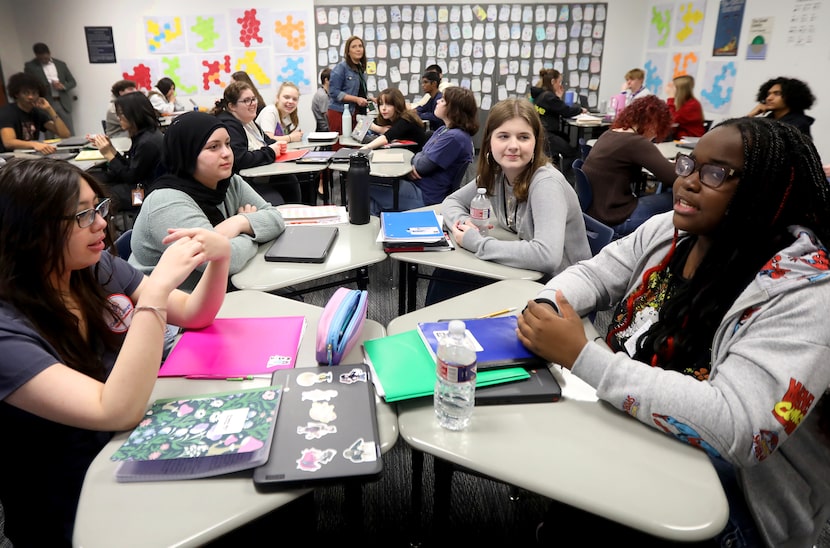
Juniors, from left, Brianna Allred, Nadia Elsayed, Riley Angell and Omolade Ayedun have a discussion as Shelley McClellan, an English teacher at Allen High School leads a talk on the American Dream at Allen High School, in Allen, Texas, Tuesday, February 3, 2026.
Anja Schlein / Special Contributor
One student suggested the Langston Hughes poem “I, Too,” in which Hughes expresses his yearning for an America in which Black people don’t have to be content with second-class status. Another suggested a photo of immigrant families at Ellis Island, coming to America in search of a better life. After a few minutes of group discussion, the students set to work.
As daunting as the idea of changing careers was at first, McClellan said it’s been a good transition. Not that it was without its challenges — even after months of preparation, she didn’t feel completely ready when her students showed up on the first day. But anytime she had questions or ran into problems, there was always someone she could ask.
“No matter what we do, we’re all lifelong learners,” she said. “And we’re always continuing to learn and to grow and to be better at our craft.”
The DMN Education Lab deepens the coverage and conversation about urgent education issues critical to the future of North Texas.
The DMN Education Lab is a community-funded journalism initiative, with support from Bobby and Lottye Lyle, Communities Foundation of Texas, The Dallas Foundation, Dallas Regional Chamber, Deedie Rose, Garrett and Cecilia Boone, Judy and Jim Gibbs, The Meadows Foundation, The Murrell Foundation, Ron and Phyllis Steinhart, Solutions Journalism Network, Southern Methodist University, Sydney Smith Hicks, and the University of Texas at Dallas. The Dallas Morning News retains full editorial control of the Education Lab’s journalism.