
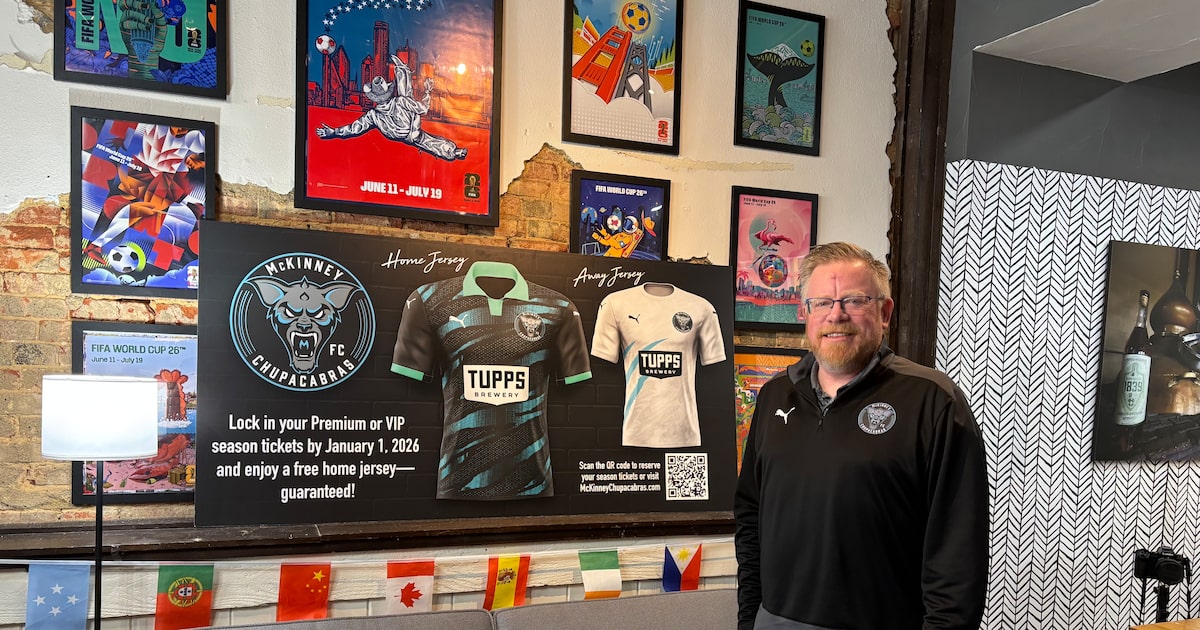
Michael Hitchcock scanned ProRel Soccer Shop for the perfect spot to showcase the striking teal, blue and black jerseys of the soccer club that has captivated the community.
Hitchcock, whose store is in Historic Downtown McKinney, isn’t just a retailer selling kits —he’s the founder of McKinney Chupacabras FC, the USL League Two team that debuted last year and plays its home matches at Ron Poe Stadium.
For a franchise competing in a development league that draws roughly 4,000 fans per game, the club delivered an impressive showing in its inaugural campaign last year.
The Chupacabras averaged 3,479 fans per game in a stadium that seats 7,000, surpassing 20,000 total spectators across six home matches.
Sports Roundup
“That is huge for a first‑year team,” said Hitchcock, reflecting on the club’s early momentum.
The Chupacabras are part of a broader surge of professional soccer clubs in North Texas as the region gears up for the 2026 World Cup.
The world’s biggest sporting event is set to reach historic scale, as it becomes the first hosted across three countries: the United States, Mexico and Canada. It will also mark the debut of an expanded 48‑team format. AT&T Stadium will host nine matches, the most of any venue in the tournament.
Riding this wave of enthusiasm, local investors are jumping into the soccer business, though some wonder whether the bubble will burst.
“I’m not sure it’s a bubble, but I would share some concerns,” said Bob Heere, professor of Sport Entertainment Management at the University of North Texas. “I don’t know if all these teams are going to be viable or get the fan support they need to survive.”
In the United States, professional soccer doesn’t currently follow the traditional tiered system seen throughout most of the world, where leagues are connected and, in theory, a team at the bottom can advance all the way to the top.
The USL is set to launch the nation’s first promotion and relegation system, establishing a fully connected, merit‑driven professional pathway to elevate the competitive standard across every division. The promotion and relegation system will not apply to MLS.
Across the Dallas–Fort Worth area, three professional teams currently operate: FC Dallas (MLS), North Texas SC (MLS NEXT Pro), and Dallas Trinity FC (USL Super League). Two more, Atlético Dallas (USL Championship) and Rodeo Soccer Club in Celina (USL League One), are slated to launch in 2027. USL League Two is considered a semi-professional league.
At the top sits Major League Soccer. It’s the flagship, the place where the biggest crowds gather and the highest salaries are paid. MLS clubs, including Frisco’s FC Dallas, operate in large markets, play in soccer‑specific stadiums and attract international talent.
On the women’s side, the summit is shared. The National Women’s Soccer League and the USL Super League both hold Division I status.
Heere believes the North Texas market is large enough to sustain growth but cautions that success is far from guaranteed.
“With eight‑plus million people, you could hypothetically support the current number of teams,” he said. “I’m not saying they’ll all be successful, but the market is big enough.”
Spreading deep roots
At Atlético Dallas’ headquarters in Richardson, optimism fills the air, even for a team still more than a year away from playing its first match.
The club plans to play at the Cotton Bowl, the historic venue positioned in the heart of a population of nearly 2.5 million.
“There isn’t a professional men’s soccer team in the city of Dallas,” said Matt Valentine, founder of Atlético Dallas. “There’s an MLS team in Frisco, but it’s 35 miles north. The demographics of Dallas suggest strong support for a team actually based in the city, close to downtown.”
The lease agreement with the Cotton Bowl is for the next three years, and the team has plans to build a restaurant and offices right in Fair Park.
In the long term, the club will explore the possibility of having its own stadium.
“Of course, we want to control our stadium, whether that means having control of the Cotton Bowl or a smaller venue,” Valentine said.
In addition to gaining community support, he said that having control of their own venue will be a key part of the team’s success.
“We need a proper soccer stadium that’s the right size and allows us to control all the revenue. Most professional sports teams control their facility in order to be successful”, Valentine said.
Heere believes local teams can stay stable by spreading deep roots in their communities and playing in venues that fit their market size.
“When you have a team in an 80,000‑seat stadium drawing three thousand fans, you’re not creating a positive or fun experience,” he said. “The teams that understand their community are the ones that will survive and thrive.”
A rising tide
That community‑first approach has fueled Hitchcock’s early success in McKinney.
Residents chose the team’s colors, logo, and bold name through a public vote.
“Chupacabras won by a landslide,” Hitchcock said.
The name draws from the legendary Latin American creature, chupacabras, or “goat‑sucker,” said to attack livestock and drain their blood.
Inside ProRel Soccer Shop, multiple screens stream soccer matches. On weekends, the store fills with fans watching Premier League games while sipping the complimentary coffee Hitchcock offers.
Hitchcock credits the rise of soccer in the U.S. largely to the broadcasting of Premier League matches.
A poll by The Economist found that 10% of Americans now identify soccer as their favorite sport, edging out baseball. Only American football and basketball rank higher.
The sport’s growth is also reflected financially. The U.S. Soccer Federation reported revenues exceeding $263 million for the fiscal year ending March 31, 2025. Meanwhile, Cause IQ reports that Texas is home to 419 soccer clubs and leagues, generating more than $161 million annually.
“There has been constant growth for the last 15 years,” Heere said. “It’s not stalling, if anything, it’s accelerating. And that includes women’s soccer. Overall, the sport is doing really well in this nation.”
Dallas Trinity FC is working to capitalize on the growing momentum behind women’s soccer.
The club, which plays its home matches at the Cotton Bowl, is now in its second season in the Gainbridge Super League.
Alongside efforts to strengthen the club’s presence in the community, DTFC’s leadership is actively working to broaden its commercial reach.
On Thursday, the team announced a local broadcasting deal with TEGNA that will bring the remainder of its spring schedule to over-the-air TV or the WFAA+ streaming platform, a move that will significantly boost the club’s visibility. Ten of those games will be televised on Ch. 29.
Building partnerships with key sponsors, fielding a competitive team, and contending for a championship every season are all essential components of the long‑term sustainability strategy the club is putting in place.
“You have to be consistent, you have to be genuine with your message,” Dallas Trinity president Charlie Neil said.
“You can’t just sell for the sake of selling — if you do, you won’t last. We take a lot of pride in putting in the time, effort, and investment to make this work,” Neil said.
In October, Dallas Trinity set a local attendance record for women’s professional sports, drawing 22,838 fans to the inaugural State Fair Clásico against Club America.
The turnout far exceeded the club’s inaugural-season average of 3,500 fans per game.
Neil said the motivation behind launching the first professional women’s team in North Texas was to give the region equal representation and to tap into the undeniable surge in interest surrounding the women’s game.
“With so many young women playing soccer here, Dallas is a great market. If you offer fans a product that’s different, unique, and accessible, and market it well, bring in the right players and tell the right stories, you can build a strong following,” Neil said.
Neil added that the club aims to cultivate a broad fan base, not one limited to women, which is why its outreach efforts extend across the entire community.
That strategy aligns with global trends: a 2023 YouGov poll across 18 international markets found that 88.7% of male fans consider themselves supporters of a women’s football team.
“We want to reach people who can identify with our players’ stories, who connect with the journey of building a club and the entrepreneurial spirit of starting something meaningful,” Neil said.
Community‑driven clubs
Hitchcock’s three decades in the soccer industry, including a stint as FC Dallas general manager from 2005-09, have shaped his approach. Community engagement is central to the Chupacabras’ identity.
In their first season, the club sold 5,000 jerseys, far exceeding expectations.
Chupacabras FC embodies the core philosophy of USL-2, a league that brings together more than 140 clubs across 37 states, each committed to building deep community ties and energizing passionate local fan bases.
Since its founding in 1995, USL League Two has served as a cornerstone of the American player‑development pathway, providing top pre‑professional and collegiate athletes with a national platform to showcase their talent and launch their careers.
“The fans have decided everything along this journey, that’s been the key for us,” Hitchcock said. “If you make it hyperlocal, meaningful, authentic, and great entertainment value, people would support something good in their community.”
Meanwhile, Atlético Dallas is preparing for its 2027 debut from its headquarters in Richardson.
The road has been bumpy. The club initially planned to play in Garland, but the agreement collapsed at the last minute. The Cotton Bowl stepped in, offering a home for a team aiming to be more than a neighborhood club.
With Dallas County as its target market, Atlético Dallas hopes to draw 10,000 fans per game in its first season.
“We don’t describe ourselves as a niche market club”, said Brian Corcoran, the club’s sporting director. “We’ve said since day one that we’re a club for all. We want to attract every passionate football fan who wants to be part of our club and feel they belong. That’s our target.”
Still, Heere warns that not every team will thrive.
“Yes, North Texas is a big market with plenty of people,” he said. “But that doesn’t mean these teams will successfully market themselves, find an identity, or connect with fans. There will be winners and losers. Some teams will find their place, and others will probably fail.”
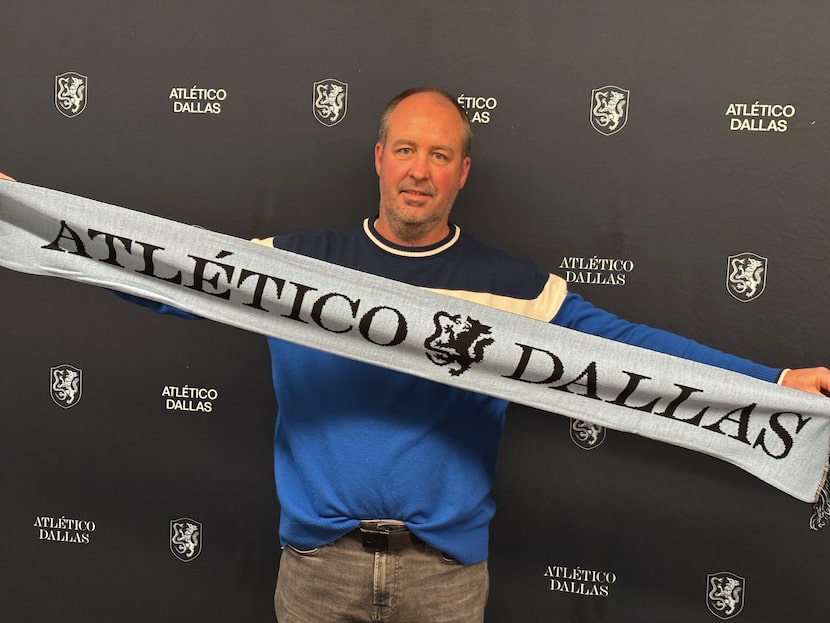
Brian Corcoran, Atlético Dallas sporting director, at the club’s headquarters in Richardson on January 14, 2026.
Abraham Nudelstejer
 National Signing Day 2026: Dallas-area high school signees, recruiting news and more
See the Dallas-Fort Worth signees and recruits going to Texas and Oklahoma colleges.
 Boys soccer leaders (2/4): See who has the best stats in D-FW
Standouts from Frisco Liberty and Sunnyvale lead the individual categories.
 See the hundreds of Dallas-area athletes who are signing for all sports
Wednesday is the first day of the regular signing period for football.