
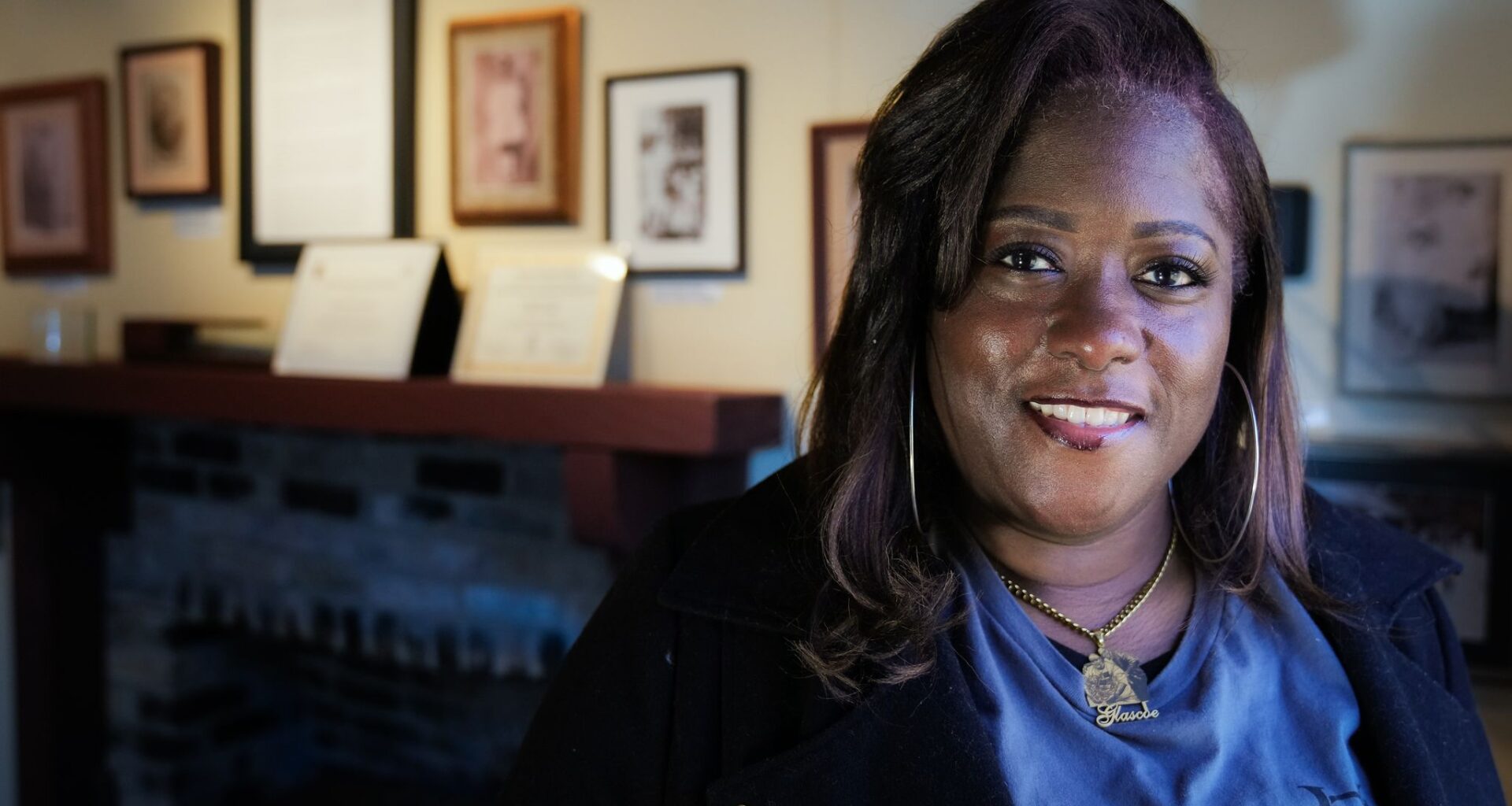
Felecia Miller at the Haskell House in Clarksville, Jan. 31, 2026. The house is the oldest documented residence in the historic district and one of the only remaining original structures from the area — one of Austin’s original Black neighborhoods. Miller is a descendant of original residents of the home, Hezekiah Haskell and his family.
Sara Diggins/Austin American-Statesman
Felecia Miller stands inside the board-and-batten house built in 1876 by a former slave named Peter Tucker.

Later, it was owned and occupied by her third-great-grandfather, Hezekiah Haskell, a Buffalo Soldier who had previously been a renter or boarder in the house.
Article continues below this ad
Head of the Clarksville Community Development Corporation, Felecia Miller, gazes out of the window at the community garden in back of the Haskell House in Clarksville, Neighbors rent inexpensive plots in the garden to tend.
Sara Diggins/Austin American-Statesman
The thin but sturdy walls of the Haskell House at 1705 Waterston Ave. in the historically African American Clarksville neighborhood are covered with framed pictures of her Austin ancestors.
Out the back window of what is now a city museum —Miller speaks convincingly of its haunted past — spreads a community garden bursting with winter harvest: spinach, cabbage, turnip greens.
Beyond that abundant view is her paternal grandmother’s house, where she played as a child.
Article continues below this ad
A tiny addition to the Haskell House — “about the size of a finger snap” Miller joked — waits out back.
In past days, the house’s residents sang on the front porch. Each song was passed along the narrow streets from porch to porch until the whole neighborhood sang in harmony.
“The bell at Sweet Home Missionary Baptist Church rang to let people know when someone had passed,” Miller said. “If we had nothing else, we had our faith.”
Article continues below this ad
Clarksville then and now
Head of the Clarksville Community Development Corporation, Felecia Miller, explains people pictured in photographs on the walls of the Haskell House in Clarksville.
Sara Diggins/Austin American-Statesman
Miller lives in Buda, but she remembers Clarksville, a former freedom colony west of downtown Austin, as the lively Black neighborhood of her youth.
While Clarksville is primarily known these days as an upscale district, at times, remnants of the historical community vigor return.
Article continues below this ad
On this day, for instance, a charity pie auction at a community hall brought Clarksville descendants back to the area between West Lynn Street and MoPac — the freeway that, during the 1970s, chopped off a third of the African American homes from the area.
At other times, reunions and funerals fill Sweet Home, a simple, dignified building and historic anchor for the community. Like many urban churches, the regular congregation has dwindled to a fraction of its peak 50 years ago.
Nearby Clarksville Colored School once echoed with children’s voices, but it was closed by the city and left vacant while students were bussed to integrate white schools. The city later opened Mary Frances Baylor Clarksville Park, named after a leading local activist and advocate for the community, on the land.
Other reminders of Clarksville’s past are sprinkled among the deep gullies, small lots and rebuilt houses in what is still, despite soaring property values, an eclectic area, at least stylistically.
Article continues below this ad
Nowadays, it is less affordable and almost entirely shorn of descendants of the independent, land-owning African Americans drawn here following emancipation, soon after the colony was founded in 1871.
Felecia Miller sits at the meeting table in the Haskell House in Clarksville, formerly a freedom colony for emancipated slaves.
Sara Diggins/Austin American-Statesman
Miller, 46, remembers area shops from her childhood, by then, none of them were owned by African Americans. Earlier in Clarksville history, some neighbors sold staples from family stores attached to houses. As in almost all early communities, informal trade would have been widespread.
If water-powered mills were constructed on Johnson Creek and its nameless tributaries — one of them, almost always dry these days, Miller and friends just called “the creek” — ready evidence of them has disappeared.
Article continues below this ad
Always returning, Miller now serves as chairwoman of the Clarksville Community Development Corporation, a nonprofit that protects the area’s historic architecture, while also offering affordable housing in Clarksville.
Felecia Miller’s affiliations were divided in childhood. Her mother, Mattie Sneed and her maternal grandparents lived in East Austin. Her father, Floyd Glascoe, who worked for the city, was her primary tie to Clarksville.
Although she attends the Greater Galilee Missionary Baptist Church in Elgin, Miller grew up at Clarksville’s Sweet Home Missionary Baptist Church where she sang in the choir, led at that time by community advocate Pauline Brown.
She still feels nostalgic about the gatherings at Sweet Home and elsewhere in the neighborhood.
Article continues below this ad
“Sunday morning, everyone went to church,” Miller said. “At 12:30, we went home. Then we’d return to the former campus of Clarksville Elementary. We’d play basketball, foursquare, kickball, 60 or more of us every Sunday — kids, adults, aunts, uncles. A great time was had by all.”
From plantation to freedom colony
Felecia Miller at the Haskell House in Clarksville.
Sara Diggins/Austin American-Statesman
These days, that warm feeling of community returns during special events and annual family reunions, which can attract as many as 300 descendants of the original residents of Clarksville, the settlement that emerged from land bordering the southwestern stretches of the Pease Plantation.
Article continues below this ad
Gov. Elisha Pease (1812-1883), an educated man who originally immigrated from the northeast, prospered in Austin. While he worked in various levels of government, he ran a 365-acre plantation with an estimated 30 to 40 enslaved people, which encompassed districts west of Shoal Creek. In 1853, the pro-Union politician was elected governor of Texas, and after the Civil War, he was appointed governor again by Gen. Philip Sheridan.
Woodlawn, his two-story Greek Revival house at 6 Niles Road, was constructed by enslaved people under the direction of master builder Abner Cook, and shared with his wife, Lucadia Christiana Niles Pease and their family. It has been beautifully restored, yet the identity of its current owner remains a public mystery.
The Pease family gave the land for Pease Park to the city on Aug. 25, 1875.
Before that, in 1871, Charles Griffin Clark, a formerly enslaved man from Mississippi who lived in Travis County, purchased two acres of land from Nathan Shelley, a former Confederate general. That land formed the heart of Clarksville.
Article continues below this ad
A book documenting historic Clarksville is displayed at the Haskell House in Clarksville.
Sara Diggins/Austin American-Statesman
“Here’s the really sad part,” Miller said. “We don’t know what happened to Charles. He had a son as well.”
Many freedom colonies were racially mixed. After the 1928 urban plan designated a six-mile-square portion of East Austin as the “Negro District” — to concentrate amenities such as schools, clinics and libraries according to Jim Crow segregation laws — Clarksville and other Austin-area freedom colonies survived in some form or another.
Sometimes that meant a church or two or a segregated elementary school run by Travis County. At other times, it manifested as a few scattered, mostly elderly residents. In some such districts, cemeteries rich with history fell into neglect, only to be rediscovered in the 21st century.
Article continues below this ad
Even as city leaders attempted to force or entice Black residents to East Austin, Clarksville hung on longer than most. It did so without paved roads and indoor plumbing, things that the city government withheld to convince residents to sell out.
“We stood our ground,” Miller said. “Even with a crosstown expressway (that) was designed to cut right through the middle of Clarksville. We had our independence, which Black people outside the freedom colonies did not have.”
The waning of a community
Felecia Miller describes the neighborhood and how it’s changed since her youth, looking out the back window of the Haskell House in Clarksville.
Sara Diggins/Austin American-Statesman
Well into the 1990s, Miller recalls that the majority of Clarksville residents were African American.
Article continues below this ad
“The houses were small,” Miller said. “To some extent, a majority of Black people still lived off the land.”
At Haskell House, other ancestral threads are woven all around her. One photo shows Hezekiah with his wife, Catherine Smith Haskell, and a child, which Miller identifies as her second-great-grandmother, Maggie Haskell.
Her memories of her paternal grandmother’s property behind the Haskell House are more concrete. There she threw rocks in a huge well before it was covered by a wooden shell.
Reunions there would spill over into the gardens of the Haskell House. A few relatives are still scattered through the neighborhood; an aunt, for instance, lives in one of Clarksville’s affordable housing units.
Article continues below this ad
The Clarksville Community Development Corporation, which Miller now chairs, was created in 1978 to acquire, protect and manage properties that would keep longtime residents and descendants in the community as Mopac encroached from the west, and upscale renovations spread from the more Victorian Old West Austin east of West Lynn Street.
At one point, access to the program, though available to many, was mostly taken up by descendants who occupied the properties.
What about previous age requirement that stated for eligibility, you must have at least one child 18 or younger living in the home?
“Though the requirement was with good intent, it created a challenge for descendants that wanted to return back to Clarksville that did not have children.” Miller said. “It also created challenges for descendants who were now of age, whose children were now adults with their own households.”
Article continues below this ad
The Clarksville documentary
This photograph is of Hezekiah Haskell and his family, among the original residents of the home and Felecia Miller’s ancestors.
Sara Diggins/Austin American-Statesman
One of the most insightful sources of tales about the neighborhood is the documentary, “The Haskell House and the Story of Clarksville,” produced and directed by longtime broadcast journalist and video producer Judy Maggio. She did so in part at the behest of the Austin Parks and Recreation Department, which runs the museum inside the oldest house in Clarksville.
One of the enduring characters in this movie is Kye Haskell, a curmudgeonly man set in his ways. He lived in Haskell House without electricity and just a kerosene lamp well into the 1960s and ‘70s. The neighborhood kids loved to purloin fruit from his trees, but “Uncle Kye” was vigilant and loudly chased them from his yard.
Article continues below this ad
When he died in 1976, his heirs deeded the shabby, one-room house with double “Cumberland-style” doors to the city, which planned to move or demolish it. According to multiple sources, including a story in the American-Statesman, Kye’s spirit prevented the move.
“There was a guy working construction, and he went to put the house on a crane,” said Sheila Ray, a Haskell family descendant, in the documentary. “When he got ready to put house on crane, my Uncle Kye visited him the night before at his house. He told him: ‘Boy, leave my house alone.’ The guy thought he was dreaming or whatever.
“The next day, the guy was getting ready to the pull house away. He didn’t do it. Kye slammed him against the wall, and threw a threat on him. And to this day, that house has not been moved, and it will not be moved, because Uncle Kye came from the grave and said ‘Do not move my house!’”
Black Clarksville refused to budge
Head of the Clarksville Community Development Corporation, Felecia Miller, looks out of the window at the community garden in back of the Haskell House in Clarksville,
Sara Diggins/Austin American-Statesman
Historian and tour guide Harrison Eppright described life in Clarksville as at the “subsistence” level.
Article continues below this ad
“They were farmers, or domestics, Eppright said. “They grew their own produce, raised their own livestock. After the 1928 Plan, most Clarksville families didn’t budge. Even though there were no sidewalks. No sewers. All the surrounding neighborhoods had them.”
Other than the church, another community center from the 1880s through the 1960s was the Clarksville Colored School. It was closed during the push for integration in 1965, and its students were sent to nearby Mathews Elementary.
What gave the residents resilience was, in part, the specific history of the place.
“This idea of people who were enslaved finally getting this chance to have their own freedom,” said community historian Stephanie Lang in the documentary, “and what that meant to them: To have their children living free, and having land, and going where they wanted to go and doing the work they want to do.
Article continues below this ad
“The power of that is in the soil. It’s not going anywhere.”
One plan almost killed Clarksville altogether. The Crosstown Expressway, first proposed in the early 1960s, mapped out a freeway along 15th street, but then zig-zagged through the heart of Clarksville.
Powerful women like Mary Frances Baylor, director of the Clarksville Neighborhood Center, and Pauline Brown, who wrote a key memoir of the era, allied with Congressman Jake Pickle, fought the expressway and won.
(Hannah Michael, a Ph.D. student in African and African Diaspora Studies at the University of Texas, has thoroughly researched the Black women’s activism in Clarksville for her dissertation project, surely to be published.)
Article continues below this ad
One of the residual issues of contention is the name of the community itself.
During the 1970s, as counter-cultural youth filled the old Victorian homes east of West Lynn Street, the name “Clarksville” expanded, for them, to include what is Old West Austin. (Perhaps the popularity of the pop song, “Last Train to Clarksville” played a part.) Some residents insist on wrapping the Clarksville mantle around Old West Austin, situated between North Lamar and West Lynn.
“It undoes all the history of Clarksville,” Miller said of the practice, “and why it was started, and all the fighting to keep its identity.”
While descendants, academics and political advocates do what they can to keep the flame of Clarksville alive, some institutions never went away.
Article continues below this ad
The Haskell House in Clarksville, Jan. 31, 2026. The house is the oldest documented residence in the historic district and one of the only remaining original structures from the area, one of Austin’s original Black neighborhoods.
Sara Diggins/Austin American-Statesman
Sweet Home Missionary Baptist Church, which conducted its early services inside Haskell House, remains a cornerstone, a center for meeting, strength, unity, community. People travel from all over Central Texas for services.
“When I walk into Sweet Home, it feels like all my ancestors wrap their arms around me,” said Hattie Harris in the documentary. “Where I sit now is where my mother sat, and I feel like she’s giving me a big hug, and all my ancestors are giving me a big hug.”
Every September a two-day family reunion bleeds into Austin Museum Day, when the Haskell House and its gardens are filled with Clarksville descendants.
Article continues below this ad
“Sweet Home is still my church,” Miller said. “If something should happen to me, hold the service at Sweet Home.
“As long as I have breath in me, I will advocate for Clarksville.”