
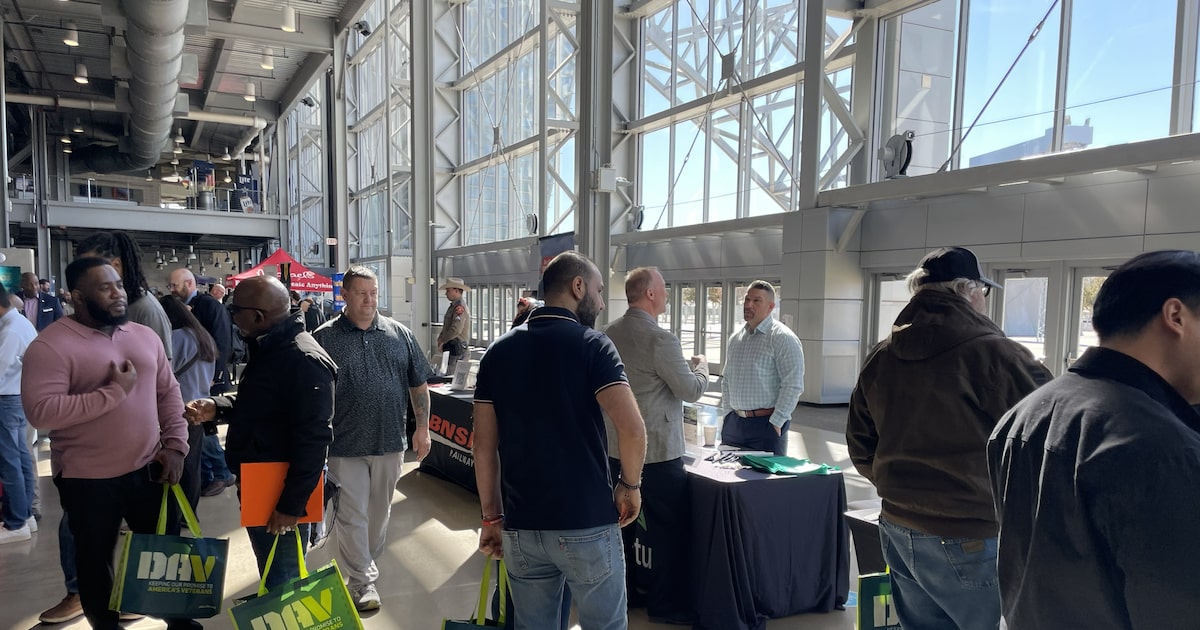
Air Force reservist Jay Crosby has attended enough job fairs in the past few months to tell when people are genuinely trying to help veterans. At some events, he said, the process feels impersonal.
As he walked the concourse at AT&T Stadium during a recent veterans job fair, Crosby said the experience felt different. The organizers had him build an online profile, contacted him before the event, and made sure his information reached employers. Recruiters, he said, seemed better prepared and more focused on what veterans like him could offer their companies. It all felt like a place where his military service was an asset, not an afterthought.
“I feel like the organization that puts this on is serious about helping vets get involved,” Crosby said.
Scenes like this are becoming more common in North Texas, where employers are increasingly turning to military veterans to fill key roles in a tight labor market. With 15 major military installations and over 1.5 million service members, Texas boasts the largest veteran population nationwide, according to the Texas Workforce Commission.
Breaking News
Each year, between 22,000 and 25,000 veterans — spanning former active duty, Army Reserve, National Guard, and Coast Guard personnel — return to or remain in Texas after their service concludes, according to the workforce commission estimates. Between April 2024 through the end of March 2025, the veteran unemployment rate remained lower than nonveteran unemployment, state data shows.
Related
Altogether, veteran employment matters in North Texas, as millions of new residents are expected to move to North Texas by 2050 to fill hundreds of thousands of jobs as businesses flock to the region and employees retire, according to workforce advocates. Employers say veterans possess leadership, time‑management and mission‑focused work habits that transfer across industries. Those skills are honed by the constant need to adapt in the military.
At the Dallas Veterans Job Fair hosted by Disabled American Veterans (DAV) and RecruitMilitary in Arlington, hundreds of former service members filed past booths for banks, law enforcement, and health care, among other industries, seeking careers that match their skills and sense of purpose. Organizers said more than 1,000 candidates registered for the event and more than 60 employers signed on, underscoring the scale of demand on both sides of the hiring table.
For many veterans at the fair, the pitch to employers starts with adaptability. Former Army Capt. Joshua Kane, who served six years as a military police officer, now works as a financial adviser at Northwestern Mutual. He said veterans’ value begins with their adaptability.
“They’re given a mission and they’re given mission parameters, but it never goes that way,” he said.
Veterans also understand the chain of command, deadlines and standard operating procedures, Kane said, which means employers don’t have to teach time management or self‑regulation from scratch. “If you hire this 22-year-old that’s done four years in the military, I know he’s gonna show up to work on time. … I know he’s probably gonna stick to the rules,” he said.
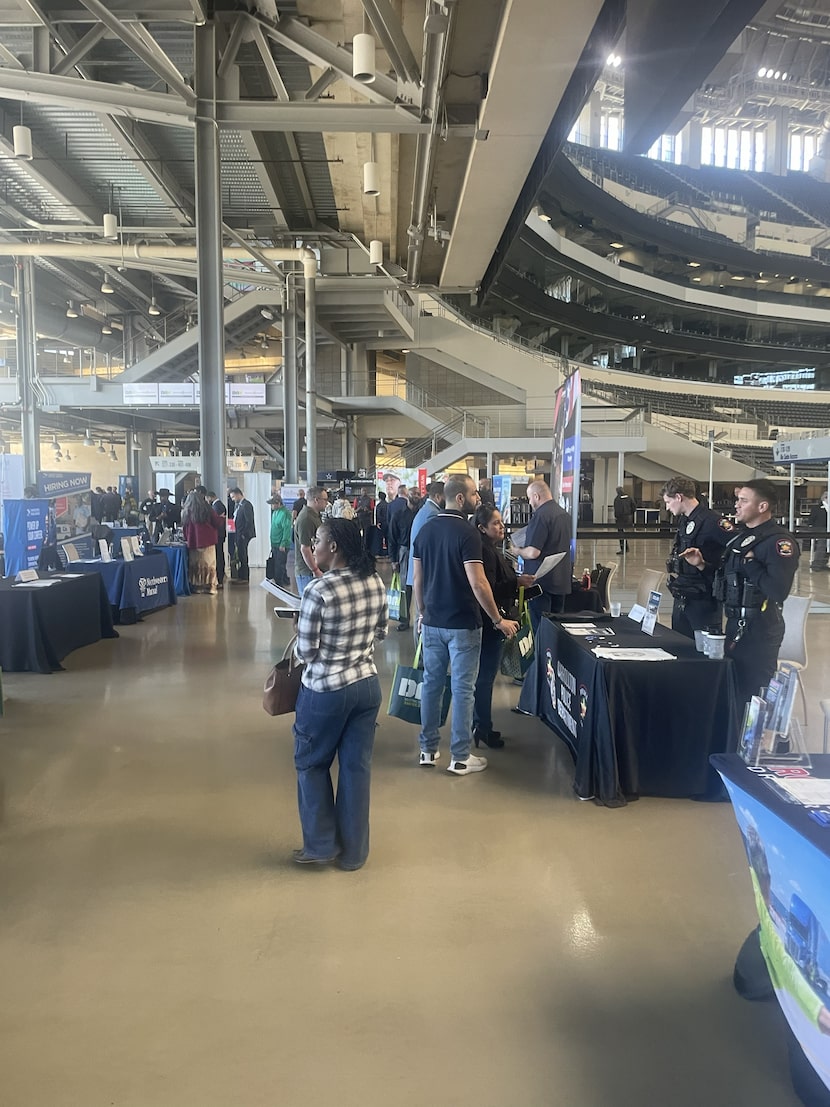
Job seekers mingle with recruiters during the DAV and RecruitMilitary job fair in Arlington on Thursday, Feb. 6, 2026, as employers look to connect with veterans for roles in the North Texas workforce.
Wilborn P. Nobles III
For retired Air Force 1st Sgt. Windy Cox, who spent 24 years in the military before moving back to Texas and pursuing work in human resources, the message is that veterans are trained leaders used to operating in high-stress environments. She said they bring loyalty, a strong sense of commitment and extensive people-management experience, even when their resumes don’t read like traditional corporate HR.
“We were given leadership training from early on and continued that through our career,” she said.
Employers say those traits can be more important than whether a veteran has held a nearly identical civilian job. Dwight Kirkpatrick, a former Army master sergeant who now works at Bank of America, described the transition from being “top of the food chain” in uniform to “one of a million” civilian job seekers.
Related

What he realized, Kirkpatrick said, is that leadership, operations and people skills are “life skills” that carry over anywhere.
“If you have a manager and you’re not a good leader, you feel that. Doesn’t matter what the job is,” he said. “You can put me somewhere where I don’t even know the job. … I can lead people, because we know how to take care of people.”
For veterans, Kirkpatrick’s advice is to remember they’ve managed million-dollar equipment and complex projects before. “The battlefield gets shifted. Still do the same thing you do … what they hire you to do is get stuff done,” he said.
Several veterans at the fair said the job market remains challenging, especially in saturated fields like information technology and business analysis, and that employers sometimes treat veteran outreach as a box to check.
Army veteran Dominique Hansberry, who has struggled to land IT and analyst roles since moving to North Texas two years ago, urged recruiters to see veterans as more than a number. At one speed-networking event, he said, some companies talked a good game about valuing veterans, but “it’s all a facade” once the event ends.
Hansberry wants employers to invest the time to really understand candidates’ military experience, and he encourages his peers to bring patience and a realistic view of the market. “On the civilian side, that’s not always the case” that doing everything right guarantees a result, he said.
Related
Still, Crosby said the Dallas fair showed what can happen when the system is built around veterans rather than expecting them to navigate alone. He praised organizers for detailed profiles, proactive outreach and a network that felt serious about veteran hiring, saying he’d tell other former service members to make full use of events like this.
“There’s a lot of us … looking for either new work or adjacent work or better work,” he said. “If any veteran was to read this, use the resources.”
For veterans interested in attending future job fairs, and access to additional no-cost resources, go to jobs.dav.org.
This reporting is part of the Future of North Texas, a community-funded journalism initiative supported by the Commit Partnership, Communities Foundation of Texas, The Dallas Foundation, the Dallas Mavericks, the Dallas Regional Chamber, Deedie Rose, Lisa and Charles Siegel, the McCune-Losinger Family Fund, The Meadows Foundation, the Perot Foundation, the United Way of Metropolitan Dallas and the University of Texas at Dallas. The News retains full editorial control of this coverage.