
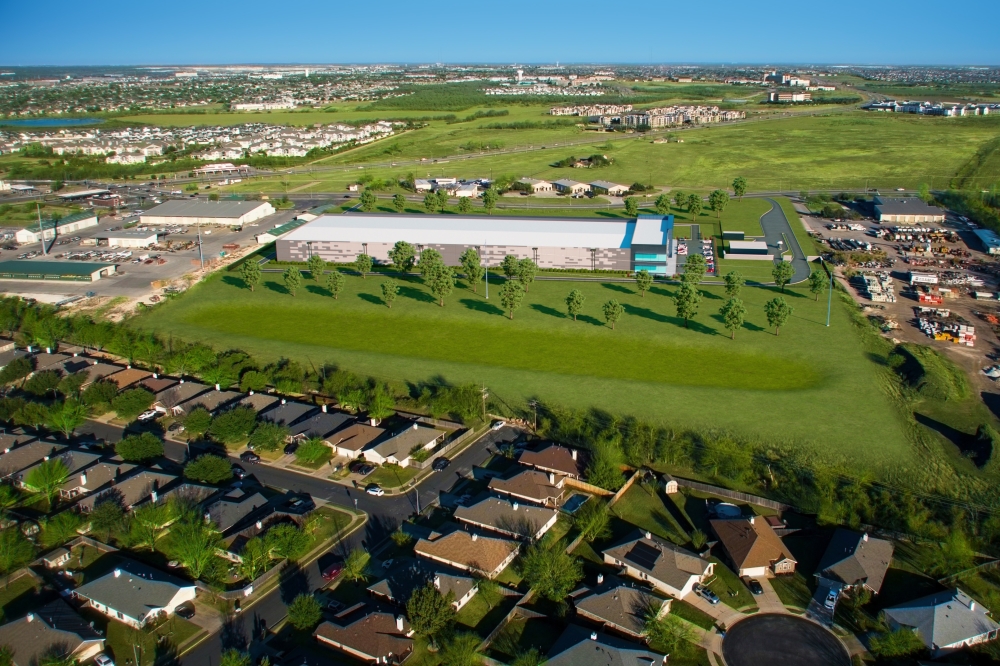
Amid a statewide surge in demand for digital infrastructure, a Skybox data center is proposed for a property near East Old Settlers Boulevard and A.W. Grimes Boulevard in Round Rock.
The property also backs up to the Chandler Creek neighborhood, prompting concerns among some residents. Among the concerns are noise pollution, and energy and water consumption on the property, which is zoned for light industrial use but is under consideration for a zoning change. Some have asked that the land be considered for other uses, such as residential or multifamily.
“We do have to figure out the highest and best uses of land, and currently that is zoned light industrial,” Mayor Pro Tem Kristin Stevens said. “We just have to make that decision. Unfortunately, it’s not zoned residential.”
The proposed data center is one of many in Williamson County and throughout Central Texas, promising to yield a large amount of property tax revenue for cities.
The big picture
If approved, the Round Rock Skybox data center would be one of at least seven confirmed data centers in various stages of development in Central Texas, including two in Pflugerville and two in Hutto.
Dave Porter, executive director of the Williamson County Economic Development Partnership, said location along the I-35 technology corridor and proximity to companies such as Dell Technologies and Nvidia are powerful draws for data center developers and chip manufacturers.
While the area is known for technology industry activity, Porter says its future may be that of an “AI corridor.”
“I think what is conducive is a pro-business environment, which Williamson County is,” Porter said. “We have lots of land available, and then you have the workforce to go with it. So those three components really are a win-win-win for Williamson County.”
“>
The discussion
Mark Noonan, senior vice president of the east for Sabey Data Centers, said Sabey has worked to be a transparent community partner and good steward of resources.
“There has been a lot in the news about some of these bigger projects that have tried to go in the dark of night, being very quiet about who it is, [using] project names and not engaging the community,” Noonan said. “We’re the opposite.”
Noonan said Sabey did not receive much pushback when it entered the community nearby.
Haynes Strader, chief development officer for Skybox, said the Round Rock facility is the company’s first to receive significant opposition.
In their words
Marshall Dungan said he learned of the Skybox proposal through his homeowners association, characterizing the city’s effort to engage residents as “lackluster.”
He also said he’s skeptical of the benefit tax dollars generated by the project would have, as well as the financial impact of any needed electrical infrastructure or increased usage by Skybox.
“Skybox is getting a great deal and the people who are giving them that great deal are doing it at the cost of the actual residents around it,” Dungan said.
Pamela Oldham shared similar concerns. She suggested that the city implement a moratorium on data centers until an ordinance with “community-first safeguards” could be created.
“>
The city reached out to the nearby HOA, posted signage and held public meetings regarding the rezoning proposal. The state requires cities to notify residents within 200 feet from the property, and the city of Round Rock expanded its notifications to 325 feet.
Representatives of Skybox and the regional power delivery company say the proposed development would not have the impacts to health, water and electric utilities residents have highlighted.
Armando Perez, a spokesperson for Oncor Electric Delivery, said the introduction of a data center is unlikely to result in rate increases for residents, as the company separates customers based on rate classes.
The peak statewide demand of the Electric Reliability Council of Texas is now about 85 GW. The grid operator expects that to nearly double in a few years, largely led by data centers. In response to the data center rush, state lawmakers passed Senate Bill 6 this year to enact new standards for customers requesting to connect 75 MW or more.
While some facilities use different cooling methods that require more water, the proposed Skybox center would use closed-loop cooling, which would require about 20,000 gallons of water to charge. City staff said this is equivalent to the annual water usage of about 15 single-family homes.
The local impact
Round Rock officials said in December that the data center model provides large amounts of property tax revenue to benefit operations of the city, school district and other taxing entities within a relatively small footprint. The proposed site for Skybox would be equivalent to about 100 homes of property tax revenue, city staff said.
Data centers also require low cost of city services, staff said, such as police and fire.
“On a per-acre basis, it’s tough to find something that provides more value to the city and to the general fund than a data center,” said Bradley Dushkin, Round Rock’s planning and development services director.
Mayor Craig Morgan also said the city’s level of valuable commercial property means city tax revenue is largely supported by such development. This keeps taxes lower for homeowners, he said.
“93% of our properties are residential; 7% is commercial,” Morgan said. “Almost 48% of [property] tax revenue comes from those big companies.”
Regarding resident concerns, staff said existing data centers have not been shown to produce water contaminants and that Skybox will be required to pay for any electric improvements and the full load of power needed, per state law.
What to expect
As for the future of Skybox, Round Rock City Council will take up the rezoning request again Feb. 12.
Should the request be denied, property owner Zydeco Development confirmed that plans are in place to build a 385,000-square-foot warehouse and distribution center on the site, which is zoned for light industrial use.
“I think there’s just a lack of understanding that the site has been zoned for this for a while, but development is coming,” Strader said. “You have the opportunity to shut down a data center project if we don’t get the vote of the City Council, but industrial development is by right.”