
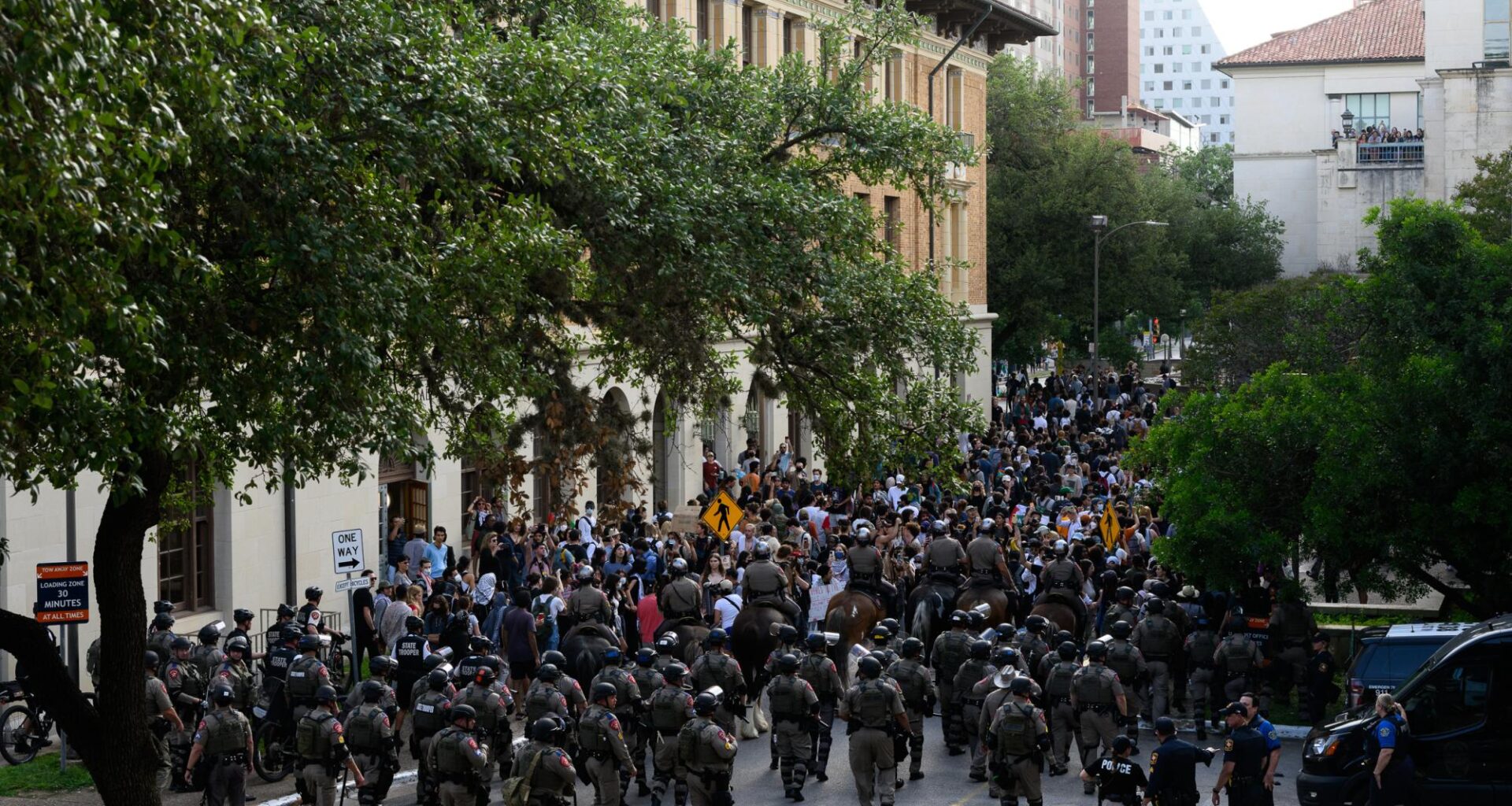
A lawsuit filed in April 2025 related to the University’s treatment of students expressing support for Palestine will advance in federal court after a judge ruled that University administrators may have violated the students’ First Amendment rights, according to a Jan. 27 court order.
Two UT students and two alumni who were arrested in 2024 at a planned protest about Palestine brought the lawsuit against law enforcement officers, the University, the UT System Board of Regents and Gov. Greg Abbott last year. The protest was hosted by UT’s Palestine Solidarity Committee in April 2024 as pro-Palestinian protests and encampments spread across college campuses nationwide. After UT preemptively cancelled the protest, state and local law enforcement mobilized on campus, leading to 57 arrests.
The plaintiffs, who were among those arrested, allege that university administrators, law enforcement officers and politicians, including Abbott, discriminated against them based on viewpoints they expressed about Israel’s military campaign in Gaza, which they view as a genocide.
“We didn’t get everything we asked for,” said Christopher Godshall-Bennett, an attorney representing the plaintiffs. “But the fact that this goes forward is a sign that says the University’s power here is not unlimited.”
The judge’s order dismissed claims made against most of the defendants in the lawsuit, including Abbott and several law enforcement officers. However, Kevin Eltife, chairman of the UT System Board of Regents, and current UT President Jim Davis remain as defendants, and the free speech elements of the case will go forward.
Joe Larsen, an attorney and board member of the Freedom of Information Foundation of Texas, said the judge’s decision is a “significant victory” for the former and current students.
“It’s the kind of opinion we should be happy to see coming from our jurists, as it’s a well-studied and not in any way a particularly partisan opinion,” he said.
Caro Achar, an engagement coordinator at the ACLU of Texas, said the University has continued to stifle free speech on college campuses and contributed toward a chilling effect in the protests’ aftermath.
“Free speech as a right is essential, and it is important to defend even when you disagree with what someone is saying,” she said. “We’re seeing a real infringement on what people are allowed to express, what people are allowed to learn, what people are allowed to engage in, what clubs people are allowed to join.”
University spokesperson Mike Rosen said in an email that UT is reviewing the order.
The lawsuit will now enter into a discovery phase, during which much-needed answers about the mass arrests may be obtained through the depositions of University officials and law enforcement officers involved in the arrests, Larsen said.
“Ultimately, after this, I wouldn’t be surprised if there are motions for summary judgment to keep it from having to go into a jury,” he said.
Though the lawsuit is far from over, Larsen believes it will influence related lawsuits, including one brought by Ammer Qadummi, the first student to be arrested at the April 24, 2024 protest and a member of UT’s Palestine Solidarity Committee. The University suspended Qadummi for three semesters, and his lawsuit is ongoing.
“All the courts that are dealing with these issues will certainly read this opinion,” Larsen said.