
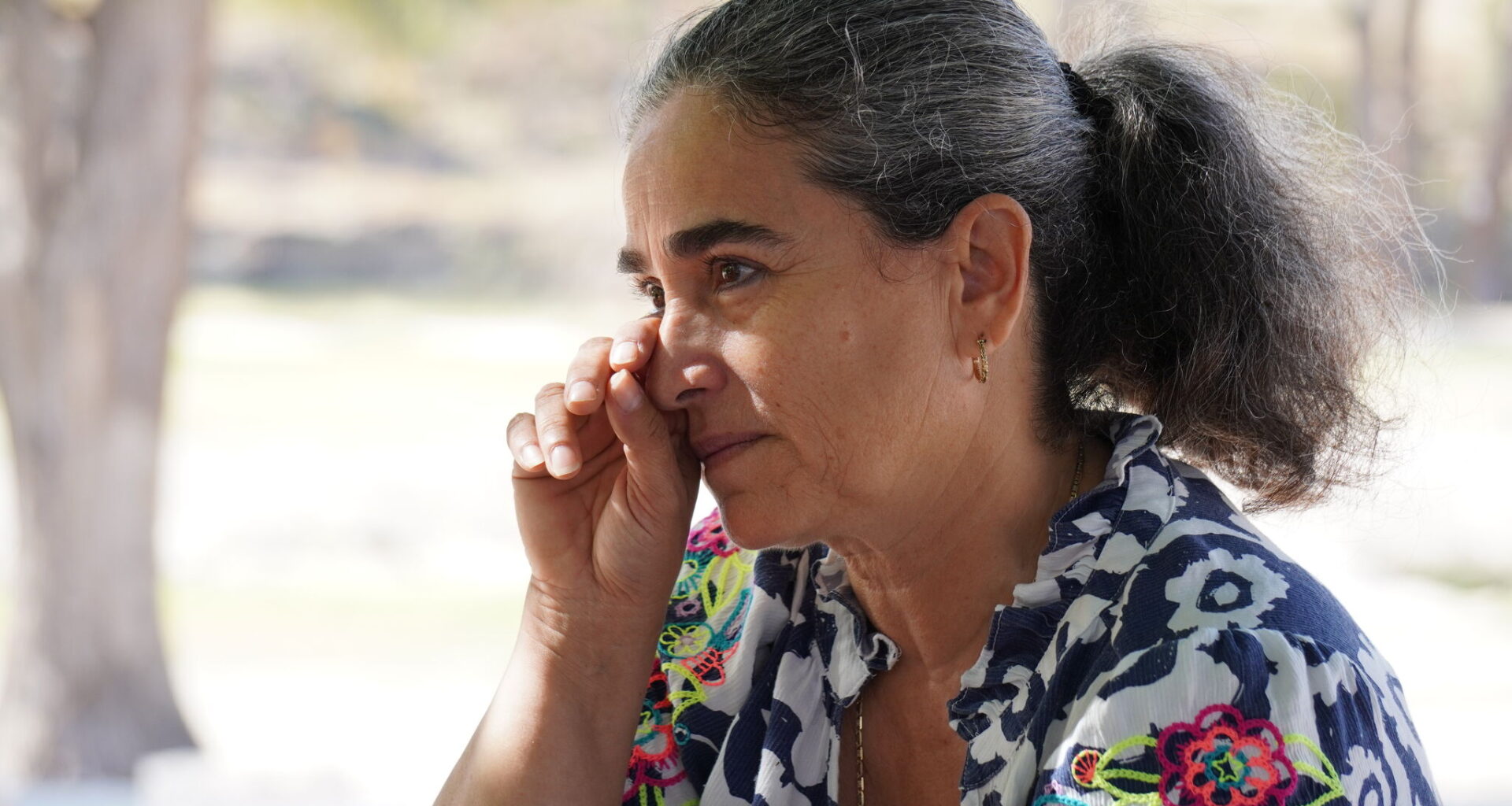
Lorena Guillen, co-owner of the Blue Oak RV Park in Ingram, about 110 miles west of Austin, becomes emotional as she recalls the night of July 4, when four RV tenants were swept away by historic flooding. She spoke while sitting at her restaurant, Howdy’s Bar and Chill, overlooking the Guadalupe River.
Megan Weise/Texas State University
KERRVILLE — A riverside RV park once meant to fund Lorena Guillen’s retirement is now shuttered for good after July 4 flooding killed four people at Blue Oak RV Park and devastated the family-run business.

Guillen and her husband purchased the park — just feet from the typically tranquil Guadalupe River — as a retirement investment built on steady cash flow. That plan collapsed when a deadly flood swept through the property during the July 4 weekend.
Article continues below this ad
Four people staying at Blue Oak were killed in the flooding, part of a Texas Hill Country disaster that claimed at least 135 lives overall and left entire riverside communities in ruins.
Guillen’s loss reflects a broader reckoning after the floods, which exposed vulnerabilities at riverside youth camps, RV parks and campgrounds. While Texas lawmakers have since passed new safety legislation, survivors say disaster relief has been uneven — often favoring homeowners over small businesses and low-income residents.
“If there’s another 40-foot flood again, knowing that there’s nobody here, I’ll be able to sleep,” Guillen said. “And I don’t think I’ll survive another flood like this.”
She’s been trying to obtain a Small Business Administration loan to rebuild after more than $2 million in damage, but the federal agency has denied her three times due to lack of collateral. After the most recent denial, she suffered a heart attack and collapsed on the floor of an SBA office.
Article continues below this ad
After a short hospital stay, Guillen recovered physically, but the remaining emotional and financial strains have forced Blue Oak RV Park — and likely its adjoining restaurant — to close permanently.
“We lost our revenue. We lost our income,” Guillen said. “The two businesses together, it was perfect, but the restaurant alone can’t pay that big mortgage.”
Guillen’s restaurant, Howdy’s Bar and Chill, nestled next to the RV park, is a cozy, classic Texas honky-tonk, where ’80s country music plays over the speakers and the walls are covered from floor to ceiling with relics from the community. Much of the food is made from Guillen’s own recipes.
On the night of the flood, residents of the RV park gathered at the restaurant to kick off the holiday with beer, music and family. During the flood, the restaurant became a refuge, where people evacuated with nothing but a beloved pet or clothes they grabbed from their RVs before they were whisked away.
Article continues below this ad
“We did a headcount, and I knew exactly who we had missing,” Guillen said. “At that point, a third wave came, and it went inside the restaurant.”
‘It was such a beautiful day’
The Burgess family arrived at Blue Oak on July 3 to pick up their daughter from camp.
“The kids were so excited,” Guillen said. “Their dog was so excited. It was such a beautiful day.”
Article continues below this ad
Hours later, John Burgess was wading through floodwater with his 1- and 3-year-old sons in his arms, with his wife following behind.
Guillen tried to get the firefighters on scene to help them, but instead her husband, Bob Canales, tied a rope around his waist to try and reach the family.
“My husband said, ‘Throw me your baby,’” Guillen recalled. “He didn’t do it. And a second later, the second wave came, and it took the family, and all four of them died.”
Uprooted cabins, cars and RVs from the camp upriver rushed past Blue Oak, with people still inside, honking their horns and screaming for help as they crashed into trees. Guillen could feel electricity from fallen power lines humming through the water.
Article continues below this ad
The firefighters were on scene but did not assist with the attempted rescue of the Burgess family or any others, she said.
“They never had the sirens on. They didn’t knock on anybody’s door,” Guillen said. “My husband was desperately trying to get them to.”
Guillen also lost one of her employees, Julian Ryan, that night. He bled to death in his driveway from injuries while trying to save his family, she said.
“I can’t be here that much because of my anxiety. My stress starts going crazy,” Guillen said. “Before, I used to work 16-hour days, seven days a week, and that was my normal, and I loved it. Now, I can barely come here for a couple of days out of the week, because it’s just too much.”
Article continues below this ad
Waiting for relief
More than $100 million has been donated to Hill Country flood relief, with donors such as the Dallas Cowboys, Buc-ee’s and George Strait, whose relief concert raised funds. Less than three weeks after the flood, the Community Foundation of the Texas Hill Country announced it had raised $60 million through its Kerr County Flood Relief Fund.
She says the community’s response has been outstanding, but the distribution of the relief funds appears to have bypassed her business, as well as some lower-income residents.
She received enough donations to rebuild her parking lot but has otherwise received little aid, she said.
Article continues below this ad
“There was so much money donated — where is it?” Guillen asked. “They’re going to start helping with the homes, which is great, but a lot of these are second or third homes, vacation homes, summer homes.”
“Obviously, everybody has the right to get their house fixed no matter what. But start with the low-income first,” she said.
Nearly a third of the July 4 flood deaths occurred in youth camps, RV parks and campgrounds.
Texas lawmakers passed Senate Bill 1, also known as Heaven’s 27 Camp Safety Act, to revamp the safety procedures for youth camps. RV parks and campsites are addressed in the bill, but most of the requirements apply to youth camps.
Article continues below this ad
The bill requires sites with cabins or sleeping quarters located within a 100-year floodplain to have an evacuation plan in place, as well as escape ladders.
Andrew Parks, committee director for the state Senate Committee on Water, Agriculture and Rural Affairs and the Texas Senate Select Committee on Disaster Preparedness and Flooding, said that the evacuation plan requirement was born from an experience at Camp La Junta, a youth camp downriver from Camp Mystic on the South Fork of the Guadalupe River.
“They had one cabin that was in the floodplain, and the water was rushing in too fast,” Parks said. “They couldn’t get out so, they climbed up into the rafters of the cabin and hung on while the wave came through.”
The Texas Association of Campground Owners has helped RV park owners get back on their feet after the flood, including raising nearly $30,000 through GoFundMe.
Article continues below this ad
“We have a PR firm that we work with, and we decided to do a series of press releases, basically indicating that, hey, the Hill Country is open for business,” said Brian Schaeffer, executive director and CEO of TACO.
“Unfortunately, the media sort of paints big swaths of Texas, like, oh, you don’t go there. It’s all been flooded out. There’s nothing left, which isn’t true,” Shaeffer said.
Although Guillen will not reopen Blue Oak, she believes SB 1 will help in future floods.
Article continues below this ad
“Anything that they can learn from this flood is important,” Guillen said. “But I think it’s also very important that they come and ask us, the people that went through it, because unless you’ve lived it, you have no idea what it is.”
This story was produced in partnership with the American-Statesman and the School of Journalism and Mass Communication at Texas State University.