
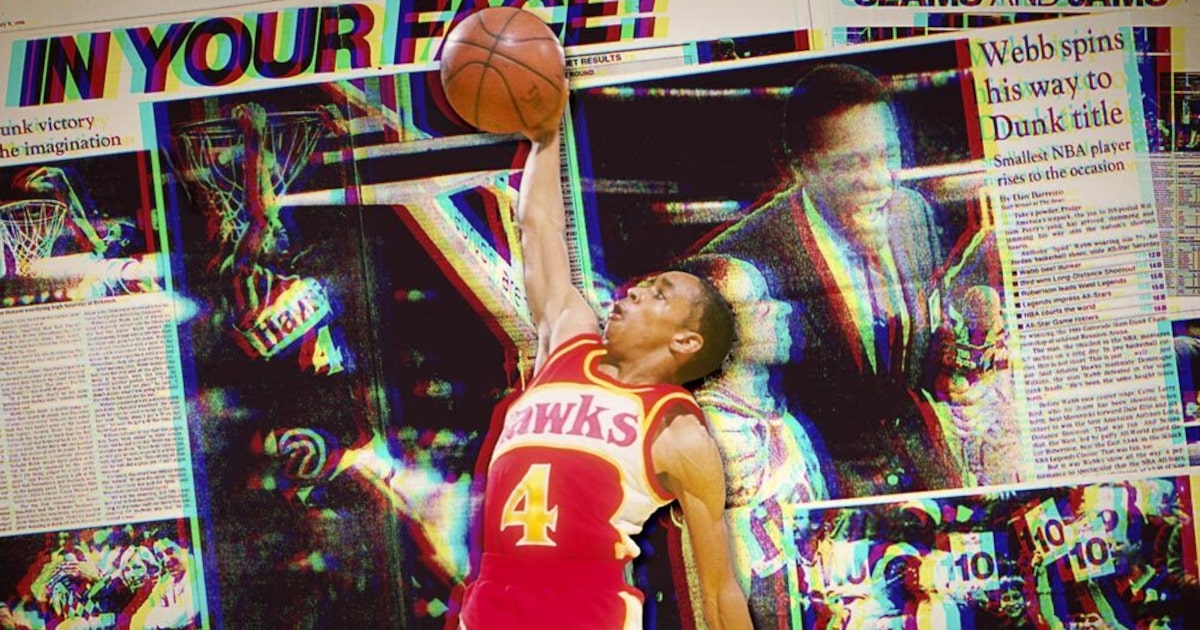
First thing Spud Webb did after learning he’d sub for Michael Jordan in the slam dunk contest at the 1986 All-Star game was fly to Los Angeles for the “Tonight Show.” For such a little guy, he was a big hit. Cracked up Johnny Carson when asked how a 5-7 guard high-fived teammates who loomed over him like streetlights. Leaning down from his seat to sweep his right hand past his feet, which barely reached the floor, Spud told Johnny they invented the “low-five.”
Next he helicoptered from Burbank to LAX for his flight to Dallas and stayed up all night at the Hyatt. Took a shuttle over to Reunion the next morning, and the security guard said nuh-uh.
Thought he was a schoolkid trying to sneak in.
Welcome home, Spud.
Mavericks
Before the Feb. 8 weekend was out, not only would security know the pride of Wilmer-Hutchins, the wide-eyed world had a pretty good idea. Spud’s gravity-defying win over his Atlanta teammate, Dominique Wilkins, “The Human Highlight Film,” electrified the home crowd and shocked his NBA peers, who had no idea he had so much lift in his leap.
The imagination of his dunks was a revelation as big as the elevation. No one 40 years ago played pitch-and-catch with themselves at that altitude. He whirled, he reversed, he double-pumped. He climbed so high, one dunk clunked his head and bounced up and out of the rim. And when he finally came down, the verdict was clear.
Even His Airness could only tip his crown afterward.
“I couldn’t have done what he did,” Jordan said.
No one is ever likely to top the tale of Anthony “Spud” Webb, whose rise from obscurity led him from Wilmer-Hutchins to Midland College to North Carolina State, the NBA and everlasting glory.
Spud had no idea what the slam dunk contest would do for him, nor did he care. He wanted to play basketball, not star in a circus. He’d rather be remembered as someone who spent 12 seasons in the league, averaging 68 games a year. He was prouder that he once led the league in free throw percentage, at 93.4.
Just the same, he wanted to win when he went back to Dallas.
“Lose at home,” he said last week, “and people remember that forever.”
We remember, Spud.
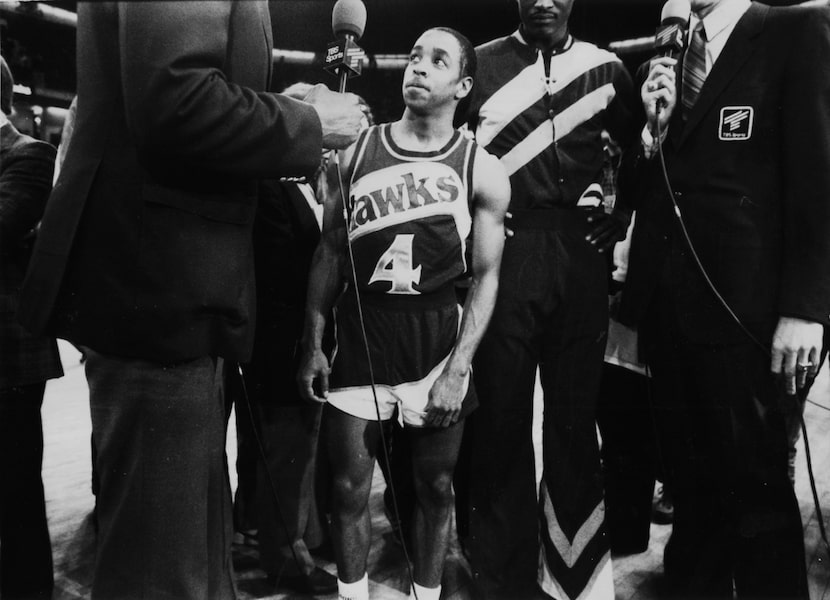
Spud Webb looks up at interviewers after winning the NBA All-Star weekend Slam-Dunk competition on Feb. 8, 1986.
Paul Brown/The Dallas Morning News
‘Spud was the people’s choice’
No sooner had David and Katie Webb gotten home with their new baby boy in 1963 than he’d acquired his curious nickname. With a head shaped like the ‘50s era Soviet satellite that green-flagged the space race, he was Sputnik, then Spud, for short. He came by his size honestly. His father, who ran Webb Soul Mart in the shadow of the Cotton Bowl, was 5-6; his mother, maybe 5-2.
Growing up, if you want to call it that, Spud learned to live with the jokes. Even at the slam dunk competition.
“He’s been the same height since birth,” Dominique Wilkins told reporters.
Spud held his own at rec centers and on the playground, but his coaches rarely believed in him. His leaping ability – measured at 42 inches at NC State, though he believes he got as high as 46 – didn’t make up for his lack of height in their eyes. He didn’t make the varsity at Wilmer-Hutchins until his senior year, when he averaged 30 points a game on a district champ.
And still all anyone could see was the top of his head.
“I was probably about 5-4,” he said. “At least that’s what I’d tell scouts just to get ‘em to come out and watch me.
“Probably more like 4-11.”
He likes to think he was at least 5-4 the first time he dunked in a game, which happened to be Wilmer-Hutchins’ opener his senior year, against Fort Worth Dunbar, the state’s top-ranked team.
A breakaway.
“Pretty sure the crowd went nuts,” he said.
What makes it even more impressive in retrospect was that his hands were so small, he couldn’t palm the ball.
Still can’t.
“I wish I could palm the ball,” he said. “I could have done a lot more dunks.”
He commanded Wilmer-Hutchins’ offense and played in local all-star games, but no one was interested except Jerry Stone, the Midland College coach. By the time Midland advanced to the national JUCO tournament in Hutchinson, Kan., so many of his teammates had dropped out, they needed the manager just to scrimmage. The Chaparrals won a national title with nine guys, and still no one wanted their best player.
Take that back: Bill Blakeley was interested, but he’d just lost his job at North Texas. Fortunately, he had a friend, Tom Abatemarco, an NC State assistant, who’d just lost his top prospect, Kenny Hutchinson, to Arkansas. Abatemarco knew his boss, Jim Valvano, would be upset if he came back home without a guard after the defending national champs lost Dereck Whittenburg and Sydney Lowe to the NBA.
Blakeley took his pal to a summer league game near Fair Park where Spud lit it up. Abatemarco bought him a seat next to his to Raleigh, where Valvano gave the new kid a once-over, then turned to his assistant.
“If this is Spud Webb,” he said, “you’re fired.”
Valvano warmed up to Spud, who, once again, held his own in a league where MJ played down the road. The Globetrotters wanted Spud after college, but Blakeley sent him instead for a little USBL seasoning at Rhode Island, where his roommate was 7-7 Manute Bol. Made for good photo ops, anyway.
Detroit took Spud in the fourth round of the ‘85 draft but cut him before he showed up. He got a free agent shot with Atlanta, where he was borderline to make the team when an elbow to the face sent him to the emergency room. Came back with 40 stitches in his mouth and told his coach, Doc Rivers, he was ready to go.
Dominique told Rivers they’d be nuts to cut him. Next thing you know, he’s starting the opener, the first NBA game he’d ever seen in person.
Which brings us to the weekend of the ‘86 slam dunk contest at Reunion. He’d planned to go all along, only on a ticket, not as a competitor. He’d figured on going home, resting a sore right ankle and visiting family. But, when Jordan pulled out because of an injury, Stan Kasten, the Hawks’ general manager, thought it would be cute if the league’s tiniest player went home and jumped in the dunk tank.
Not everyone thought it was such a great idea. Rivers told him not to do it. Worried he might embarrass himself in front of the homefolk.
In Doc’s defense, he had no reason to think otherwise. It’s not like Spud showed off his hops in practice.
“A lot of guys on the team didn’t even know I could dunk like that,” Spud said. “We didn’t dunk after practice or anything like that.”
Never challenged Dominique?
“Probably would have lost,” he said.
But you beat him in the finals.
“Probably the only time I ever would have beat him. It was just the variety of the dunks, and a guy my size doing them.”
First, of course, he had to get in the building. Caught a shuttle from the Hyatt across the street to the arena with Byron Hunter, who’d known Spud since high school. Hunter knew his way around because he worked a security detail for Don and Linda Carter, the Mavs’ original owners.
“I walked in with Spud,” Hunter told me last week, “and the guards want to know who this guy with me is and how they’re ashamed that I’m trying to sneak him into the arena.”
Not until Hunter flagged down a league official was Spud finally cleared for takeoff. Believe it or not, he didn’t have a flight plan. He didn’t decide what dunks he’d use until the ref handed him the basketball. Hadn’t practiced anything in months.
For a little context, the dunk contest, the bright idea of Rick Welts, then a rising exec in the NBA and now the Mavs’ CEO, was only in its third year and still a draw of the league’s elite. Larry Nance won the first one in ‘84, beating out a field that included Dr. J. Dominique won in ‘85, the first of his two titles. Jordan won back-to-back after Spud.
Besides Spud and Dominique, the ‘86 field featured Roy Hinson, Terry Tyler, Jerome Kersey, Paul Pressey, Terence Stansbury and Dominique’s little brother, Gerald. Spud led in points after two rounds with a repertoire that included 360-degree jams; a reverse double-pump; a straight-ahead double, and a jackknife.
By the time Spud made the finals against Dominique, the packed house had already cast its vote.
“Spud was the people’s choice,” former Celtic Dave Cowens, one of the five judges, said afterward. “We tried to be as fair as we could, but I don’t know how he could have lost it.”
Cowens and the other four judges – NBA greats Cazzie Russell and Satch Sanders, as well as Roger Staubach and Martina Navratilova – gave Dominique and Spud perfect 50s on their first tries. On his second, Dominique pulled off a savage windmill, the same dunk that had earned a perfect score the year before and won him the title. This time, he got a 48.
For his final attempt at the title, Spud decided on a rainbow lob in which the ball would bounce in the lane, then off the glass. If all went according to plan, he’d arrive at the rim roughly the same time the ball was coming off the boards, at which point he’d pick it with one hand and flush it.
By the way, he bounced the ball because he couldn’t palm it, remember?
Final score: Five 10s.
Staubach, who knew a Hail Mary when he saw one, told reporters he gave Spud “a little edge in creativity … We knew that the fans wanted Spud to win, but we had to be sure that he deserved it.”
Dominique had no complaints.
“Everybody likes to see a little guy do well, especially a little guy with talent,” he said afterward. “But, putting that all aside, he still did a great job.
“I can’t argue with that.”
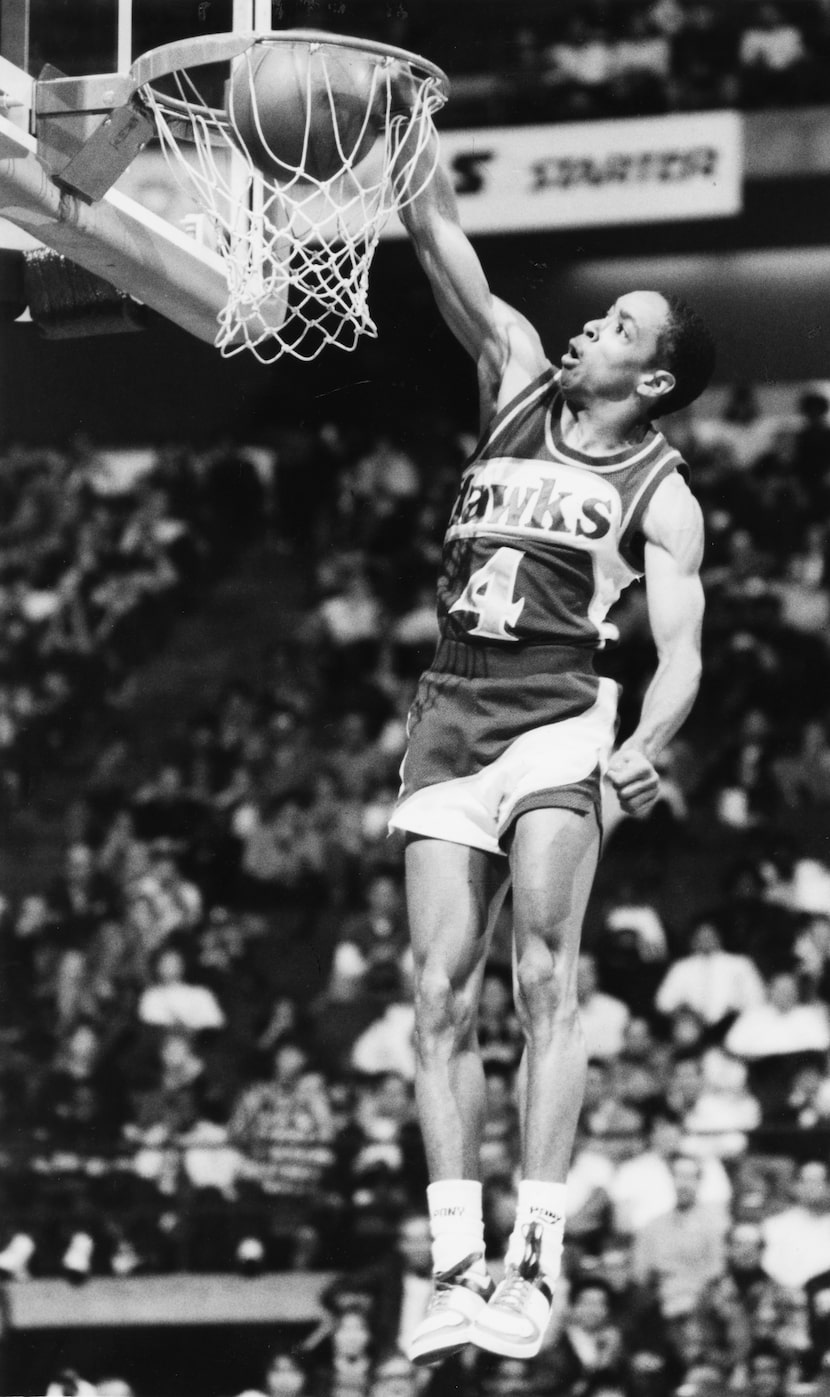
Spud Webb dunks in the 1986 NBA slam dunk contest at Reunion Arena in Dallas.
The Dallas Morning News
For his title, Spud received a check for $12,500, which is good money when you’re making the NBA minimum of $75,000. His only side money until that weekend was a one-year deal with Pony, which provided warm-ups and his size-8 shoes. Within six months, Robin Blakeley, his agent and Bill’s son, had negotiated a dozen national endorsements. The media response was overwhelming. The Dallas Morning News devoted two-and-a-half pages to his exploits, and it mushroomed from there. “Sports Illustrated,” “Time,” “Newsweek,” “Ebony” and “ABC World News Tonight” requested interviews. He did Arsenio Hall and turned down David Letterman.
A Hollywood producer called the next week about doing his life story. Every few years, someone calls. A documentary is in the works now, as a matter of fact.
Not that Spud gets too worked up about it.
“He was such a reluctant star,” Blakeley told me. “He doesn’t understand why anybody would want to talk to him.”
Spud still inspires 40 years later
When I finally got Spud on the phone last week, he was on the golf course. At 62, he’s officially the president of basketball operations for the Texas Legends, the Mavs’ G League affiliate in Frisco. But mostly he plays golf. He’s not as good as he used to be. All those landings have taken a toll. He’s had scopes on both knees. A hip replacement. But he’s still a 10 handicap.
He’s heavier now than he was as a player – when he went a buck-fifty, at most – but people still recognize him. Most say they saw him win the title in person, which he doubts.
“Reunion don’t hold no 200,000 people,” he said, chuckling.
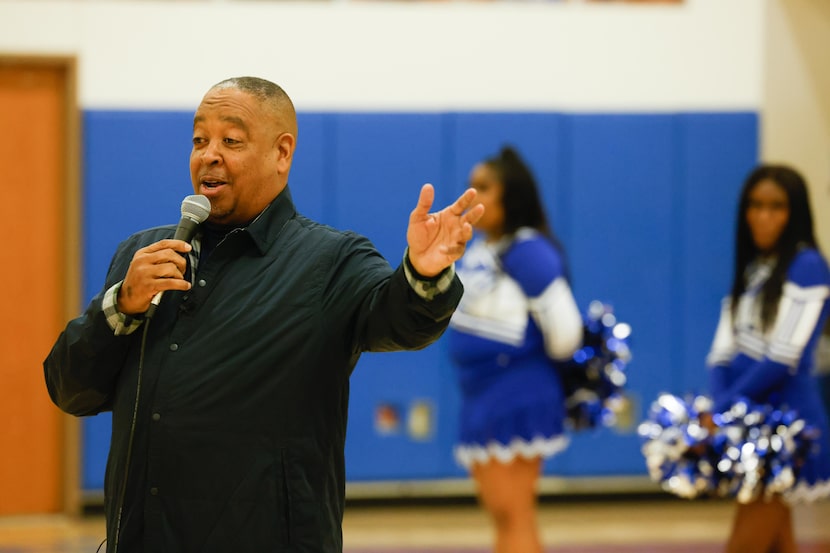
Former NBA basketball player Michael Anthony Jerome “Spud” Webb during halftime ceremony for his jersey retirement at Wilmer Hutchins High School in Dallas on January 25, 2022.
Lola Gomez / Staff Photographer
One guy said he’d always told his wife he was too small to play basketball, and Spud had messed up his excuse.
“I guess that’s a compliment, right?” he said.
The people who don’t know Spud’s story are filled in quickly by others only too happy to do so. The reaction is the same as it was 40 years ago.
“They’re shocked,” Spud said of the newbies. “They’re so used to seeing those tall guys dunking. You can see the whole room sizing you up. They’re thinking, ‘If he played, I could have played.’ Even some of the guys who play now.
“‘No way you won the dunk contest.’”
You can look it up. What a weekend. First he makes Johnny Carson laugh, then he’s center stage at Reunion.
David in a gym full of Goliaths.
One last thing, Spud:
How tall are you really?
“I’m 5-7, I guess,“ he said. “That’s what my license says.”
Twitter/X: @KSherringtonDMN
Find more Mavericks coverage from The Dallas Morning News here.