

The team is developing a wearable, real-time heart monitoring sensor that utilizes
nanoparticles, artificial intelligence and quantum phenomena.
CREATORS

As wearable devices such as smartwatches, smart rings and artificial intelligence
(AI) glasses have become more commonplace, the interest in accurately gathering and
tracking health data has continued to grow. Alongside that growth has been a desire
for wearable devices to be more subtle and less intrusive to people’s daily lives.
A team from Texas Tech University’s Edward E. Whitacre Jr. College of Engineering hopes to continue this trend after receiving a National Institute of General Medical
Sciences grant of over $580,000 to fund a four-year project: developing a wearable
magnetic sensor that utilizes machine learning models for accurate and predictive
monitoring.
The project is led by Kai Wu, assistant professor in the Department of Electrical & Computer Engineering, and Minxiang “Glenn” Zeng, assistant professor in the Department of Chemical Engineering.

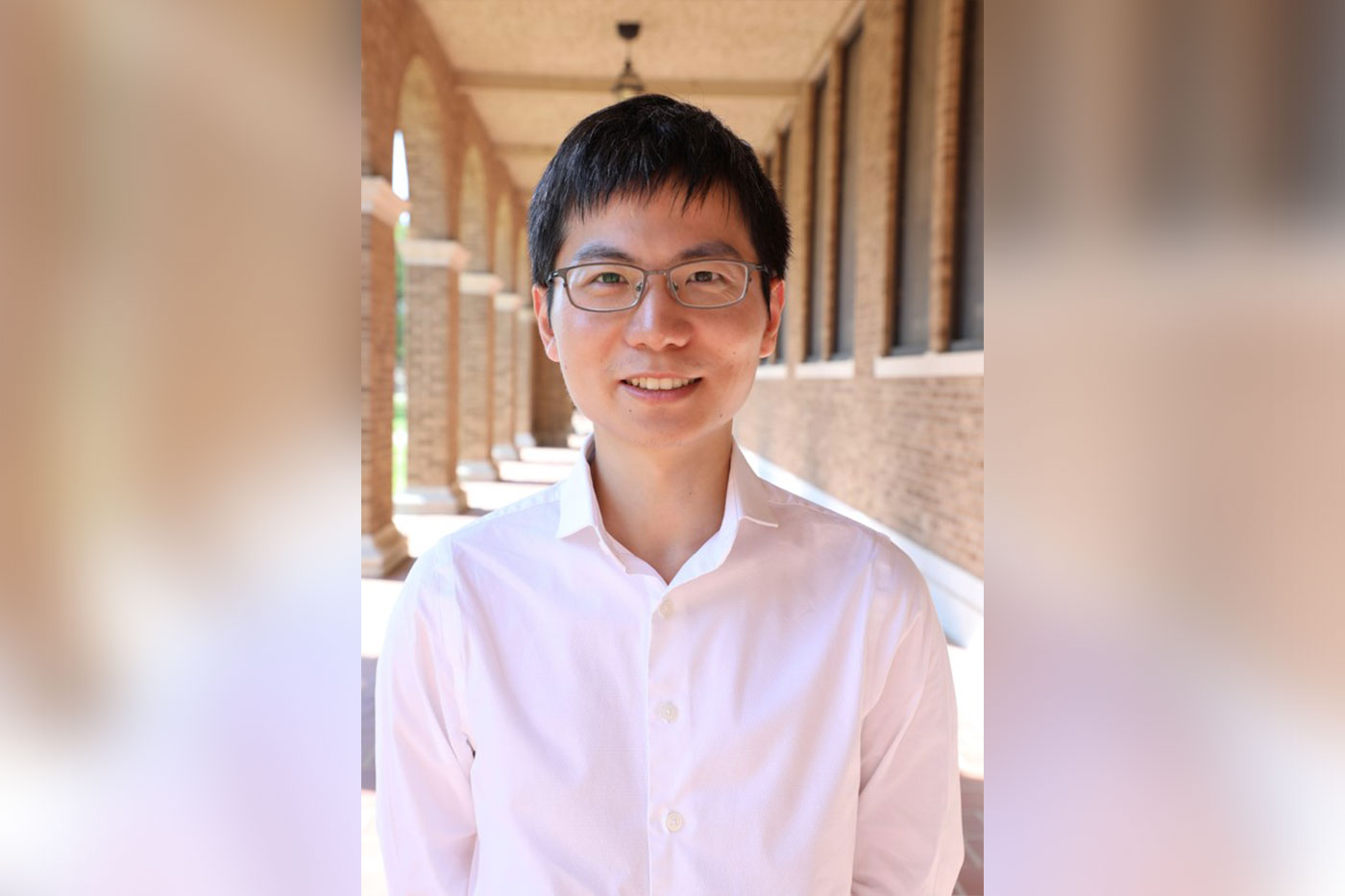 Kai Wu and Minxiang “Glenn” Zeng
This novel sensor combines nanoparticles and materials and polymers to create a lightweight
sensor that easily adheres and adjusts to wherever it is placed.
“The bio sensor would be like a temporary tattoo that can stick on a person’s chest,”
Wu said. “It’s non-invasive, wearable and won’t cause any abnormal or uncomfortable
feelings for a user.”
The sensor would monitor cardiac activity and better predict and distinguish more
than 10 types of abnormal heartbeats. This, Wu said, would be especially important
for patients after cardiovascular surgery who would want 24-hour monitoring of their
heart activity.
Traditional heart monitoring devices record electrocardiograms (ECG) that measure
electrical activity in a person’s heart. More advanced tools like magnetocardiography
(MCG) detect the tiny magnetic fields generated by the heart. While ECGs are more
readily accessible, they may not show the full picture of a person’s cardiac health;
meanwhile, MCGs provide more accurate readings but are limited in terms of commercial
use because they rely on large and expensive equipment.
The project aims to address this conundrum and bring advanced cardiac monitoring directly
to people through the development of granular magnetoresistive sensors.
The sensors would rely on two quantum phenomena occurring between the nanoparticles
and polymers of the sensor: tunneling and hopping. Tunneling occurs when a particle
passes through a potential energy barrier that it should not be able to cross. Hopping
occurs when a particle transitions between quantum states with the assistance of thermal
energy.
“Based on the magnetic field produced by the human heart, we can convert the field
into the voltage signal from the sensor itself, and we can do 24-hour recordings of
the signals from the sensor,” Wu said.
AI, specifically machine learning models, will be vital in analyzing such a large
amount of data and giving users real-time monitoring of their heart’s condition.
“Take a smartwatch, like the one I’m wearing,” Wu said, raising his arm to show the
square shape of the popular device. “It can monitor a person’s heartbeat, but it does
not involve AI to say what condition a person is going through, right? These devices
can only tell you what your heart rate is. But the AI algorithm, combined with the
wearable sensor, could provide more information if a person is going to suffer from
some specific abnormal heartbeat.”
Wu said a motivating factor behind this project is the end-user’s experience, and
this extends to the cost of the eventual sensor, too.
To create the sensors, the team will use 3D printing, a first for Wu. Over the last
10 years, Wu has developed sensors using advanced nanofabrication facilities. 3D printing
will not only help keep the development costs down but also could play a big factor
in future commercialization and accessibility.
Wu said he sees this new sensor as helping address an imbalance of resources in health
care, especially for rural patients who often must drive hours for specialized medical
care.
“3D printing is not only cheaper, but it can print the sensor very fast,” he said.
“We can mass produce the sensor in large volumes, which would also cut down on costs.
This would be a big benefit for people in rural or resource-limited areas.”
As excited as Wu is for future cardiovascular patients who may one day wear this device,
he is equally excited for the opportunity to take on this challenge that combines
3D printed sensors, quantum phenomena and artificial intelligence.
“We are converting some theoretical work from the books into real-life application
that can benefit the whole of humanity,” he said. “If you had told me 10 years ago
that I could use quantum physics to benefit human beings in health care, I would have
said that’s crazy. But now, I’m trying to use quantum phenomena and 3D printing to
benefit health care.”