
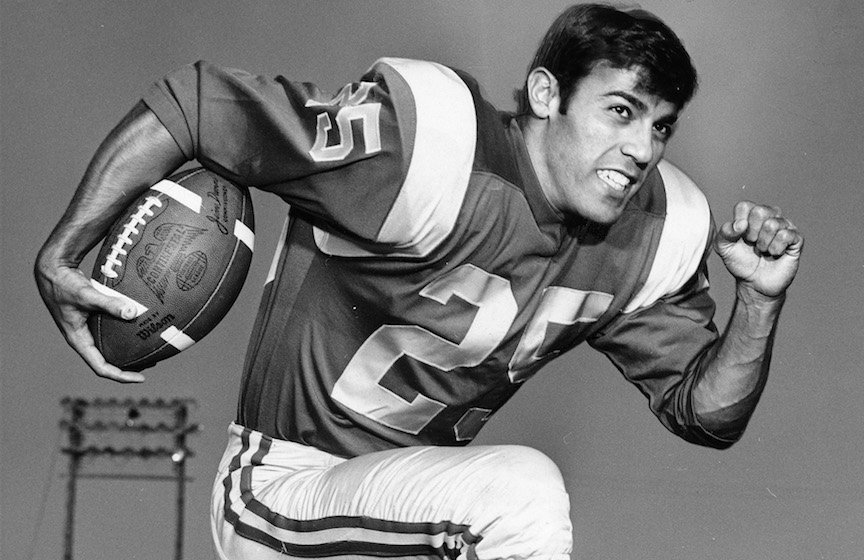
The world on Monday learned of the passing of Chris Gilbert, the first in a line of running back legends to come out of the University of Texas football program. He was 79.
He reportedly had suffered from Alzheimer’s disease.
Mr. Gilbert has a connection to Fort Worth.
Though picked in the fifth round by the New York Jets in 1969, Gilbert instead signed with the semipro Fort Worth Braves of the Continental Football League.
There’s a joke in here about the Jets being so bad, Gilbert chose a semipro team in Fort Worth instead. Not the case in those days. In fact, those Jets were coming off a victory in Super Bowl III, led by Broadway Joe Namath, and would go 10-4, first in the AFL East, under Weeb Ewbank in 1969.
“There are many small reasons for my wanting to play in Fort Worth,” Gilbert told reporters.
The primary reason was school. He said he was 12 hours short of graduating UT and could commute to class from Fort Worth. Two, if he wasn’t in school, he would lose his draft deferment.
That was probably no small reason.
The Braves played in three leagues, beginning with the Continental Football League, which folded in 1969. In 1970, the remaining teams formed the Texas Football League, and the 1971 season, ended abruptly after five games because it was increasingly more difficult to keep the lights turned on, was played under the banner of the Trans-American Football League.
Home games were played at Farrington Field. Their owner was Fort Worth businessman Tommy Mercer, a former track athlete and basketball player at TCU. Mercer inherited the family business, Mercer Trucking, and built it into a 32-corporation conglomerate consisting of ranching, oil, transportation, and interests in pipelines, pipe yards, drilling, insurance, and advertising companies.
His business interests included the Falstaff and Miller beer distributorships in Fort Worth.
“His most endearing quality was he owned beer distributorships,” said Phil Luebbehusen, a former Braves player. “So, we got all the beer we could drink.”
Mercer won Gilbert’s services, paying him a reported $18,000, or almost $160,000 today.
At his first practice at Rockwood Park, Gilbert attracted 250 onlookers, far more than any other previous Braves practice.
Mercer had turnstiles turning in his head.
“I honestly believe we’ll be successful this season,” Mercer said to reporters. “And that my initial investment will be returned. After that I hope to use the team as a source of revenue for charity and service organizations. This is my community. I make my living here and I think it only right that the team should be an integral part of the community.”
In addition to Gilbert, Mercer also signed Greg Lott and Danny Abbott, both former UT players. In 1970, Mercer flirted with signing star UT quarterback James Street. (An aside: Frank Goodish, aka wrestler Bruiser Brody, also played with the Braves. He had played at West Texas State, today West Texas A&M.)
Gilbert had been an All-American at Texas, the first of the school’s great wishbone running backs under Darrell Royal.
Gilbert, however, never worked out. He also never played a down in the NFL.
Staying true to his word, he stayed in school, showing up only on Friday walkthroughs and games on Saturday, Luebbehusen recalled in an interview two years ago.
“He had an orange Corvette, I remember that,” Luebbehusen said. “Plus, I mean, nothing against his talent, but he was fairly small for a running back and not as fast as you’d think. Because he didn’t practice with us, we never got to know him that well. There was never any resentment, not on our part, because he was making so much more money than we were.”
Plus, there was all the beer they could drink.
The Braves, however, did have the league’s leading rusher that season in 1969, which ended in a disappointing 5-7 record. It was James Walker, a hometown guy who graduated from Dunbar High School and played two years at Santa Barbara College.
He was biding his time until he was eligible for the NFL Draft.
“Sure, I would like to go up,” Walker told reporters. “I’m not particular about teams, just the one that pays me the most money.”
Naturally.
Walker eventually got his shot with the New England Patriots, but he didn’t make it.
Another guy in that backfield was Gene Thomas, who joined the team after being cut by the Chiefs.
“He was by far the best running back I’ve ever seen,” Luebbehusen said of Thomas. “But it was fun. It was the most fun I ever had playing football and a lot of good guys and some pretty talented guys. I mean, you wonder, God, how good must the NFL be if these guys couldn’t make it.”
After his year with the Braves, Gilbert decided to put football in the rearview window. According to UT, he transitioned into a career as an investor and business executive in Houston. He also co-founded Camp Olympia in 1968, which has become one of the most successful summer camps in the state.