

Judson Independent School District announced it will close four schools by the end of the school year to cut into its $37 million budget deficit.
The school board approved the closures in a 6-1 vote during a Monday meeting, but did not name which schools would be shuttered.
Trustee Jose Macias Jr. was the lone “no” vote, advocating to close only two campuses.
Officials say that closing four campuses will save the district $7 million, cutting about one-fifth of Judson’s budget deficit.
District staff presented different consolidation scenarios, letting board members pick between closing two, three, four or five schools in three different feeder patterns.
Feeder patterns determine where students go after graduating from elementary and later middle school based on where they live in the district. Judson has three: Judson High School, Warren High School and Veterans Memorial High School.
The school board picked the third scenario, which would close one middle school in Judson High School’s feeder pattern and three elementary schools or one in each feeder pattern.
This plan will make it easier to evenly distribute students across the district, addressing underutilization, reducing the burden on staffing cuts, make it easier to move student programs and addresses long-term enrollment challenges, said Interim Superintendent Mary Duhart-Toppen, who was appointed less than a week ago when the board voted to terminate Superintendent Milton Fields.
“It will mean less changes in the future because we’re taking three off the table,” Duhart-Toppen said. “And so now we don’t have to go back in and look at another school.”
To make their recommendations, district staff considered enrollment, campus utilizations, feeder patterns, potential pattern changes and special programming offered at each school.
Duhart-Toppen said the district paid special attention to elementary and middle school campuses under 60% utilization based on the number of classrooms and how many students can fit per class.
Currently, Judson has 10 elementary schools that are under 60% utilized and four elementary schools under 50% utilized. As for middle schools, four are under 60% and three are under 50% utilized.
District staff campuses should be stay at 85% utilization as a “best practice.”
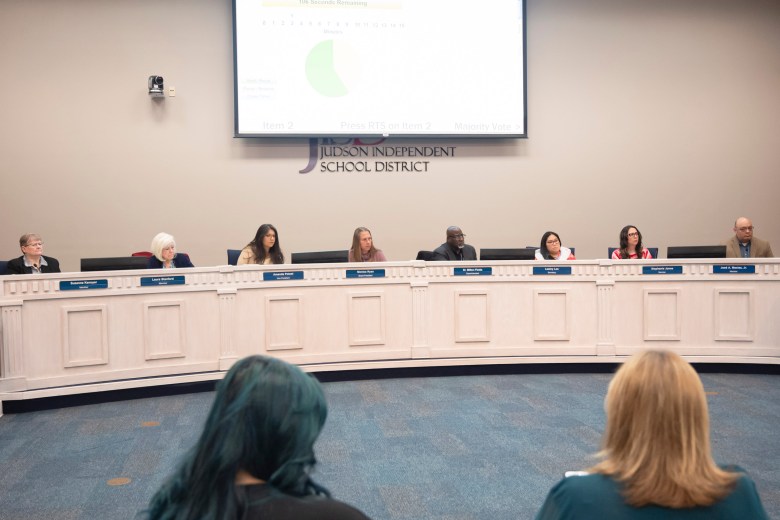 The Judson School Board of Trustees listen to public comment regarding Superintendent Milton Fields’ employment during a special-called meeting at the Judson ISD Educational Resource Center on Saturday, January 10, 2026 in San Antonio, Texas. Credit: Jo E. Norris for the San Antonio Report
Demographers contracted by the district said Judson’s enrollment is decreasing and projected to keep falling due to lower birth rates in the area and the rise of school choice brought on by a higher number of nearby charter schools and the state’s new education savings accounts program, which would let families use taxpayer dollars to pay for private school tuition.
Based on these predictions, demographers suggested Judson closing three to five elementary schools or one to two middle schools to keep up with enrollment trends.
Judson has a current enrollment of 22,621. During the 2024-25 school year, the district reported having 23,531 students, and the year before that, Judson had 23,848 students.
Student enrollment is projected to fall below 22,000 by 2027-28.
District staff have been discussing consolidation for months, holding growth and planning committee meetings with district employees, parents and community members.
Last year, Judson considered closing three campuses but board members ended up voting against consolidation, concerned that the process was too rushed and close to the end of the school year.
The financial challenge also falls in line with administrative turmoil at Judson.
Judson hasn’t had a chief financial officer since October, when its last CFO left after only two months on the job. There have been months of tense budget discussion and public spats during meetings.
“We know and understand that campuses must be must be closed for our work to continue in fiscally responsible way,” said Tanya Alarcon, a principal at Woodlawn Elementary School. “We must also consider that these decisions must be made with a mind toward equity.”
The next steps for district staff will be to adjust school boundaries for the 2026-27 school year, identify which campuses will close, move student programs, assess transportation and figure out what to do with closed campuses.
Closing a middle school will be difficult because of its student programming. Duhart-Toppen said they will also have to readjust non-instructional spaces like gyms and cafeterias, along with transportation services.
Judson’s board will have to take another vote to finalize closures.
“I cannot tell you how worried we because it is already February,” Duhart-Toppen told board members. “The longer we wait, the longer it’s going to take us to get ready for 2026-27.”