

The phone rang at 11:55 Saturday night. The call was coming from inside the house. “Do you hear that?” asked the voice on the other end. “Sounds like Fallujah outside my window.” It was my son, behind closed doors in his bedroom about 20 paces away. I told him that was an oddly specific and outdated reference for a 22-year-old, and begged him to get some sleep before his early morning flight.
At which I turned off One Battle After Another, stepped outside my northwest Dallas home and wondered if war had finally broken out while I was catching up on Oscar nominees. The incessant pop-pop-pop lasted forever – on and off, actually, for about 10 minutes, which just felt like an eternity. A neighbor would later post to our hectic Facebook group that he “easily heard 30+ shots” from “a handgun for sure.”
I was having Vietnam flashbacks. Well, Vietnam-movie flashbacks. Or New Year’s Eve flashbacks, anyway. Or, really, any random Saturday night. Or Tuesday night. Look, just night, OK?
Nobody in the neighborhood could tell where it was coming from. Marsh Lane and Merrell Road? No, wait. Webb Chapel Road and Royal Lane! No, definitely south of Cromwell Drive. Or maybe it was coming from the Dodge Charger that peeled out of the Royal Park parking lot, at Royal and the Northaven Trail, at 12:31 Sunday morning.
I got that specific time and place Monday from Brian Wharton, who lives a few blocks from me and coordinates our expanded neighborhood patrol. That’s where we all pitch in for an occasional drive-around by an off-duty Dallas police officer because we just don’t pay enough to live in this city. Wharton said he actually started hearing shots around 10:30 Saturday night.
Opinion
“After a while,” he said, “you get used to it.”
Another contender for The City of Dallas’ Official Motto.
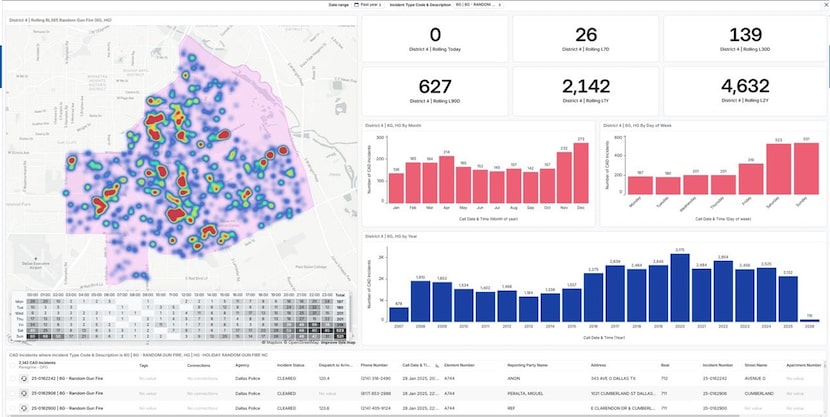
A screenshot from the internal dashboard the Dallas Police Department uses to track random gunfire. This comes from council member Maxie Johnson’s district.
Dallas PD
I asked a Dallas Police Department spokesman Monday for any further details. All he could confirm were several 911 calls around midnight, but that “officers in the area did not observe any gunshots or locate anyone in need of assistance.” There’d been another random gunfire call, too, earlier in the evening along St. Croix Drive between Forest Lane and Northaven Road. Officers didn’t find anybody there, either, but collected evidence enough to generate a Discharge Firearm in Certain Municipalities offense report.
That’ll show ’em.
Saturday night’s latest round of random gunfire erupted 37 hours before the Dallas City Council’s Public Safety Committee re-re-revisited the subject with reps from the DPD. It’s tempting to call it a coincidence, but see above. Besides, I started writing this column in 2009, when I first heard cops and the council start taking random gunfire seriously, and still we’re in the pilot program part of the problem-solving.
Two decades is an awfully long time to talk, talk, talk about something that’s “terrorizing people and making them feel unnecessarily unsafe,” as council member and committee chair Cara Mendelsohn put it Monday afternoon.
Police Maj. Yancey Nelson told the council that random gunfire is actually down 11% over the last three years, though in some divisions far more than others. In the city center, it’s down about 20%; in southwest Dallas, about 16%. But in my neck of the Great Northwest, it’s down just 1.7%. And in the southeast, where Nelson’s the patrol commander, it’s actually up 4%.
Nelson told the council that DPD aims to respond to calls of random gunfire within 30 seconds to two minutes. Not with a human, because that’ll never, ever happen, but with – you guessed it, because it’s 2026 – a drone, which would be connected to mics and license plate readers.
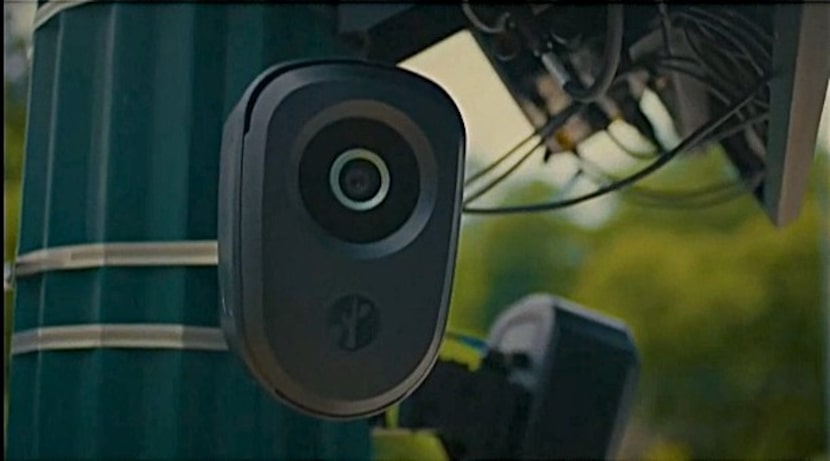
Dallas police said Monday they hope to use surveillance cameras to pinpoint random gunfire locations. This is from the video the Dallas City Council’s Public Safety Committee screened during DPD’s latest presentation.
Dallas PD
The latter already received pushback from the Community Police Oversight Board in December, with one member of the board wondering of the surveillance cameras, “Who thought it was a good idea to create a tracking system for Dallasites that could be accessed by any number of bad actors?” On Bluesky Wednesday morning, police oversight board member Brandon Friedman said he would push for the council to create an ad hoc committee to review the city’s surge in surveillance technology.
“In isolation, many of these products and case studies often sound like great solutions to urban problems,” he wrote. “Taken together, you now suddenly live in a surveillance-driven police state. That’s not the type of city I want to live in. We need to get a handle on where this is all headed.”
Some of us are old enough to remember when the DPD first discussed, some two decades ago, using ShotSpotter’s network of acoustic sensors to pinpoint where a gun is fired. But in 2009, Oncor roadblocked its rollout by refusing to let ShotSpotter hang its sensors on electrical poles. Two years later, ShotSpotter killed the pilot, and in 2015, the city deemed it too expensive anyway, which was the same thing former Chief Eddie García said in 2023 when pushing against the gunfire detection system San Antonio had already dumped and Houston blamed for rising response times. The ex-chief wanted, instead, more license plate readers.
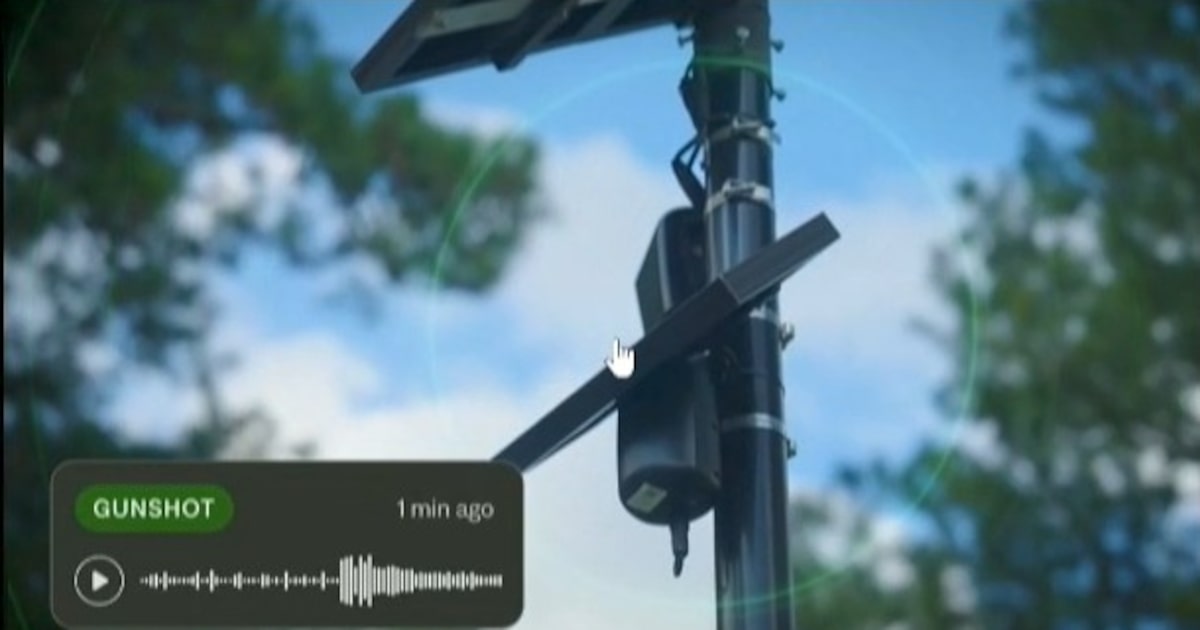
A year later, the council approved spending $336,362 to pilot Crime Gunshot Intelligence Technologies’ gunshot detection program, FireFLY LE, which also uses mounted microphones to pick up the sound of gunfire. A 2021 Arizona State University study found that FireFLY “captured a majority of the gunshots in the study area” and that “its effective range may be even larger than expected.”
But just two months ago, Nelson told the council FireFly wasn’t living up to expectations. Which sounds about right: Even CGIT’s president and co-founder Tim Kelly told this newspaper in 2024 that FireFLY on its own wouldn’t reduce gun violence — “not standing alone,” as he put it. “It needs to be part of a larger process.” Which is what Nelson presented Monday, when he showed council a video filled with cameras and drones — then cautioned everyone not to get too excited, as this was just a conceptual sneak peek at Dallas’ possible future.
The police and council have been debating fixes and promising change for decades, and it can’t come fast enough for my neighbors and for council members like southeast Dallas’ Jaime Resendez. He told Nelson on Monday that being able to pinpoint the location of random gunfire is “one of the most important things you can do to improve the quality of life” for the residents of Dallas.
Kathy Stewart, who represents the northeast, told Nelson she, too, heard gunshots early Sunday morning, along Audelia Road near Walnut Hill Lane, but that she didn’t climb out of bed to report it because until there’s a solution in place, what would be the point? She told Nelson that “gunfire makes people afraid, and anything we can do to reduce that fear is a high priority.”
I thought about that Monday night, when, standing on the back porch, I heard a few pops in the distance before heading back inside to finish the movie I started Saturday night. Because after a while, you get used to it.