
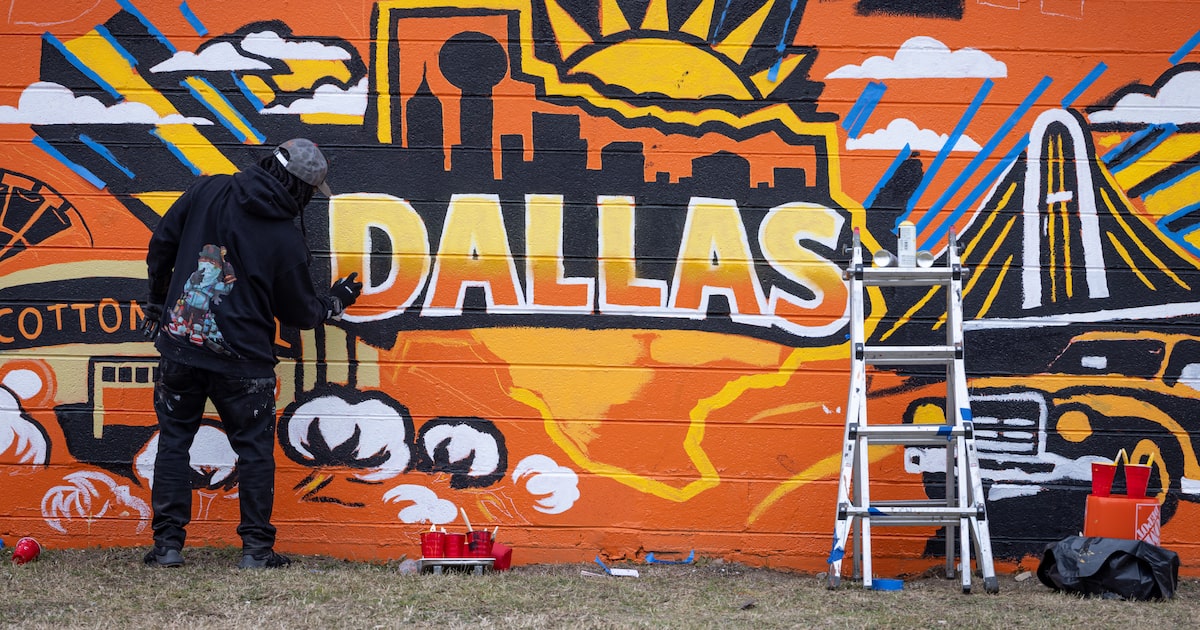
On a bitter cold morning, Theo Ponchaveli outlines lettering on the side of a building with a positive message: “Sunny South Dallas.”
Not far from the wall, a brass band starts to play. The esteemed artist maps out his design with black, white, yellow and orange. Then, more than a dozen volunteers descend on the canvas.
The mural, painted during recent Martin Luther King Jr. holiday celebrations, was the first this year from The Walls Project, a nonprofit that sponsors public art across North Texas.
In South Dallas, art isn’t only found in museums, but on the walls of a neighborhood looking to revitalize. The art is part of a broader beautification effort for a community looking to preserve its culture in an area grappling with growth amid historic disinvestment.
Breaking News
The paintings — which include one of local civil rights leader Juanita Craft — don’t just tell a story. They signal support for economic development and care for a community. Supporters say they are a calling to address issues ranging from everyday litter to human rights.
South Dallas community members said they were seeing the impact. The moment someone becomes persuaded by art can be difficult to track. Research from across the country shows art has a positive effect on neighborhoods and community wellbeing, connecting people and contributing to the local economy. Art cannot force anyone to improve life, but it can draw them in and convince them to invest in the well-being of communities, supporters say.
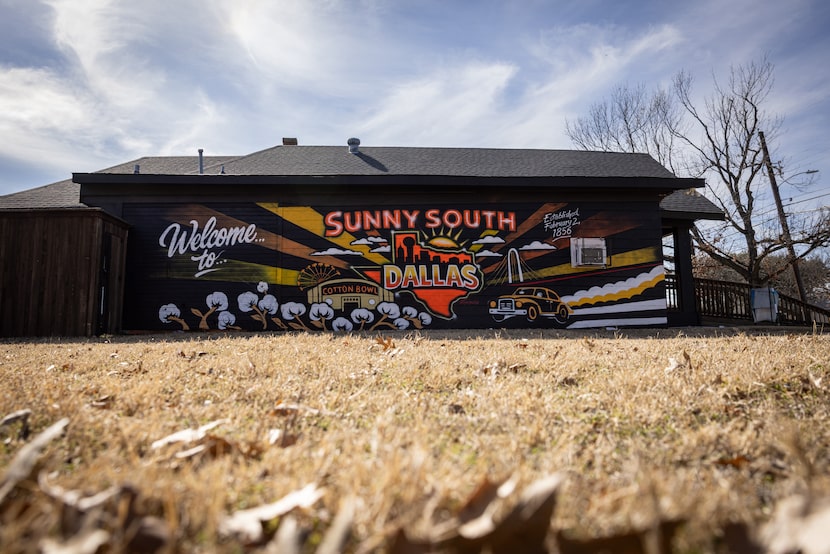
The finished mural on a building in South Dallas by artist Theo Ponchaveli with the help of volunteers on Feb. 2, 2026.
Angela Piazza / Staff Photographer
“If anything could change a person or perspective, or inspire or motivate them, it would be music or art,” Ponchaveli said. “Sometimes a person can’t always rehab the building, but there’s a wall, a blank canvas.”
The mural wasn’t his usual process. The chilly air changed the paint’s consistency and some paint didn’t stay within the lines. Still, Ponchaveli appreciated the volunteers’ efforts.
They came that day from South Dallas or across North Texas and worked with him in the cold. The art transformed the wall into a destination. Ponchaveli learns about business and philanthropy working with the project. The Walls Project uses public art, along with programming for youth and numerous partnerships, to address community needs and human rights issues.
In addition to Texas, the project operates in Colorado and Louisiana, boasting more than 250 public art pieces and more than $6 million in economic opportunities for artists. The project began partnering with the city of Dallas in 2019 for its MLK Festival, where the project brings together supporters and sponsors to address blight in the area. This year, about 500 volunteers worked over the MLK celebration weekend.
From 2020 to 2024, volunteers collected more than 1,200 bags of trash in coordination with two other nonprofits, according to The Walls Project. Nearly 1,200 volunteers addressed more than 860 “instances of blight,” such as high weeds, litter or dumping, with help from the city and others, according to a 2024 Dallas Walls Project report.
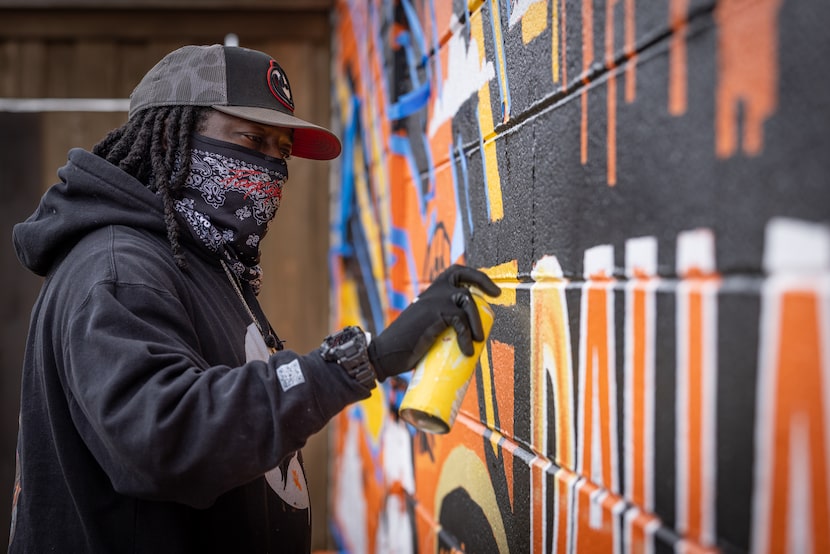
South Dallas artist Theo Ponchaveli paints a new mural depicting the words “Welcome to Sunny South Dallas” during MLK Fest on Jan. 17, 2026, in Dallas.
Angela Piazza / Staff Photographer
People who live and work in South Dallas are leading a renaissance, said Casey Phillips, CEO of The Walls Project, who credited the community for its work revitalizing. The organization aims to serve communities, he said, but art serves as a unifier.
“When you bring people together with intention,” Phillips said, “that creates the opportunity to have deep conversations around all the things that are impacting the world, including in your community.”
Can art drive change?
A collage of images forms the new mural along Martin Luther King Jr. Boulevard, welcoming passersby to South Dallas. Depictions of a car headed toward the state, the city skyline and Fair Park are joined with illustrations of cotton and the date of the city’s establishment.
When Traswell Livingston III, the property owner, looks at the side of his building, he sees the story of a bright community “rich in sweat equity,” that built its culture, acknowledges history and is speeding toward its future.
“It helps with pride,” said Livingston, a real estate broker who is also president of ASD, which provides permanent, supportive housing. “Beautification, as simple as cleaning up the community, does way more instantly.”
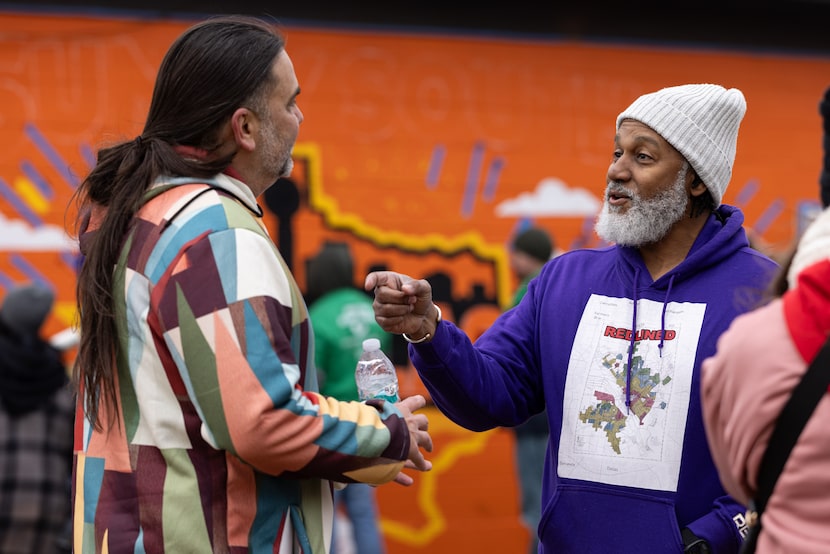
Casey Phillips (left), CEO of The Walls Project, speaks to building owner Traswell Livingston while a mural is painted on his building during MLK Fest on Jan. 17, 2026, in South Dallas.
Angela Piazza / Staff Photographer
Livingston hopes the mural offers a bit of history and optimism for kids dealing with poverty, crime or stereotypes of the area. He believes everyday life impacts their self-esteem, even having to step over litter on their way home from school.
When compared with other areas of the city, data shows that South Dallas has seen disparities in health, education and income.
Cultural resources have been linked to better health, schooling and security in lower-income neighborhoods. This emerged from 2017 research about New York City, conducted by the University of Pennsylvania. Access to arts and culture is associated with decreases in child abuse and neglect, obesity and serious crimes. The research also saw kids scoring better in some exams.
Nonprofits, such as The Walls Project, could be having a measurable impact, according to a 2025 study in Washington state commissioned by ArtsFund in cooperation with SMU DataArts. The Washington study found that communities with higher concentrations of arts and cultural nonprofits have 3% lower levels of income inequality among residents. Communities with these types of nonprofits saw higher rates of volunteerism, more gathering spaces and active voters.
“There does seem to be this really important network effect and glue that arts and culture organizations can provide to communities,” said Jen Benoit-Bryan, director at Southern Methodist University DataArts.
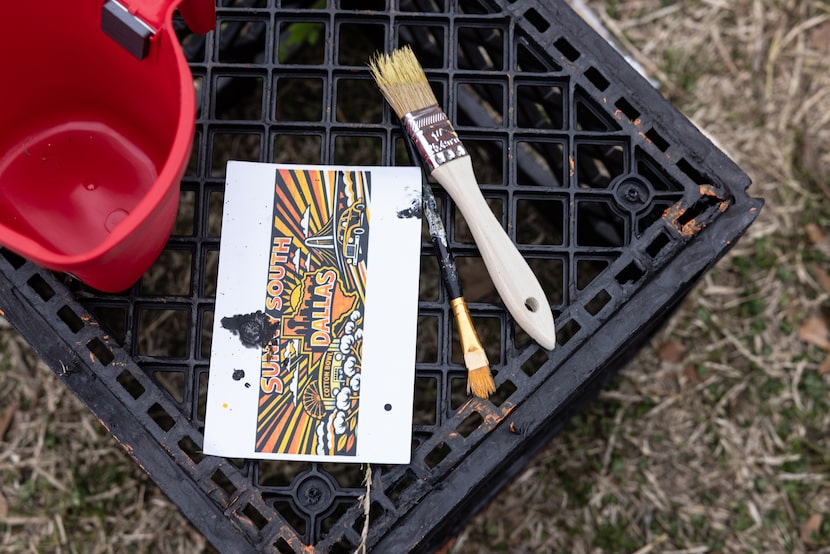
A new mural design by artist Theo Ponchaveli that was painted during MLK Fest on Jan. 17, 2026, in South Dallas.
Angela Piazza / Staff Photographer
Efforts in South Dallas are still unfolding, and the area has its own unique circumstances when compared with areas like Washington state or New York. On a national level, public murals make neighborhoods more attractive to tourists and new residents, Erin Harkey, CEO of Americans for the Arts, said in a statement.
Research from the organization found that about 70% of Americans agreed arts improve the “image and identity” of their communities. Nearly the same amount also believed that arts and culture positively affect overall health and well-being.
Harkey said that with collaboration, arts groups “excel as connectors,” linking and amplifying impact in efforts dealing with health, housing or transportation and driving community progress.
“The arts serve as important economic and social catalysts,” Harkey said, “but lasting and meaningful solutions to systemic issues like poverty and structural injustice require coordinated action across multiple sectors.”
Branching out
Across North Texas, The Walls Project has sponsored more than 14 murals. Eight more are being planned. That work is not done by the organization alone.
“We’ve become a convener and a neutral ground for ideas and perspectives,” Phillips said. “We all learn from each other. Nobody has all the answers.”
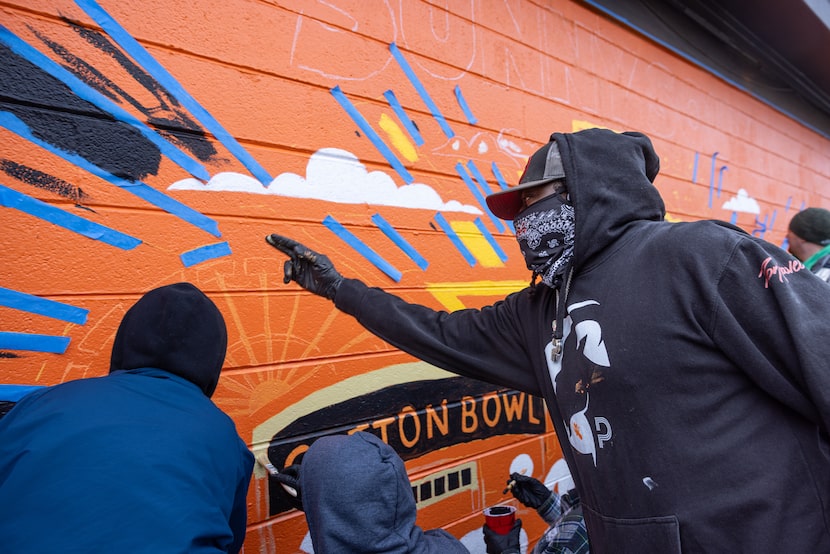
Artist Theo Ponchaveli directs volunteers helping paint a mural he created as an homage to South Dallas during MLK Fest on Jan. 17, 2026, in South Dallas.
Angela Piazza / Staff Photographer
Phillips said the organization brings together sponsors, community groups and people like coders, activists and politicians, with a board including conservative and progressive thinkers.
The Walls Project was invited by community members to work in the South Dallas area. It found similarities between South Dallas and its work in North Baton Rouge, Phillips said, where he saw issues such as “systematic disinvestment, lack of affordable housing,” and a need for opportunity for young people.
The project is working to raise $200,000 to build a digital art and design studio for teens at the Dallas Bethlehem Center, which it hopes to open in summer. The nonprofit also has afterschool programs at nearby Lincoln High School and James Madison High School, teaching music production and landscape architecture.
Over the next several years, the project plans to create larger investments in South Dallas and expand its offerings.
Paul Franklin, senior program manager for the project, said that when youth have more access to the arts, it gives them the ability to excel.
“It’s amazing being able to create change and see their ideas come to life, and see a spark of creativity in them,” Franklin said of the kids. “They start to understand the possibilities that they can do anything.”
Everyday observations
As his mural came together, Ponchaveli spent hours in the cold. While most volunteers had long gone, he was joined by a 7-year-old. He leaned down, showing the boy how to use the paintbrush.
Shannon Key watched as Ponchaveli coached her son on making clean lines around the shape of Texas. She’s a volunteer coordinator for The Walls Project who lives in the area.
“A lot of this neighborhood has been underserved and underutilized,” Key said, “so the murals really help bring the neighborhood back to life and signal to people that it’s a welcoming place full of art, culture and soul.”
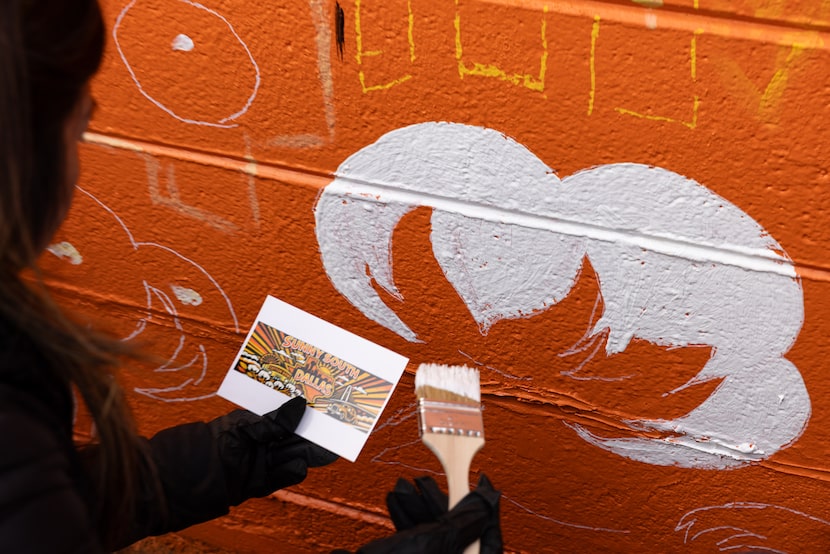
A volunteer fills in cotton on a Sunny South Dallas mural created by artist Theo Ponchaveli during MLK Fest on Jan. 17, 2026, in South Dallas.
Angela Piazza / Staff Photographer
In 2024, Hasani Burton, a city public art committee member, got a Walls Project mural on his more than 100-year-old building at the corner of Malcolm X and Martin Luther King Jr. boulevards.
An image of the late Juanita Craft, a local civil rights leader, smiles as motorists pass by. Burton is redeveloping his property, having it serve as a space for hundreds of small businesses, marketing and advertisement. He sees the mural as a catalyst for his development and himself a steward of the area’s culture and history.
“We are not coming into the community; we are of the community and there’s history here,” Burton said, adding he believes the painting has deterred graffiti, vandalism or trespassing.
While the structure was once a spot for “poster vandalism” or marketing, he said passersby now take photos with the mural.
Lakeem Wilson, who is from South Dallas and painted the mural, said he hopes it shows business owners the area is a cultural district and can serve as a tourist destination. He’s since gained publicity, drawing viewers into his work centered around Black culture and empowerment.
“If you go through a community and it’s nothing but blank walls or painted houses, you don’t really understand the culture of the neighborhood or what’s going on,” Wilson said.
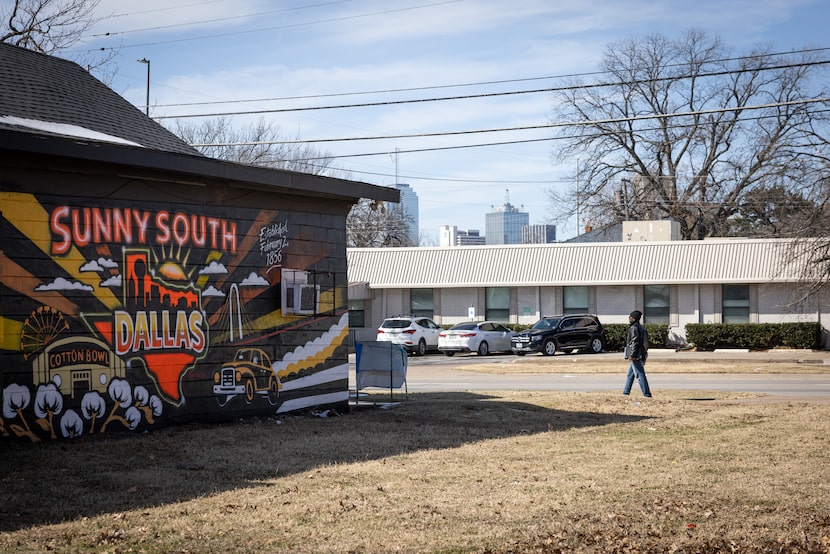
The finished mural on a building in South Dallas by artist Theo Ponchaveli with the help of volunteers on Feb. 2, 2026.
Angela Piazza / Staff Photographer
He hopes younger residents see art as a pathway toward opportunity, adding that art can raise a neighborhood’s esteem or serve as a reminder, but can’t solve every issue.
Individual choices lead to improvements in everyday life, Wilson said, whether that is seeking resources, leaving negative situations, prioritizing self-improvement or becoming an active community member.
“Hopefully, the art ignites and initiates people to want to get involved or change themselves,” Wilson said. “It’s up to the individuals to show up, and that’s something art can’t do for you.”
Did you know that what you just read was a solutions journalism story, supported by the Solutions Journalism Network? It didn’t just examine a problem; it scrutinized a response. By presenting evidence of who is making progress, we remove any excuse that a problem is intractable.
This reporting is part of the Future of North Texas, a community-funded journalism initiative supported by the Commit Partnership, Communities Foundation of Texas, The Dallas Foundation, the Dallas Mavericks, the Dallas Regional Chamber, Deedie Rose, Lisa and Charles Siegel, the McCune-Losinger Family Fund, The Meadows Foundation, the Perot Foundation, the United Way of Metropolitan Dallas and the University of Texas at Dallas. The News retains full editorial control of this coverage.