
Real journalists wrote and edited this (not AI)—independent, community-driven journalism survives because you back it. Donate to sustain Prism’s mission and the humans behind it.
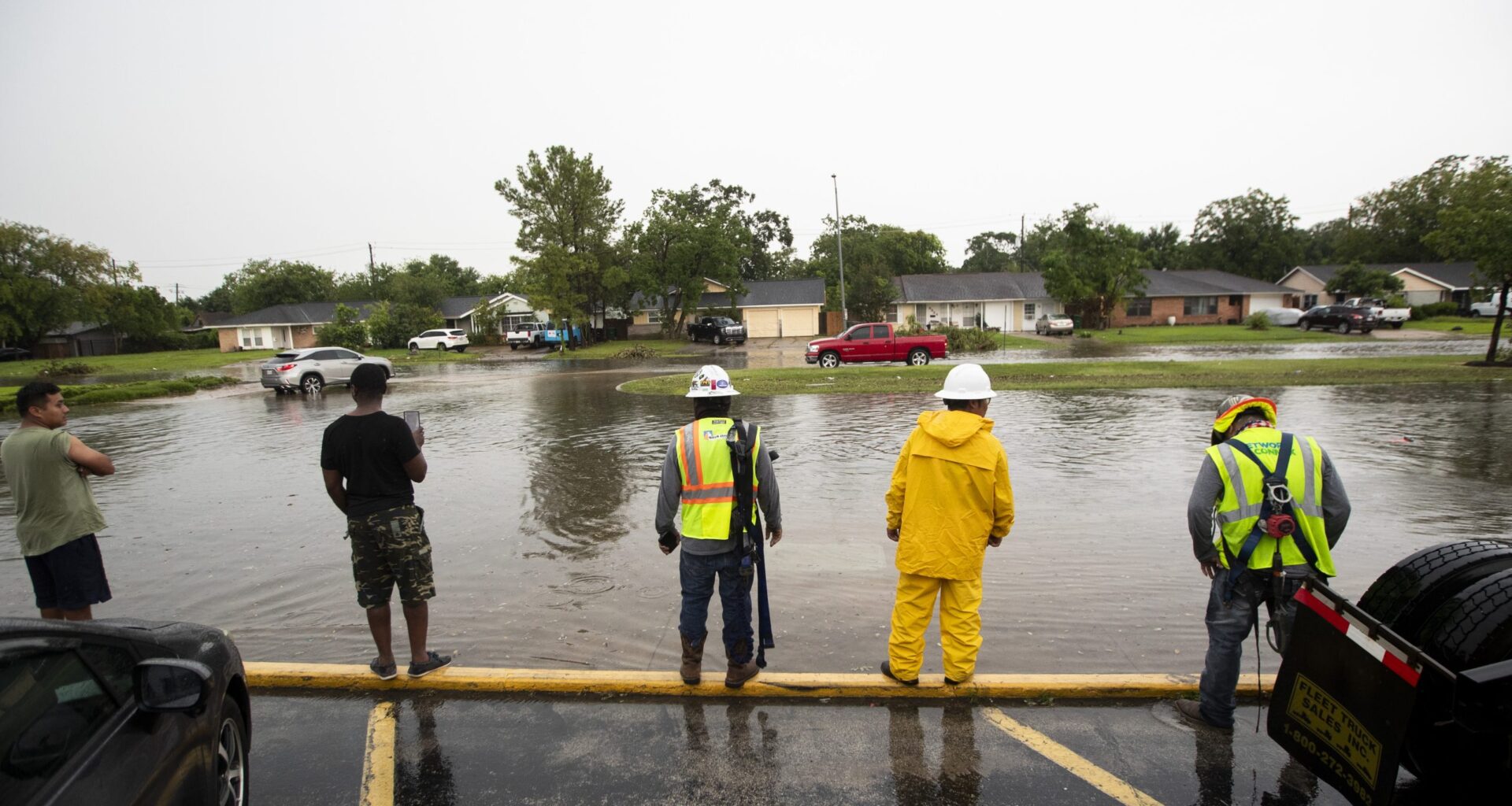
Houston residents flooded the City Council chambers last year to oppose the 2026 budget that increases the Houston Police Department’s (HPD) budget by $67 million to a total $1.1 billion. But as more money is directed toward policing, other pressing issues are falling to the wayside, advocates say. Even though Houston is a city prone to flooding, council members recently approved the use of $30 million of stormwater mitigation funds to demolish old buildings.
Ahead of the vote, City Controller Chris Hollins told City Council, “This is not a disagreement about whether blighted and dangerous buildings are a problem in Houston—they are. This is about whether the city is legally permitted to spend $30 million from a restricted stormwater fund to demolish buildings—and the answer is no.”
Last year, the Texas Supreme Court ruled that the city of Houston had failed to allot the necessary millions of dollars to fix drainage issues by not putting aside enough of its property tax revenue toward these projects. Now the city is mandated to add $100 million to the fund annually.
But some residents feel that the city is not prioritizing infrastructure and other social services enough, and is instead pouring money into policing.
“One thing that the city does really, really well is find legal loopholes to legally justify expenditures, and this is one kind of case in point,” former council member Letitia Plummer told Prism. She noted that the top concerns for most residents is public safety and flooding. “But no one is talking about the root causes of why crime exists,” Plummer noted. Instead, she sees a pattern of disinvestment, pulling resources from food security or reentry programs while increasing police budgets.
The city’s contract with the Houston Police Officers’ Union will raise HPD salaries by 36.5% over five years. Meanwhile other city services lost out, including the Houston Health Department, with a city budget allocation that fell from $54 million to $50 million after already losing $42 million in federal funding from its nearly $99 million operating budget. Minutes after the budget passed, officers removed Alice Liu and over 40 other residents protesting the vote.
“We do believe that flooding, infrastructure, and disasters is a key issue that’s going to bring people together for what we deserve,” Liu said in an interview. But she also feared that city departments like the Health Department and library system would compete with flooding infrastructure dollars as a result of the police acquiring more city revenue.
None of the nine council members in favor of the reallocation of stormwater mitigation funds provided a statement in time for publishing.
Liu, who is co-director of disaster recovery group West Street Recovery (WSR), joined other residents to conduct a political education campaign during the city budgeting process to educate neighbors and increase council member opposition to the proposed city budget. Each in-person meeting had a large number of elderly low-income Black and Latino residents in attendance. WSR’s newsletter and social media posts fueled concern and outrage among young residents who ultimately attended the budget hearings.
“In the same way that we were really working hard to set the narrative on our end and educate our base in the community, the mayor’s office had also spent at least six months leading up to the budget vote dropping these crumbs of, ‘Oh what we’re doing with cutting department budgets is ultimately about efficiency,’” Liu said.
Mayor John Whitmire worked with multinational accounting firm Ernst & Young to further his campaign promise to cut areas of the city budget deemed wasteful. Whitmire unveiled Ernst & Young’s City of Houston Efficiency Study weeks after President Donald Trump announced the Department of Government Efficiency and days before Texas House Speaker Dustin Burrows announced a new committee of “Delivery of Government Efficiency.”
Whitmire did not provide a statement in time for publishing.
In August, Harris County attempted to get on even footing with the city of Houston on police funding. County commissioners voted to also give its officers a pay raise, adding over $140 million to the county annual budget. The move stressed the budget ahead of the deliberation process, surging the county deficit to over $200 million.
County Judge Lina Hidalgo opposed the raise in fear of inevitable cuts to city services. She told a resident during an August Special Commissioners Court meeting that she met with some of the commissioners who supported the police raise ahead of the vote. “I visited with some of these guys ahead of the vote last time,” she said. “I said, guys, let’s go to the voters because you’re looking at law enforcement versus children, law enforcement versus flooding. That’s a tough one.”
Harris County Commissioners Court had censured Hidalgo days earlier after she defended a “penny tax” to continue funding the county’s Early REACH Program, which allows eligible children to receive free child care. The condemnation of Hidalgo passed along the same voting lines of commissioners supporting the police raise, with a 3-1 vote.
“One of the big messages in the room from advocates was, ‘This is not what public safety is,’” said Felix Kapoor, co-director of home repair and community organizing for WSR. “Public safety is not exclusively limited to historic investments to law enforcement with guns and bullets. It also means grocery stores. It also means clean air. It also means protecting our infrastructure from flooding. It means healthy schools. It means easy transportation.”
After weeks of speaking at county meetings, Kapoor and others began wearing police regalia during their public comment remarks. “We just decided that, hey, if you’re only going to listen to police,” he said, “what if we put on police hats and some sort of designation assigning us as law enforcement? Maybe you’ll actually listen to our message that this money needs to get invested into food, care, health of our air, maybe even health care support of our communities.”
City and county budgetary commitments to flooding infrastructure are vulnerable, yet the climate crisis persists. According to public policy think tank Texas 2036, rainfall intensity by 2036 will increase by 10% compared with 2001 to 2020, and 20% relative to 1950 to 1999. With rainfall intensifying, urban flooding will also increase by 2036. Houston’s Climate Impact Assessment affirms that warming ocean temperatures will result in more intense storms that will bring about more intense rainfall.
The Federal Emergency Management Agency (FEMA) has long been a critical asset to Houston disaster recovery efforts. Without federal support, Houston could never recover from storms such as 2017’s Hurricane Harvey, one of the costliest natural disasters in U.S. history with an estimated $125 billion in damages.
Trump has expressed interest in eliminating FEMA, which worries Zoe Middleton, an associate policy director at the Union of Concerned Scientists. “Having an emergency response, emergency management, and early-phase disaster recovery administration agency that’s in free-fall and being weaponized is incredibly dangerous,” Middleton said. “We’ll see increased strain on [cities and counties], and that strain will reduce their ability to respond to disaster, prepare for disaster, and mitigate risk. It’s an extraordinary ripple effect.”
Middleton said the unravelling of FEMA was directly linked with Trump’s authoritarian urge for control. “You can create a lot of control or gather a lot of control by injecting uncertainty into situations and using disaster aid as a tool for punishment or incentive to align with other parts of your political agenda,” she said.
For instance, Trump threatened to withhold disaster relief funding from California amid the deadly Los Angeles wildfires unless the state enacted voter ID laws.
It remains to be seen how Houston will fare against a looming hurricane season with shifting priorities from most levels of government.
Editorial Team:
Sahar Fatima, Lead Editor
Lara Witt, Top Editor
Stephanie Harris, Copy Editor
Related