
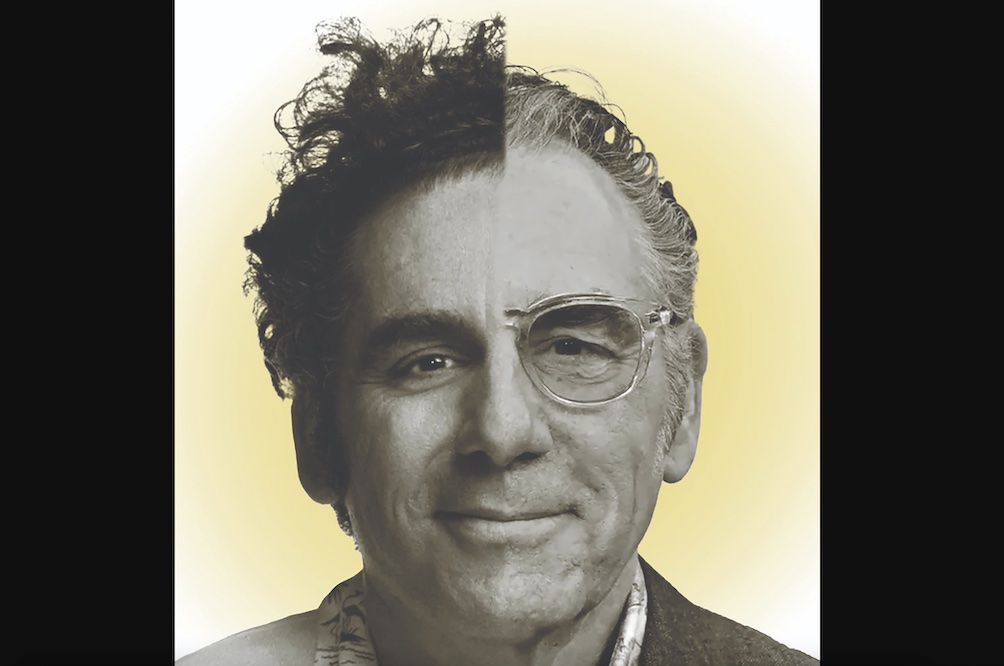
!["For many years, I looked at the nature of anger [and] how it brings about change," Richards says. "I had to deal with the awful sides of myself."](https://www.newsbeep.com/us-tx/wp-content/uploads/2026/02/Richards.jpg) “For many years, I looked at the nature of anger [and] how it brings about change,” Richards says. “I had to deal with the awful sides of myself.” Credit: Courtesy Photo / Michael Richards
“For many years, I looked at the nature of anger [and] how it brings about change,” Richards says. “I had to deal with the awful sides of myself.” Credit: Courtesy Photo / Michael Richards
Actor and comedian Michael Richards, best known for playing the whiplike and fiercely loyal hustler Cosmo Kramer in the classic 1990s sitcom Seinfeld, has spent the last 20 years reckoning with the consequences of a public controversy.
In 2006, during a performance at the Laugh Factory in Los Angeles, Richards hurled racial slurs at Black members of the audience who were heckling him. The incident was captured on video, and the three-time Emmy Award-winning actor’s career was immediately derailed.
It’s been a difficult journey since then, but Richards, who is bringing his Entrances and Exits tour to the Empire Theatre on Friday, Feb. 13, finally feels like he’s done the self-reflective work that may allow him to step out of the shadows.
During a recent interview with the Current, Richards, 76, talked about the philosophy behind his new tour, the power of performing live, and the lessons he’s learned from his past mistakes.
What is the meaning behind the title of your tour, Entrances and Exits?
We come into things, and then we go out of things. I’ve always liked that title. This performance on stage is not about my memoir, [also titled] Entrances and Exits. Although there are some stories I retell, I’m actually on my feet acting them out. I prefer to do that. I feel I’m more powerful on stage than with words on paper. I’m certainly more animated. So, I’ve always been fascinated with coming into things and then passing through them. I will be in San Antonio — and then I will leave.
There’s also the “final exit,” which could be interpreted as something darker, yes?
That’s universal – coming into life and then taking an exit and dying. But I don’t mean it to be dark. Every day, we come in, and we go out. Then, we attend to the next situation — the next passage or act in my life. That’s built into time and being a human being on this planet — this coming and going. All moments are passing.
This definitely doesn’t sound like a traditional stand-up comedy set.
I’ve done [stand-up] before, but I was very experimental. It was like taking a leash off. I was fast and to the point. I liked that format, but I never regarded myself as a stand-up in the traditional sense. [The tour] is very loose. I’m not tied down word-for-word like, I’ll say, an accomplished stand-up comic like Jerry Seinfeld. I know Jerry would never go on the stage unless he had every single word in place. That was essential in keeping the nature of Seinfeld together. Interestingly enough, Kramer is loose and lives in the imagination.
Kramer — speaking of memorable entrances and exits.
Yeah, I had to stay very focused on the positioning and psychology of that character. There was a lot of order to the chaos Kramer would express in all circumstances — the way he came in, and the way he went out. I came in strong, usually to gain more intention. [Kramer] always had something to come in with, and then he would go out to get it done — giddy up! — as his story unfolded.
It sounds like the show is going to leave room for a lot of reflection. If we look back to the controversy you faced in 2006, how do you reflect on that today?
I learned a lot about myself. [That night], I entered the realm of anger, and I backed that anger up with a thermonuclear weapon. I was very unhappy with that show, and I never went back to standup because of it. I wasn’t happy doing standup, and it was starting to take its toll on me. Usually, I could handle the audience and the extemporaneous [comments] — whether they were good or not. I heard [a negative comment] and that triggered an inner critic in me telling me [my performance] was not as funny as it should be. I was a bit depressed. All that blew up in my face. It was a catastrophe that was needed to bring all that to an end. It was a shift that was necessary.
How did you come to that understanding over the last 20 years?
For many years, I looked at the nature of anger [and] how it brings about change. I had to deal with the awful sides of myself. How evil am I saying such despicable things to my fellow man just because I’m not in form that night? It was [actor] Boris Karloff (Frankenstein) who said a clown in the night was the most frightening image he could think of. I was a clown in the night.
Social justice activist Bryan Stevenson is credited for saying that a “person is more than the worst thing they’ve ever done.” When you hear that quote, how does it resonate with your own journey?
That’s absolutely true. The dark out there is in myself, and the way to get to it is to attend to your being and dialogue with your shadow. I’ve been doing it for years. Even now, with all the conflict [in the country] and one side against another, we’re dealing with anger. We’re warring against ourselves — the American spirit. At the very beginning, we asked ourselves, “Can we create a country where everybody from all parts of the world can live?” We’ve been struggling with harmonizing. This is certainly the task for this century. Are we going to make it [or] are we just going to blow ourselves up because we couldn’t get a hold of the dark in every one of us. Each of us has to [find] our humanity. It’s all inside ourselves.
$48.19-$145.79, 8 p.m., Friday, Feb. 13, Empire Theatre, 226 N. St. Mary’s St., (210) 226-5700, majesticempire.com.
Sign Up for SA Current newsletters.
Follow us: Apple News | Google News | NewsBreak | Reddit | Instagram | Facebook | Twitter | Or sign up for our RSS Feed
Related Stories
Monday’s event is organized by San Antonio’s Reggie Scott Young, author of ‘Yardbirds Squawking at the Moon.’

‘Murmurations’ at the Contemporary at Blue Star, functions like a mid-career survey, sampling the past 20 years of various long-term projects.