
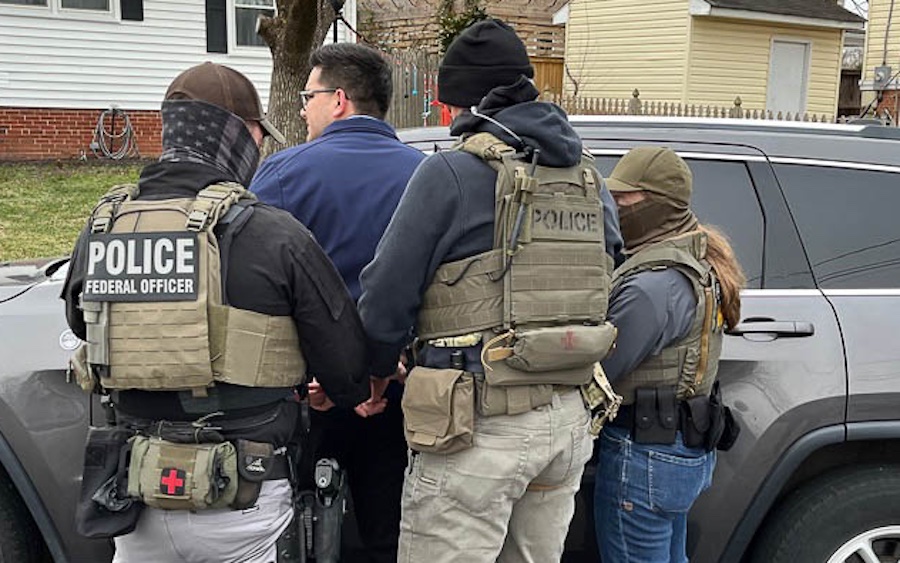
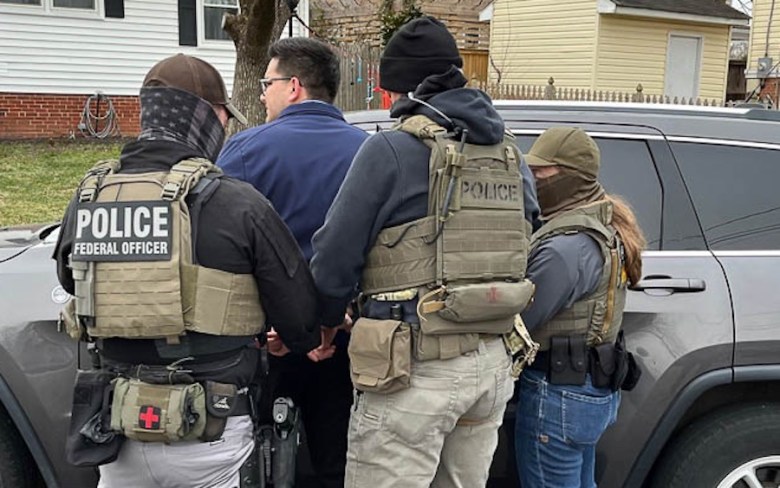
 Masked ICE agents arrest a man during a raid last year in Arlington, Virginia. Credit: Courtesy Photo / U.S. Immigration and Customs Enforcement
Editor’s note: The San Antonio Current does not condone or encourage violence of any kind against law enforcement officials. The purpose of this article is to address questions raised in public forums since the start of the Trump administration’s sweeping immigration crackdown.
During a town hall hosted last week by District 9 Councilwoman Misty Spears, one attendee sought the elected official’s counsel on whether Texas’ “Stand Your Ground” law applies when it comes to masked immigration agents bursting into homes.
“This is a ‘Stand Your Ground’ state, correct?” the woman in the audience asked. “This state has a Castle Doctrine. So when [U.S. Immigration and Customs Enforcement] is busting down people’s doors unconstitutionally … do I have a right to protect myself from armed, masked men who are breaking into my home, or my backyard, or my car?”
Before the event was over, two other audience members posed similar inquiries to the councilwoman.
Such questions have also percolated up in online forums following the ICE shooting deaths of Renee Good and Alex Pretti in Minneapolis. And they appeared again last week in San Antonio social media posts after video showing ICE agents breaking into an Alamo City home went viral.
What’s more, both houses of the Arizona Legislature passed recent resolutions censuring state Attorney General Kris Mayes for stating in an interview that the state’s “Stand Your Ground” law could create a “combustible situation” as ICE carries out raids there.
During Councilwoman Spears’ town hall, San Antonio Police Chief Bill McManus warned that those who take up arms against federal agents do so “at their own peril.”
While McManus didn’t elaborate on the nature of that peril, the recent shootings in Minneapolis show the stakes involved. And the outcome of the FBI’s 1993 on the Branch Davidian compound in Waco offers further evidence of just how swift and deadly armed encounters with federal officers can be.
When it comes to the legality of whether Texas’ “Stand Your Ground” statute applies during law enforcement actions, Temple-based Second Amendment Attorney Christopher “CJ” Grisham told the Current the question of when civilians can use deadly force is complicated — and extremely limited in scope.
“The only time you can use force to resist any law enforcement in the State of Texas is to resist excessive force,” said Grisham, who’s made a career of fighting Bureau of Alcohol, Tobacco, Firearms and Explosives-related convictions. “Some would argue that if you’ve got a bunch of guys coming in, pointing MP5s or AR-15s at people’s heads, that’s excessive, especially if you’re not armed.”
However, Grisham continued: “If they’re executing a warrant, and going into your home and arresting somebody, and they’re visibly identified as law enforcement, then the ‘Stand Your Ground’ law does not apply.”
ICE agents have faced criticism for donning masks that conceal their identities and wearing apparel that either doesn’t show their agency name or fails to identify them as law enforcement altogether. Further, online videos have shown agents refusing to provide warrants during arrests, and an ICE memo obtained by the Associated Press tells agents they’re authorized to force their way into homes without warrants.
Still, Grisham said federal law enforcement agents “have more leeway” under the law when it comes to shielding their identities.
Under 42 U.S.C. 1983, individuals may sue state and local government officials for violating their constitutional rights when acting “under color of law,” or carrying out law enforcement activities. Although the code is considered important federal civil rights law, it doesn’t grant the same power to pursue claims against the federal government or federal law enforcement, Grisham said.
“I’ve always found it weird that here you’ve got a federal Constitution that gives you the right to bear arms, to be free from unlawful search and seizures, but yet when the federal government does it, you’ve got no recourse,” Grisham said. “So, is it really right if you can’t go after the federal government? That’s the problem.”
The question of how extensively the Constitution protects individuals from the actions of federal officials may explain why some ICE agents feel emboldened to “go way above what their authority is under the law,” the attorney added.
“It’s because they can get away with it,” Grisham said.
So, here’s the bottom line: those who take up arms against the federal immigration agents are unlikely to live to tell the tale. And those who do can expect an uphill legal fight against the power of the federal government.
Sign Up for SA Current newsletters.
Follow us: Apple News | Google News | NewsBreak | Reddit | Instagram | Facebook | Twitter | Or sign up for our RSS Feed
Related Stories
ICE’s lack of clarity comes as concern builds nationwide about the feds targeting large events for immigration roundups.

Four council members want the city to look into whether it can legally cut off future contracts to companies that do work for the ICE facility.
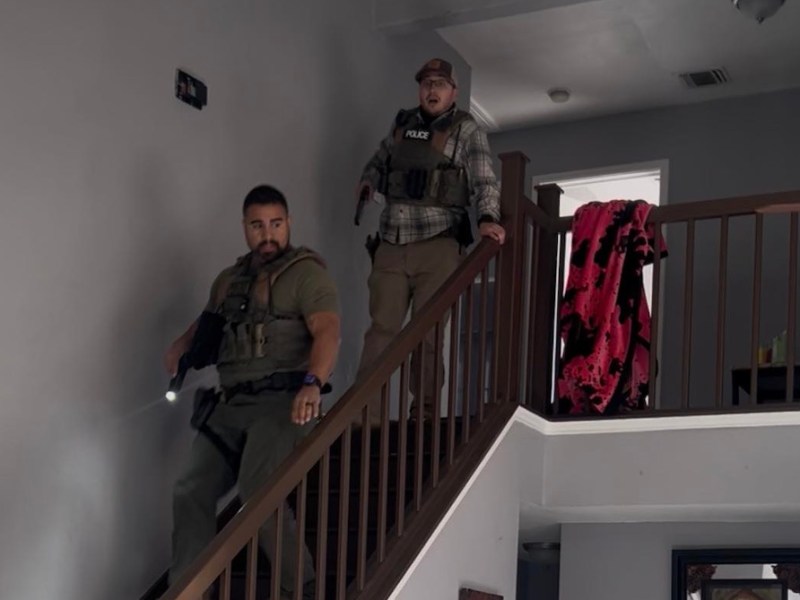
U.S. Rep. Joaquin Castro said now-viral video shows ICE agents ‘roughed up somebody’ after entering the house without a warrant.