
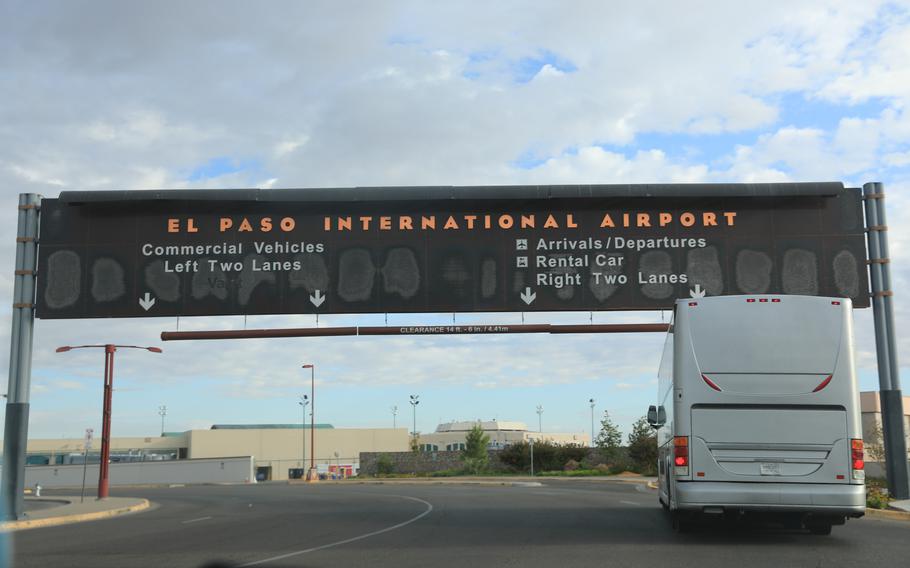
Conflicting information swirled Wednesday morning on what caused the Federal Aviation Administration to close the airspace around Fort Bliss and El Paso, Texas, and what role the military may have played. (Jacob Lang/U.S. Army)
Conflicting information swirled Wednesday morning on what caused the Federal Aviation Administration to close the airspace around Fort Bliss and El Paso, Texas, and what role the military may have played.
The FAA made the move at 11:30 p.m. Tuesday night, announcing the closure of airspace around the El Paso International Airport would last for 10 days. It reversed course and reopened the space roughly seven hours later.
By noon ET, several media outlets, including the Associated Press, reported the closure was sparked by a disagreement between Defense Department officials pushing to test a drone-busting laser and the FAA’s need to ensure safe air travel.
Despite a meeting scheduled later this month to discuss the issue, the Pentagon wanted to go ahead and test it, prompting the FAA to shutter the airspace, the AP reported. It was not clear whether the laser was ultimately deployed.
Rep. Tony Gonzales, a Texas Republican whose district will soon include parts of El Paso and Fort Bliss, said Wednesday afternoon that the closure was the result of “growing pains” as the military and the Department of Homeland Security gain more funding and authority to combat the daily incursions of drones flown into the United States by Mexican drug cartels.
“The real story here is the military, working with Department of Homeland Security, is moving in the right direction on counter-drone, counter-UAS, operations,” said Gonzales, a retired master chief petty officer.
However, he made very clear that more communication is needed to prevent the confusion and worry that filled many in west Texas. He, too, was surprised to learn in the middle of the night that airspace around El Paso had been immediately closed for 10 days.
“People should not wake up and have more questions than answers,” Gonzales said. “It’s important to keep lawmakers informed on what’s happening on a regular basis. The more transparent we can be and the more sharing of information that we can provide, then that offers less room for someone to make up some imaginary thing.”
Last year’s massive spending bill, dubbed the One Big Beautiful Bill, included about $500 million for the Department of Homeland Security to spend on counter-drone technology.
The military often uses the term directed energy for lasers and has in recent years begun testing platforms that attach to combat vehicles such as the Stryker armored vehicle. Last year, the Army tested laser systems atop infantry squad vehicles at Yuma Proving Ground in Arizona and at Fort Sill, Okla.
The Fiscal Year 2026 National Defense Authorization Act afforded new authorities to test and use counter-drone technology. Drones are sometimes referred to as unmanned aerial systems, or UAS.
“What we’re seeing is the beginnings of more counter-UAS operations happening and working through the right and wrong way of doing things,” Gonzales said. “Keeping the public safe but also accomplishing the mission.”
Fort Bliss is located in El Paso, but it’s the troops deployed on the federal mission who are working along the U.S. border with Mexico. Roughly 10,000 troops, primarily soldiers and Marines, operate under the leadership of the Joint Task Force-Southern Border and U.S. Northern Command.
The 101st Airborne Division is the current headquarters leading the task force.
The task force and NORTHCOM referred all questions to the Pentagon.
Immediately after the airspace reopened, Transportation Secretary Sean Duffy said in a post on X that the closure was related to a drone incursion from drug cartels in Mexico. He said the FAA and Defense Department “acted swiftly to address a cartel drone incursion. The threat has been neutralized, and there is no danger to commercial travel in the region. The restrictions have been lifted and normal flights are resuming.”
But Rep. Veronica Escobar, the Democrat who represents the region, held an early morning news conference and said this was not an emergency situation — rather, it was planned by the FAA without notice provided to the local officials or Fort Bliss.
“Based on the information I have right now — which is the same information that the House Armed Services Committee has been provided [and] the ranking member in Congress — that is not the information, what you’ve just shared, is not what we in Congress have been told.”
The Pentagon declined Wednesday to give additional information about its involvement in any closure of the airspace and repeated Duffy’s statement. A timeline for any drone incursion was not provided by the Pentagon or Duffy.
Like Gonzales, Escobar and El Paso Mayor Renard Johnson said they learned of the closure during overnight phone calls. Some residents feared for their safety, worrying there was an immediate threat to the area, Escobar said.
In a call with area hospitals, Johnson said he learned that a flight carrying surgical equipment was rerouted because of the closure.
“That type of equipment did not show up in El Paso,” he said in a news conference. “Medical flights were forced to divert to Las Cruces [N.M.],” he said. “This was a major and unnecessary disruption, one that has not occurred since 9/11. El Paso is not just a dot on a map. We are a major, major city.”
With roughly 700,000 residents, it is the sixth-largest city in Texas. Fort Bliss, which stretches across the state line into New Mexico, is home to 90,000 soldiers and family members and is a key training site for National Guard units preparing to deploy.
The base did not respond to questions about how the airspace closure affected operations. However, Gonzales said he checked in and no operations were affected.
Sen. Jack Reed, D-R.I, and ranking member of the Senate Armed Services Committee, said he expects a full accounting of what happened.
“The airspace closure over El Paso triggered immediate chaos and confusion and cannot be dismissed as a minor misunderstanding,” he said in a statement. “A 10-day shutdown of a major U.S. air corridor is an extraordinary step that demands a clear and consistent explanation. The conflicting accounts coming from different parts of the federal government only deepen public concern and raise serious questions about coordination and decision-making.”
El Paso residents are likely familiar with drones coming in from Mexican drug cartels because they have occurred “as long as drones have existed,” Escobar said.
“There was nothing extraordinary about any drone incursion into U.S. that I’m aware of,” she said.
Escobar is a former member of the House Armed Services Committee and said she has been in communication with Ranking Member Adam Smith of Washington.
“If there were any incursion that would have posed a threat, the Armed Services Committee would have been made aware, and that would have been shared with me in my conversation with the ranking member this morning,” she said.
El Paso Police Chief Pete Pacillas said he received no information about drones causing a dangerous situation in the community.
Johnson reiterated that drones are not new to the city.
“A drone shutting down our airspace, we’ve got to get better than this,” he said.
Small drones can sometimes carry drugs, particularly fentanyl, a potent synthetic drug that is profitable for the cartels even in amounts so tiny it fits within a ring box, Gonzales said.
From Juarez, Mexico, drone operators can deposit drugs into areas such a baseball fields or parks, where others can easily collect them. With the number of people crossing the border without authorization down, federal border agents can now refocus on these incursions.
“You’re having Border Patrol agents now be out in the field and actually do their job of combating some of these threats to our country,” he said.
But there must be a better way, Gonzales said.
“What are some lessons learned and how do we make sure that the public is safe and also informed? As well as the agencies allowed to do the work they need to do,” he said.
Contributing: Stars and Stripes reporter Matthew Adams.