
Dallas Area Rapid Transit officials are taking the first steps to establish a new funding and governance model in negotiations with member cities considering withdrawal from DART.
At their Feb. 10 meeting, DART officials approved initial proposals for a plan that could lead six DART member cities to consider canceling their upcoming withdrawal elections. The DART board will consider final approval at its Feb. 24 meeting.
What happened
Nearly half of DART’s 13 member cities have now scheduled withdrawal elections, including Plano, Highland Park, University Park, Irving, Farmers Branch and Addison.
DART board Chair Randall Bryant presented an alternative funding model at the Feb. 10 meeting that would give the equivalent of 25% of DART sales tax receipts back to the member cities for six years. Funding would be distributed to all 13 cities based on sales tax collections, meeting documents state.
The board approved the new funding plan 14-1, as well as a new governance plan that would shift more voting power to the suburban cities.
“We need a seamless system. I wholeheartedly support this,” Dallas board representative Roy Lopez said. “This is the only way I think we can save DART.”
Some context
Since calling special withdrawal elections last fall, several DART member cities have been in negotiations with the agency, submitting written proposals that if approved would cause them to cancel their elections.
Plano City Manager Mark Israelson said at a Feb. 9 meeting that the city has received a “meaningful” proposal from DART in negotiations, causing Plano City Council to table a vote to approve a contract for its alternative transit system.
“There are several actions that would need to happen over the next two weeks for that offer to really materialize, but those are very meaningful actions that will be taken,” Israelson said.
What it means
DART’s proposal is similar to Plano’s recent January proposal, which modified DART’s general mobility program interlocal agreement for all 13 member cities.
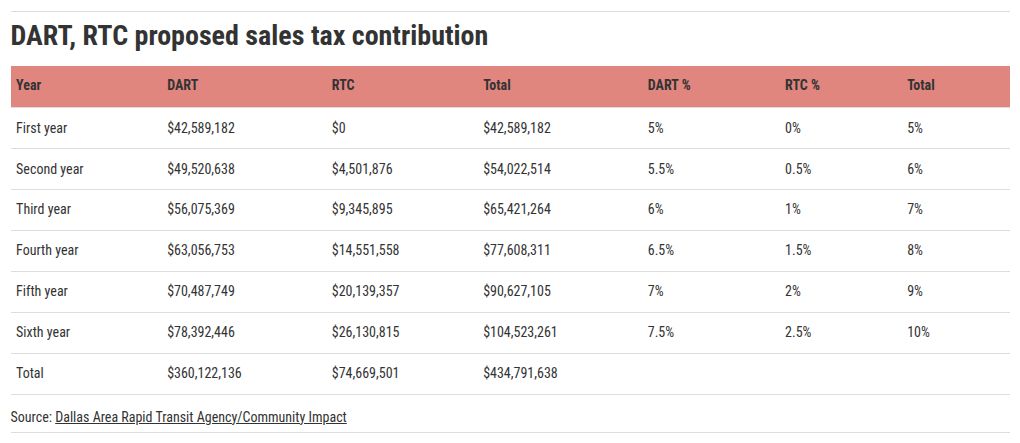
The agency’s previous general mobility program, approved last March, would have returned $186.5 million to certain cities over six years. The new proposal the DART board will consider would return $434.8 million to all cities for local transit, according to meeting documents.
The funds for returning 25% of collected sales tax to member cities would be gathered from three sources:
Guaranteed base funding from DART and the Regional Transportation CommitteeTransferring the regional rail system to an independent management authorityCreating new revenue streamsDART and RTC’s contribution would provide a base of 10% sales tax return, and DART officials would work with other regional authorities to make up the rest of the 25% contribution.
Meeting documents state DART’s contribution to funding the sales tax return would start at 5% and increase to 7.5% over six years, while the RTC would have fixed dollar contributions and eventually increase to contributing 2.5%.
The board discussed using vehicle registration fees in nonmember cities as a potential new revenue stream, which Bryant said expansion or new application of would require legislative action.
“Regardless of the services that we provide for our riders, one of our most notable achievements is removing cars from the road,” Bryant said. “If this region is going to experience the growth, and if TxDOT is going to say we need more transit across the state, then those that are benefiting from what we’re doing and those that are advocating for more of what we’re doing have to step up.”
The debate
Enrique MacGregor, board representative for Cockrell Hill and Dallas, was the only board member who voted against the funding plan. He said that although the proposal showed a good faith effort to work with the member cities, he was concerned that cities would continue to demand more money after the new program is in place.
“I have no doubt in my mind that except for some possible smaller exceptions, on election day, DART will win,” MacGregor said. “What’s happening is now we’re just handing money out to cities that threaten with [withdrawing] as a way to get money.”
The cities would have the ability to decide how to use the returned funds, Bryant said, whether that’s investing in their local transit services or working on roads.
Irving Mayor Rick Stopfer said his city would use the recaptured funds to support local DART programs.
“I get a little frustrated when people say that we’re after a money grab,” Stopfer said. “It was not set up because we were looking for dollars and cents. It was set up because we’re trying to figure out how to provide a better service.”
Several board members, including board representative for Garland Marc Abraham, said that the new program and the control it gives to individual cities will make it easier for DART to expand and add more member cities.
“We have to add new member cities,” Abraham said. “The population’s growing up north [in] Frisco, McKinney, Prosper. That’s where it is, so we’ve got to serve that area, and we’ve got to figure out how, but we can’t do that when we’re infighting with each other.”
CEO Nadine Lee said the plan will have a “significant impact financially” on DART and could result in reduced services and operations. While the “best case scenario” would be cities using their recaptured funds to bolster their own DART programs as Irving Mayor Stopfer proposed, Lee said she has not heard many cities make that offer.
“Reducing our services even further will only exacerbate the complaints that we hear from our cities,” Lee said. “We’re accused of having empty buses, and I think the buses will be even more empty because the services just aren’t going to be up to par.”
Next steps
“I’m asking us and our cities and the [North Central Texas Council of Governments] and the region, and ultimately the state, to commit to a process for six years,” Bryant said.
In six years, the cities who called withdrawal elections would have the ability to call one again. After three legislative sessions and six years of attempting this new process, Bryant said he would understand at that point if member cities again wanted to consider withdrawing.
Dates to know
Feb. 12: RTC workshop and potential action on funding partnership programFeb. 23: Collin and Denton County ballot language finalization deadlineFeb. 23: Plano City Council considers alternative transit service contractFeb. 24: DART Committee of the Whole/Board consideration of new GMP interlocal agreement to replace prior GMP interlocal agreementFeb. 27: Dallas County ballot language finalization deadlineMarch 18: deadline to rescind electionMarch 24: DART public hearing on potential services changesMay 2: withdrawal elections