

City officials tabled a vote Tuesday over a power conglomerate’s request for more land to operate a data center in southeast Fort Worth.
City Council members cited concerns about potential impact on infrastructure and resources, requesting more information about the project’s plans.
Black Mountain, the Fort Worth-based power giant, has obtained and rezoned over 450 acres for a planned $10 billion data center.
The company and its CEO Rhett Bennett requested City Council members approve rezoning 80 acres from agricultural to light industrial use in a Feb. 10 meeting. The land is split into two zoning items, with one requesting the rezoning of 42 acres and the other 38 acres.
City leaders were originally set to vote on the zone change for the 42 acres in a January meeting.
Black Mountain received approval from the zoning commission in meetings from December and January to rezone the 80 acres.
The company has pursued multiple zoning cases beginning in January 2025. If both zone change requests are ultimately approved by Fort Worth City Council members, the company’s land for the data center would total around 530 acres.
Council member Jeanette Martinez said she was not comfortable moving forward with the amended zoning due to a lack of information regarding the impacts of data centers and how it would affect the city’s infrastructure and resources.
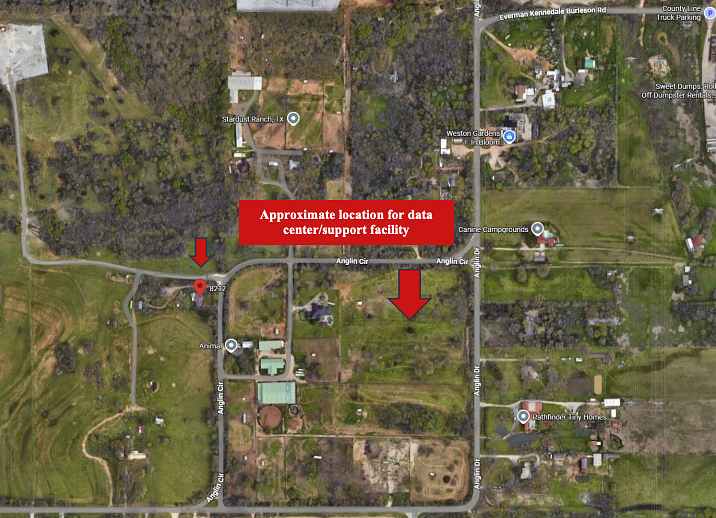 Fort Worth-based energy giant Black Mountain plans to operate a data center in southeast Fort Worth, between Forest Hill and Everman. (Courtesy photo | City of Fort Worth)
Council member Chris Nettles requested the company return March 10 with the proposed land changes, along with clarifications explaining whether the additional land parcels are needed for more construction of the data center.
“I need real clarity of what the whole complex is going to look like,” Nettles said.
The project has drawn criticism from the public, including neighboring businesses and residents.
Sue Weston’s business, Weston Gardens, sits roughly 100 yards from Black Mountain’s land. She and other residents asked council members in September to reject the zoning change, emphasizing the data center would hinder nearby businesses and impact natural areas due to noise pollution, traffic congestion and water usage.
Bennett said in response that the company took its neighbors into account and plans to include a buffer to mitigate noise disturbances. The project will rely on well water and the city’s municipal water supply, he explained.
Large data centers can consume as much as 5 million gallons a day — enough water to supply a town between 10,000 and 50,000 people, according to the Environmental and Energy Study Institute.
The facilities also require hundreds of megawatts of electricity. A single megawatt can power the average American home for over a month.
Letitia Wilbourn, an environmental justice advocate and Echo Heights resident, said Black Mountain representatives should have met with residents and community leaders from neighboring areas, including the cities of Arlington, Mansfield and Kennedale, to notify them of potential impacts.
She described the area where the data center will sit as “already highly polluted.”
The company met with city officials with Forest Hill and Everman in February to discuss project plans, said Bob Riley, a consultant with engineering firm Halff, the company working with Black Mountain.
Black Mountain did not immediately respond to the Fort Worth Report’s request for an interview.
State records show the company has plans to operate other data centers across various counties in North Texas.
A company listed as Fort Worth Power Core LLC, which shares the same mailing address as Black Mountain, obtained air quality permits issued by the Texas Commission on Environmental Quality, the state’s environmental regulation agency. The permits allow the company to operate facilities in:
Bell County
Carson County
Fannin County
Hale County
Jack County
Parker County
Tarrant County
Somervell County
Wheeler County
Williamson County
The permits authorize the company to conduct power generation and electric services, records show.
Nicole Lopez is the environment reporter for the Fort Worth Report. Contact her at nicole.lopez@fortworthreport.org.
At the Fort Worth Report, news decisions are made independently of our board members and financial supporters. Read more about our editorial independence policy here.
This <a target=”_blank” href=”https://fortworthreport.org/2026/02/11/10b-data-center-hits-wall-after-fort-worth-leaders-cite-resources-land-usage-concerns/”>article</a> first appeared on <a target=”_blank” href=”https://fortworthreport.org”>Fort Worth Report</a> and is republished here under a <a target=”_blank” href=”https://creativecommons.org/licenses/by-nd/4.0/”>Creative Commons Attribution-NoDerivatives 4.0 International License</a>.<img src=”https://i0.wp.com/fortworthreport.org/wp-content/uploads/2021/04/cropped-favicon.png?resize=150%2C150&quality=80&ssl=1″ style=”width:1em;height:1em;margin-left:10px;”>
<img id=”republication-tracker-tool-source” src=”https://fortworthreport.org/?republication-pixel=true&post=405465&ga4=2820184429″ style=”width:1px;height:1px;”><script> PARSELY = { autotrack: false, onload: function() { PARSELY.beacon.trackPageView({ url: “https://fortworthreport.org/2026/02/11/10b-data-center-hits-wall-after-fort-worth-leaders-cite-resources-land-usage-concerns/”, urlref: window.location.href }); } } </script> <script id=”parsely-cfg” src=”//cdn.parsely.com/keys/fortworthreport.org/p.js”></script>