
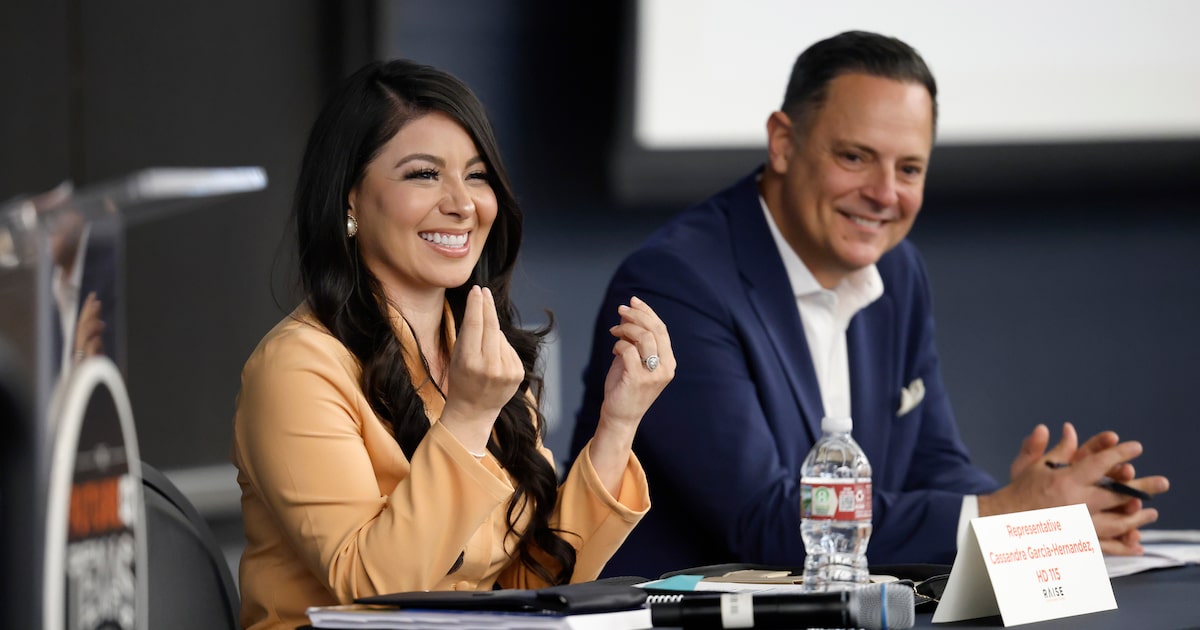
Two North Texas state lawmakers said during a town hall meeting Wednesday that state leaders have a duty to make sure public school districts have the financial support they need to educate the state’s students.
Rep. Cassandra Garcia Hernandez, D-Farmers Branch, and Rep. Rafael Anchia, D-Dallas, spoke at Carrollton-Farmers Branch ISD’s Nancy Watten Technology and Events Center during a town hall meeting on public education. The event was organized by the education advocacy group Raise Your Hand Texas, as a part of a series of candidate forums in cities across the state. Both Anchia and Garcia Hernandez are running unopposed in next month’s Democratic primary.
Here are five key takeaways from the meeting:
A lack of funding is leading to tough decisions in Texas schools
The Education Lab
During the last legislative session, lawmakers sent $8.5 billion in new money to Texas schools, mainly for teacher pay raises. But Anchia said lawmakers didn’t raise the state’s per-pupil allotment enough to put districts on sound financial footing. Insufficient funding from the state, combined with declining revenue from enrollment losses, are leaving districts in a bind, he said. He noted that many districts are closing and consolidating schools in an effort to shore up their budgets.
Education savings accounts make school budgets even more complicated
Texas lawmakers passed a $1 billion education savings account plan last year. Gov. Greg Abbott and other proponents have said the plan, which offers families public money to pay for private school tuition or other expenses such as homeschool costs, will create more competition, forcing school districts to improve their offerings.
But Garcia Hernandez said that increased competition also forces districts to recruit students in a way they’ve never had to before, without a budget to do it. At a time when districts are losing enrollment due to declining birth rates and increased competition from charter schools, she said she worries about the impact the new education savings account program will have on public school budgets.
School property tax elimination is unlikely, both lawmakers agreed
Abbott has proposed a plan to eliminate the school property taxes paid by homeowners across the state, and using state budget surpluses to cover the funding gap for schools.
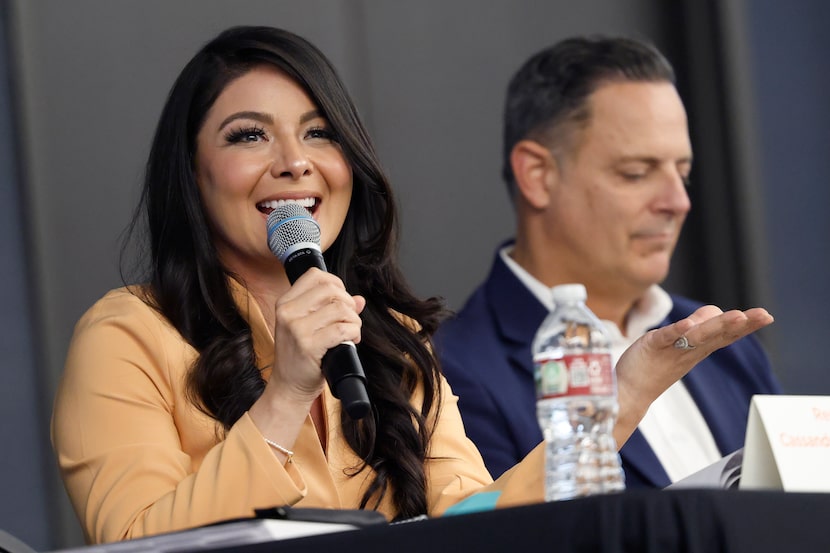
State Representatives Cassandra Garcia-Hernandez of District 115 (left) responds to a question as Rafael Anchia of District 103 listens during a panel discussion about education hosted by Raise Your Hand Texas at the Carrollton-Farmers Branch Conference Center in Irving, February 11, 2026.
Tom Fox / Staff Photographer
Garcia Hernandez said that plan would be all but impossible to carry out under Texas’ current tax structure. If it were to happen, she said the idea of leaving the duty of funding public schools solely in the hands of state lawmakers and the governor leaves her worried. Doing so would take decision-making power away from the communities those school districts serve, she said.
Anchia added that Texas’ constitution severely limits the number of methods the state has for bringing in revenue. Texas has no state income tax or statewide property tax. If the state were to abolish school property taxes, it would likely cause sales tax to skyrocket, he said. That would be bad for schools because sales tax is a less stable source of revenue, and bad for retailers because it would drive their prices up dramatically, he said.
State takeovers may sometimes be necessary, but…
Both Garcia Hernandez and Anchia said they recognize that there are cases in which a school district is in such bad shape that the Texas Education Agency has no choice but to step in.
But both agreed that many of the state takeovers should be used as a last resort. Anchia said he’d seen little evidence that state-appointed school boards do a better job of running their districts than elected boards do. That being the case, he said he’d prefer to see the state default toward leaving districts in the hands of democratically elected board members who are accountable to the communities they serve.
“My view is that that should always be the default, and only in extreme circumstances do you do a takeover,” he said. “But I don’t think that Fort Worth, especially, was that set of circumstances.”
Garcia Hernandez agreed. There may be cases in which a takeover is necessary, she said, but it should only come after state officials have tried to intervene in other ways. The state should begin by bringing resources into districts and working alongside the people in charge, she said. If that doesn’t lead to progress, she said, a takeover may still be necessary.
“It needs to be support, not punishment,” she said.
Policies around technology in the classroom are evolving
Last year, state lawmakers passed a bill barring students from using cell phones in class.
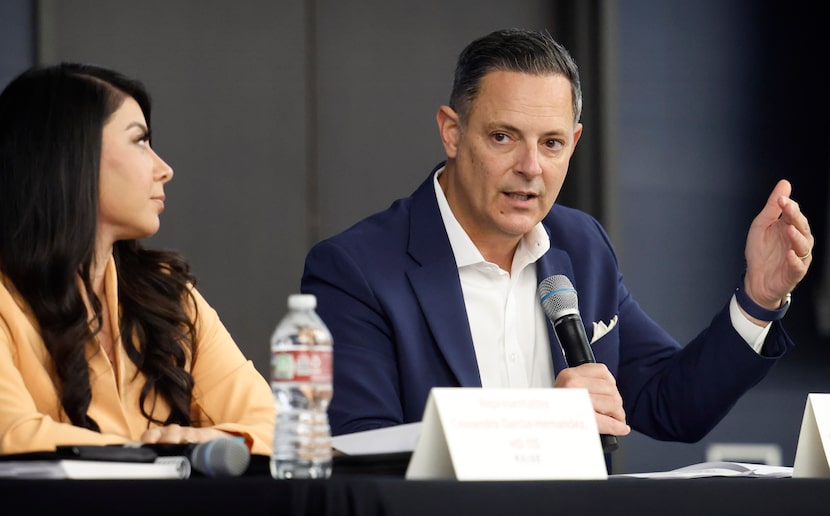
State Representative Rafael Anchia of District 103 (right) responds to a question as Cassandra Garcia-Hernandez of District 115 listens during a panel discussion about education hosted by Raise Your Hand Texas at the Carrollton-Farmers Branch Conference Center in Irving, February 11, 2026.
Tom Fox / Staff Photographer
Garcia Hernandez, who was one of the bill’s authors, said she heard little pushback from constituents about the idea. The few people who expressed concern were parents who were worried about being able to reach their children in an emergency like a school shooting, she said.
But Garcia Hernandez said the benefits of the policy are clear: Students are more engaged in class and teachers have fewer distractions to contend with. The policy wasn’t perfect, she said — the state gave districts no extra funding to pay for equipment like magnetic pouches some districts require students to store their phones in during the day — but she’s pleased with the results she’s heard about so far.
Going forward, Garcia Hernandez said lawmakers are discussing the idea of creating similar policies limiting how and when students may use other devices, like tablets. Schools need to help students learn to use technology appropriately, she said, so it may not be possible to ban those devices outright. But it’s important that classroom technology contributes to students’ education and doesn’t disrupt it, she said.
The DMN Education Lab deepens the coverage and conversation about urgent education issues critical to the future of North Texas.
The DMN Education Lab is a community-funded journalism initiative, with support from Bobby and Lottye Lyle, Communities Foundation of Texas, The Dallas Foundation, Dallas Regional Chamber, Deedie Rose, Garrett and Cecilia Boone, Judy and Jim Gibbs, The Meadows Foundation, The Murrell Foundation, Ron and Phyllis Steinhart, Solutions Journalism Network, Southern Methodist University, Sydney Smith Hicks, and the University of Texas at Dallas. The Dallas Morning News retains full editorial control of the Education Lab’s journalism.