

Any honest libertarian seeking elected office faces an existential crisis: He can lose a hero or win and become an arm of the villain. Despite his best efforts to stay a hero in recent years, Don Huffines—loser of both a 2018 reelection bid for the Texas Senate and a 2022 race for governor, and brother of an aide to many leaders of our great state—is close again to being part of the problem that he says has plagued his life: the government.
Huffines currently stands as the polling favorite in the race to become the GOP nominee for Texas comptroller, a role in which he’d oversee the state’s finances, and in which he promises to “DOGE” an already austere state budget. The raspy, Murray Rothbard–quoting, Tea Party crusader from Dallas has spent his recent years out of office blaming an ever-growing list of grievances on the tyrannical forces in Austin. Drawing his ire: vaccine mandates for government employees (even though he’s gainfully self-employed and runs a real estate empire), property taxes (fair enough), and also, apparently, the traffic jams he’s been sitting in. The personal, rest assured, always seems political.
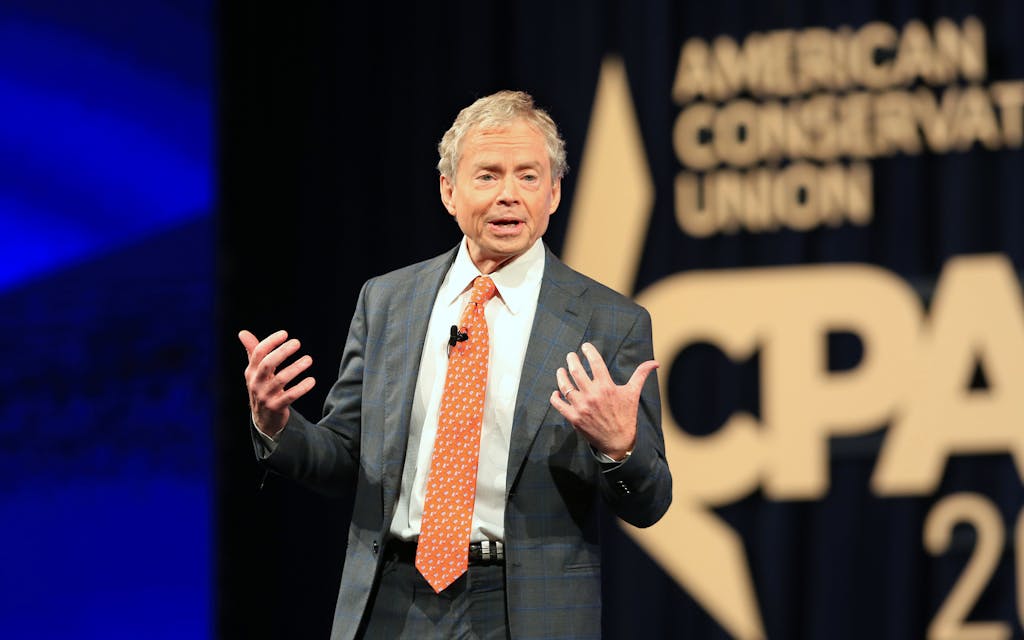 Former state Senator Don Huffines speaking during the Conservative Political Action Conference in Dallas on July 10, 2021.Dylan Hollingsworth/Bloomberg via Getty
Huffines has tidily resolved the contradiction of seeking-office-while-hating-office with a simple platitude: “The fundamental role of government,” I heard him tell a crowd in Dripping Springs in 2022, “is to protect you from the government.” Should Huffines prevail in the March 3 GOP primary against Kelly Hancock, Christi Craddick, and Michael Berlanga, almost certainly assuring victory in November, there will be no one to protect the government from him.
You’d be forgiven for not knowing much about the race. Indeed, you’d be forgiven for not knowing much about the office. No one gets into politics to be comptroller. Governors get a pulpit, lieutenant governors get to set policy, attorneys general get indicted. Comptrollers, on the other hand, work at a desk and release impact studies. With rare exception, the office has served during the last few decades as a landing place for careers that failed to launch—a seat for those who seek prestige but settle, reluctantly, for power.
If you believe in government, the charge of the office keeps things downright boring. But if you don’t, the nearly three-thousand-employee agency is something of a content house, a space where you can publicize your comings and goings and build a brand. The comptroller’s largest duty is to collect taxes and provide the Legislature with a revenue estimate heading into each biannual session against which it must balance the budget. Want to cut state spending? Offer a dreary forecast and make a show of it. (Famously, Comptroller Susan Combs’s 2012–2013 revenue underestimate of $11.3 billion pushed lawmakers to cut more than $5 billion for public education during the 2011 session.) The office also controls state grant funding—allocating money for, say, counties that install broadband—and approves all vendors who receive state contracts. Don’t like environmental protections? End state grants for wetland conservation and steer state bids away from companies with green investments.
Decades ago we had politicians—Bob Bullock in the seventies and eighties, John Sharp in the nineties—who knew how to wield the office’s tools to make a name for it and themselves. Now, after a three-decade Lent, the stunts are back. The launching of Elon Musk’s Department of Government Efficiency in Washington, D.C., has created an army of armchair accountants, and in turn the primary for comptroller has become a Facebook Marketplace of ideas. The three lead candidates—Craddick, Hancock, and Huffines—have all pledged on social media to end DEI in Texas after the state government has done so no fewer than three times, to use the power of the purse to close a border Trump has already closed, and to DOGE whatever the Lege’s 2025 DOGE committee failed to DOGE. They all told me that the government is too large and inefficient, and they shared the bespoke idea to finally “treat it like a business”—or, at least, like a “kitchen-table” discussion.
“The comptroller is an extremely important position and has a lot of authority, and it hasn’t historically been treated that way,” Huffines, who has bright-blue eyes and a shock of curly white hair that sometimes flirts with unkemptness, told me in a somewhat dreary twang. He broke into an elfin smile. “I plan on using it differently.”
Over Zoom from his Dallas office, Huffines then began to outline the specific levers he would pull as comptroller to achieve an efficient government and to achieve his longtime goal of alleviating Texans’ property taxes. For one, he wouldn’t take a paycheck, which would theoretically allow the state to bring down every homeowner’s property taxes by one and a half cents. He also told me he would withhold funding from any governmental entity with DEI programs, audit and investigate universities to ensure they were spending tax dollars appropriately, and direct local appraisal districts to be more taxpayer friendly. When I asked if there were any grants that he was eyeing to cut, he demurred. “There’ll be many,” he said with a chuckle, declining to name names. “I’m not at liberty right now to discuss that because I’m in a competitive primary.”
Huffines is willing to throw his money around wantonly to ensure the government can’t do the same. He has taken out a $10 million loan. His brother Phillip (not the one who worked for Abbott) has staked him $3 million, and he has amassed a war chest of an additional $2.8 million. That’s been put to use with an ad declaring himself, inefficiently, the only “MAGA Trump Republican” in the race and with billboards across the state—described as “flames of liberty.”
His opponents are also loudly and lavishly campaigning. Hancock, the couth and coiffed acting comptroller who was appointed from the Texas Senate by Greg Abbott in June, has raised more than $3.8 million from the traditional big business wing of the party. He has worked for their devotion: Hancock’s first act in the upper chamber of the Legislature was trying to eliminate the consumer-protection-focused Office of Public Insurance Counsel, and in his subsequent thirteen years in that office, he consistently advocated to protect the insurance industry from lawsuits.
He is now touring Texas, often in a private jet belonging to John Carona, the Republican Huffines primaried out of the state Senate in 2014, and promising to continue to advocate for those interests. In his pitch, he highlights that in his new office he has already ended a Bush-era grant program for Historically Underutilized Businesses (HUB) (“DEI using different letters,” he wrote me), created grant funding for sheriffs who cooperate with Immigration and Customs Enforcement, and worked to exclude schools with ties to “terrorist organizations” from the state’s private school voucher program.
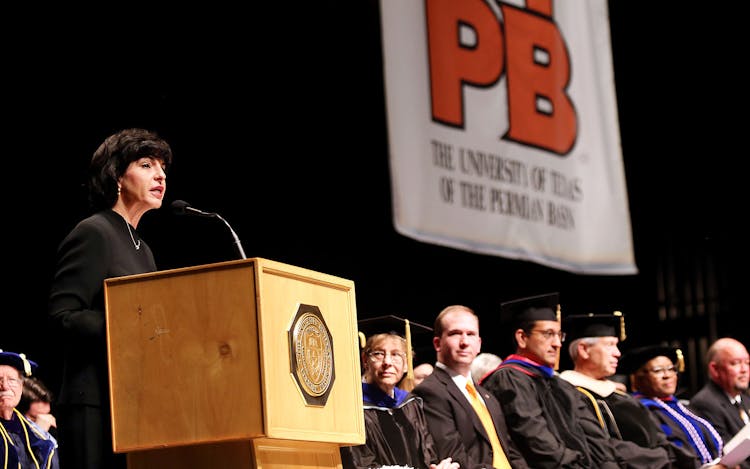 Christi Craddick speaking during the University of Texas–Permian Basin’s commencement ceremony on May 9, 2015. Edyta Blaszczyk/Odessa American via AP
 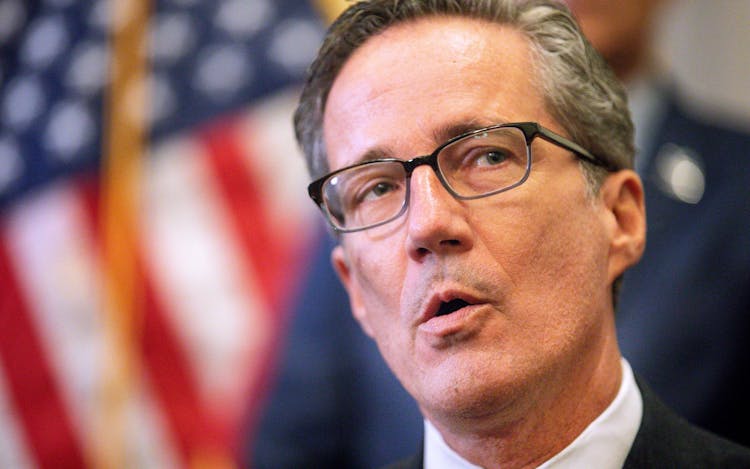 Texas state Senator Kelly Hancock speaking during a press conference where Texas Governor Greg Abbott signed Senate Bills 2 and 3 at the Capitol, in Austin, on June 8, 2021. Montinique Monroe/Getty
Christi Craddick, who currently serves on the Railroad Commission, the state’s oil and gas regulator, has raised nearly $5 million, largely from oil and gas magnates. She too, is a symbol of the status quo—a scion of a powerful Legislative family. To Texas Monthly, she highlighted her work cutting permitting times as her major qualification. On X, she has put her backers’ money into ads touting that the Legislature she’s never served in “banned boys from girls’ sports” and that she’s prepared to “hold the line.” (“As comptroller, my role is financial stewardship,” she replied when Texas Monthly asked her what the comptroller possibly has to do with this area of policy, “but I can absolutely use the office’s oversight and administration responsibilities to ensure state dollars and state-administered programs follow Texas law and the policies the Legislature enacts.”)
The race, then, has drawn representatives of three important Texas conservative constituencies: an insurance industry mouthpiece, an oil industry mouthpiece, and a guy with a big mouth. It has rapidly become the most expensive contest for the office in state history. All of a sudden, as everyone else looks away, big interests are paying attention to one of Texas’s most boring statewide offices.
Are you not entertained?
The Oxford English Dictionary defines the word Republican, of course, but not in a way that usefully describes the wide spectrum of belief in the modern Texas GOP. Within the broad tent of pro-business interests and the religious right, there are some meaningful disagreements. For one, Hancock’s wing supports a tax-incentive program to lure megacorporations to the state; Huffines vehemently opposes what he sees as a Trojan Horse for liberal values and seeks prophylactics to Texas’s “Californication.” (Hancock, for his part, told me the biggest distinction between him and Huffines was not policy but the accident that he’s already in office. “I am all about results, not rhetoric,” he wrote. “I am the only candidate in this race who has done and is currently doing the job of Texas comptroller.” Craddick, similarly, said what made her stand out was that she was “the only candidate who has actually won statewide.”)
There is only one certainty: No matter how conservative an elected official is, there is always someone further to the right of them. Much of the grassroots right wing in Texas believe Abbott—who has signed a near-total abortion ban, a bill letting Texans carry firearms without a permit, and legislation mandating the Ten Commandments be displayed in public school classrooms—is a quisling.
Huffines first came to public office in the Tea Party wave of the Obama era as the Man Further to the Right. He deposed Carona, a sitting Republican senator, in a primary and swept into office—then was promptly swept out by a Democrat in a stunning upset in the next election. But he had a second great awakening during the pandemic, when he deemed Abbott tantamount to a tyrant for imposing mask mandates and restricting business and church activity. (Meanwhile, Huffines’s brother James, the aide, led Abbott’s strike force to reopen the state.) He launched a primary challenge from Abbott’s right.
The race was never a close one, but it did expose a growing faultline in the GOP. Abbott had the support of the big business wing of the party, the traditional conservative power brokers in Texas who flipped the state red in the nineties. The Huffines campaign, on the other hand, was bankrolled by far-right Christian fundamentalist megadonors. A PAC mostly funded by Tim Dunn, the West Texas oilman, and Farris Wilks, also an oilman, contributed $3.7 million.
A month before the 2022 gubernatorial primary, as we concluded an interview, Huffines turned the tables and asked me a question. “From what you are hearing, could I win?” No, I told him; and indeed he lost by 55 percentage points. But I was half wrong. Ultimately Abbott’s head wouldn’t roll, but Huffines did turn which way it faced. To appease the grassroots right wing, Abbott tacked toward Huffines’ positions on immigration (eventually declaring an “invasion” on the border), vaccine mandates (banning them), and property taxes (stopping short of eliminating, but at least seeking to alleviate, them).
Huffines fell. But two years later his backers would become ascendant when the Texas Legislature impeached Attorney General Ken Paxton but failed to remove him from office. Dunn, Paxton’s biggest benefactor, waged war in the 2024 GOP primary against incumbents who voted against his man. (Hancock, one of only two Republican senators to vote to convict, was not up for reelection.) The anti-tort Texans for Lawsuit Reform, the main big business conservative group, largely defended those Dunn was targeting. This time, the far right routed and placed a new class of pugnacious right-wingers in the Lege.
The Christian far right now controls most of the statewide seats too. Abbott, who is backing Hancock, is an opponent, but one who frequently yields. Lieutenant Governor Dan Patrick took a $3 million loan from Dunn’s political action committee during the Paxton impeachment and an additional $2 million from its rebranded iteration last July. Paxton is leaving the AG’s office to pursue a seat in the U.S. Senate, but the four-way GOP primary to replace him has devolved into a pissing contest over who will most plausibly use the office to attack the religious liberty of Muslims. The Overton window is now floor to ceiling.
The traditional, business-oriented conservative wing has largely come to heel in turn. In the fall, it hosted a fundraiser at which a bevy of freshmen lawmakers who had deposed the PAC’s candidates two years ago appeared. In November, it appointed Patrick’s son, Ryan, as its new CEO.
If the GOP Civil War still exists, the comptroller’s race is its final front—though even that battle has now gone cold. Many of TLR’s board members and major backers are floating Hancock, and the group’s PAC gave him a donation. But Ryan Patrick told me the organization doesn’t plan to endorse in the open primary. He rejected a question about whether the group was retreating more generally.
Meanwhile Huffines’s backers include many grassroots, far-right organizations, as well as Dallas businessmen who supported Abbott over him in 2022 (such as hotelier Monty Bennett) and a PAC largely funded by Philadelphia billionaire and voucher-proponent Jeff Yass. Huffines prominently touts the endorsements of the late Charlie Kirk, anti-trans activist Riley Gains, more than two thirds of the members of the State Republican Executive Committee, Senator Ted Cruz, Ron Paul, and DOGE cofounder Vivek Ramaswamy (he always lists Kirk first).
Huffines does not enjoy Dunn and Wilks’s support anymore, however. The latter oilman has totally withdrawn from political spending this cycle. The former has withheld money from other far-right flag bearers—most notably Paxton. When asked about Dunn’s lack of support this go around, a Huffines spokesman evaded the question. “Our campaign is supported by thousands of patriotic Texans from across the state,” he wrote. “Some give their time as volunteers, some serve as prayer warriors, and others generously give their resources to help us share our message statewide.”
Dunn’s withdrawal could relate to Huffines ever-so-slightly rebuking him. In 2024, Huffines pulled out of and disavowed a conference that a Dunn group held about the “war on white America.” Perhaps he is now learning the lesson his own career offered to others: There is always a further right.
But in this race, Huffines is the small-government crusader’s best representative. “I’ll be government too,” he admitted as we wrapped up our interview. “But I’m a bulldog.”
Then, as in 2022, Huffines flipped our roles and asked me a question. “Who runs Texas?” he inquired.
I answered, uncertainly: the Legislature. He laughed out loud. “The Legislature only meets every two years!” he reminded me.
“Who then?” I asked.
“Bureaucrats,” he spat back.
Then he was off to campaign to become one.
Read Next