
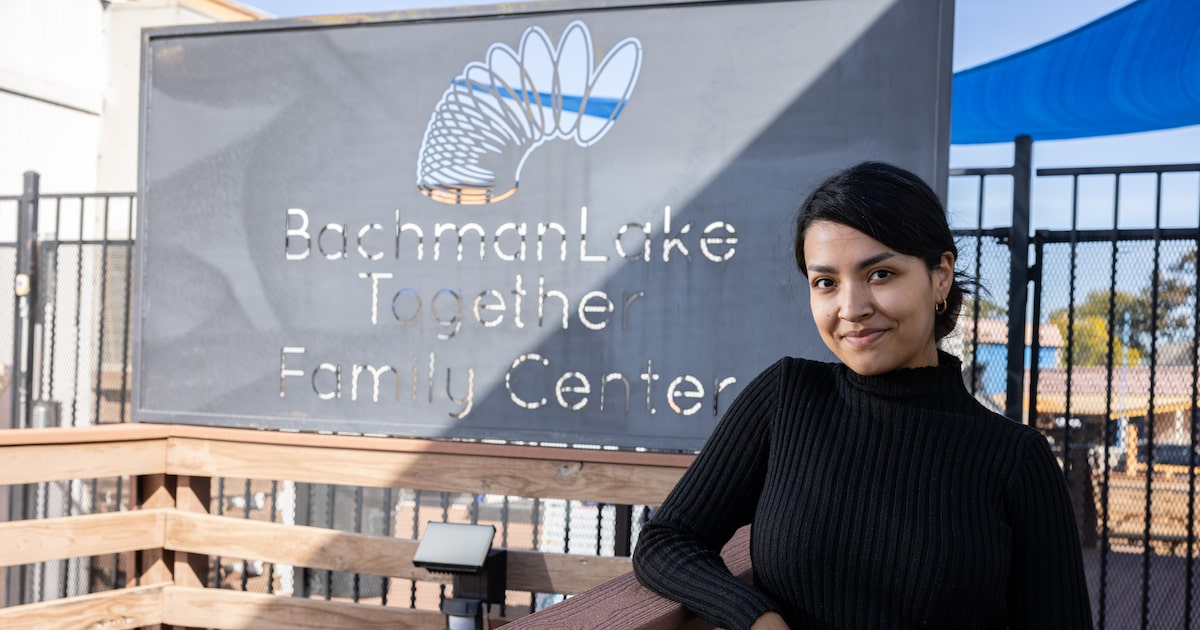
Kamila Vargas-Gonzalez clicked on the email. She knew it was her official job offer, and what it meant for her and her family.
She immediately snapped a screen shot and, with a sense of pride and accomplishment, shared it in her family’s group chat. She was now the development and communications coordinator for Bachman Lake Together.
With tens of thousands of graduates in North Texas still never enrolling in college and most young adults not earning a living wage, leaders say stories like that of Kamila Vargas‑Gonzalez highlight both the power and the limits of the region’s efforts.
Vargas-Gonzalez grew up in a family living on the margins in northwest Dallas’ Bachman Lake neighborhood. That existence made it difficult to imagine ever being her family’s breadwinner.
Her life essentially transformed, thanks to a partnership dedicated to putting Dallas residents into Dallas jobs.
The Education Lab
“This is the greatest outcome we could have had,” she said. “We feel a little bit more liberated, and you can breathe a little bit more. … It affects everybody who I live with.”
Vargas-Gonzalez, 23, made that leap with the help of Dallas County Promise, a scholarship and advising initiative for high school seniors that covers any remaining tuition after financial aid. In partnership with Education Is Freedom and Bachman Lake Together, the regional coalition works to turn local talent into a workforce that can afford to stay in Dallas.
Related

That’s important because, of 23,000 Dallas ISD students who finished high school between 2012 and 2014, nearly half did not make it to college, according to the Texas Higher Education Coordinating Board. And while there are exceptions, a college degree is critical to earning a living wage.
Texas leaders worry current residents will lose out on lucrative job opportunities as state projections show millions of new residents moving to North Texas by 2050 to fill jobs created by company growth and retirements. Only 32% of Dallas County adults ages 25–34 earned at least a living wage of $60,651 in 2023, according to the Commit Partnership (Commit supports The Future of North Texas initiative at The Dallas Morning News).
The cost of getting by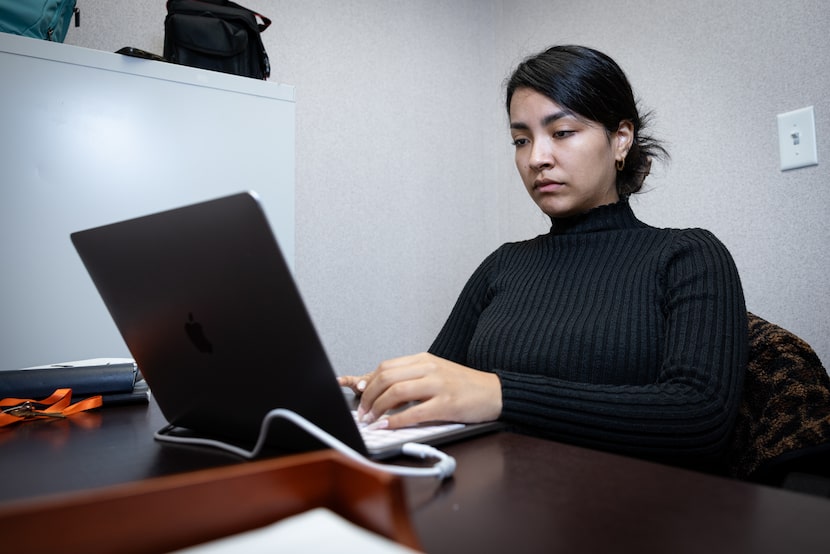
Kamila Vargas-Gonzalez worked on a social media post for a community resource fair at the Bachman Lake Together Family Center when she was an intern on Nov. 10, 2025.
Angela Piazza / Staff Photographer
Growing up in Bachman Lake, Vargas‑Gonzalez saw how hard her family had to work just to keep up with rent and groceries.
Raised by a single mother who worked for minimum wage, Vargas‑Gonzalez and her family moved frequently from one apartment to another, always seeking affordable rent. Living in a heavily Latino neighborhood, her family walked to the public library, neighborhood tiendas, and fiestas across the street.
Her mom and grandmother pieced together service and hourly jobs to support their family. They shared an “unreliable car,” so they occasionally walked home with grocery carts, sometimes racing across traffic to avoid getting hit.
Related

She also said many neighbors lacked reliable transportation and worked jobs that “kind of take advantage of some of the folks’ status to get away with paying them lower wages.” That exploitation is common for low‑income workers in her neighborhood, she said.
For Vargas‑Gonzalez, the path from a cramped apartment near Bachman Lake to Southern Methodist University, and now a salaried job in community work, is a “full circle” moment.
College was “always the plan,” she said, but never guaranteed. The price tag was terrifying. The idea of taking on tens of thousands of dollars in debt felt like a risk she couldn’t afford. She said there was no time to think about college.
“It only existed in neighborhoods like Preston Hollow or Highland Park,” she said, about the wealthy enclaves a short drive from her home.
Things began to change in her senior year at Thomas Jefferson High School, when her Education is Freedom college and career adviser stepped in. The adviser helped her navigate workshops on college applications, financial aid, SAT, ACT, and more. With support, Vargas‑Gonzalez secured a Dallas County Promise scholarship.
Vargas‑Gonzalez completed her associate degree at Dallas College before transferring to SMU, graduating in May 2025 with a Bachelor of Arts in Corporate Communication and Public Affairs.
Related

Financial aid covered part of the bill at Dallas College, and Promise funding helped pay the rest, “lifting off that kind of burden I had off my shoulders, the biggest burden,” she said. At SMU, tuition was covered by the North Texas Community College Scholarship, while Pell Grants covered things such as textbooks, parking, clothing and food.
Without that aid, she believes she would have been “stressed out in debt,” scrambling to patch together work and classes instead of focusing on school.
Talent is everywhere. Access is not.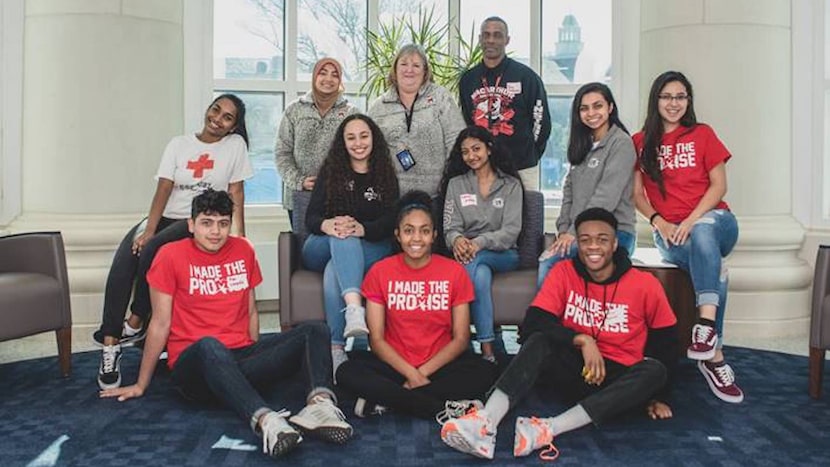
Dallas County Promise, launched by The Commit Partnership, is a coalition created to ease the financial burden of attending college through financial aid grants. The program also pairs students with success coaches.
Courtesy of The Commit Partnership
Launched in 2017 by Dallas College and Commit, Dallas County Promise is a regional coalition of school districts, colleges, universities, employers and community organizations united in an effort to make college access and upward mobility possible for more young people in Dallas.
The program involves 10 colleges and universities and more than 86 high schools across more than a dozen school districts and charter school networks.
Each year, about 98% of eligible seniors in Dallas County, or more than 28,000 students at participating high schools, complete what is known as the Promise Path form, said Eric Ban, executive director of the Economic Mobility Center. The online form connects students to the program’s college and career support.
More than 133,000 students have submitted the Promise Path form since the first Promise seniors graduated in 2018, according to program data. More than 72,000 of them enrolled in college and more than 19,000 completed a postsecondary credential as of fall 2024.
The Economic Mobility Center is a separate nonprofit that manages Promise while Commit and Dallas College focus on boosting living-wage attainment. Ban said the center’s role is to demystify college options for students and coordinate program partners, including Education is Freedom, Dallas College, K-12 districts, universities and, increasingly, employers.
“This was really a community coming together, planning together,” Ban said.
Promise started in response to a sobering data point. Roughly 81,000 people from Dallas County who completed eighth grade between 2012-14 also completed high school, yet about 30,000 never enrolled in higher education, according to the Texas Higher Education Coordinating Board.
Today, more than 60% of jobs in Texas require some postsecondary education or training, according to the Texas Higher Education Coordinating Board.
But Promise was never just about tuition, Ban said. It was always about guiding students into stable careers. “We’ve taken the last 18 months to really build a plan as a community … and start talking to freshmen, sophomores, juniors and seniors,” Ban said, describing efforts to expand programming into lower grade levels.
“You really can’t start having these conversations early enough.”
The Promise program doesn’t itself put students into college classes in high school. But many participants earn dual credit through separate programs offered by school districts and Dallas College.
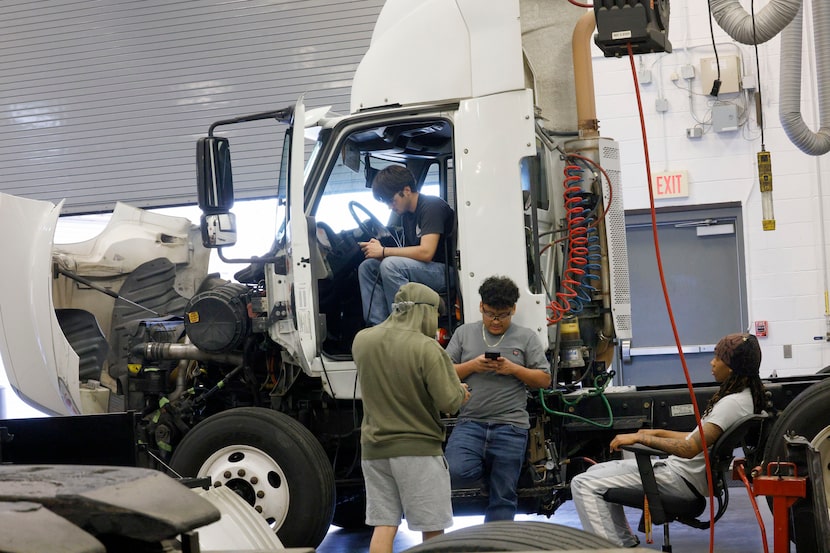
Dallas College Diesel Maintenance Technician Program students Adrian Villalpando, 18, sitting inside the truck, Jeovany Lopez, 19, from left, Alexis Vidal, 19, and Oliver Armstrong, 19, learn about the International TranStar truck during their class at the college, Wednesday, Feb. 26, 2025, in Lancaster.
Chitose Suzuki / Staff Photographer
Most Promise students have a tuition-covered route through Dallas College, and those with stronger GPAs can receive support from four-year university partners, Ban said.
Ban said student outcomes “are going in the right direction.” Policy changes in Texas, along with local data, show “when students show up in Dallas College with 15 [college] credits [earned in high school], it triples their three-year degree completion rates.”
Even with the progress, Ban says too many students who signal interest in college and look academically ready still never enroll in college. Others delay a year or two, pulled first into the labor market by short-term wages and family needs.
Related

That’s why school counseling and career advising matters, said Susanna Russell, CEO of Education Is Freedom. Counseling and career advising early on can help students align their interests and abilities with related classes, financial aid opportunities and career or college programs.
Education Is Freedom emphasizes long-term, individualized support tailored to each student’s needs, Russell said. She described their model as “sustained, consistent, personalized follow-up” rather than just automated reminders.
Doing this is vital. But Texas’ high student-to-counselor ratios and insufficient resources limit the ability of many counselors to provide support that puts students on track to careers or college, advocates say. A single school counselor in Texas sees 300 to 450 students, according to the Texas School Counseling Association.
Russell says Education Is Freedom is now working to reach students even earlier, expanding advising and career exploration efforts into middle schools. The goal is to provide more students with the same experience Vargas-Gonzalez received.
“Students like Kamila remind us why our work matters,” Russell said, “because talent is everywhere. Access and navigation and trusted partners are not, and so we want to ensure that every single student graduates with a plan and the support they need to realize it.”
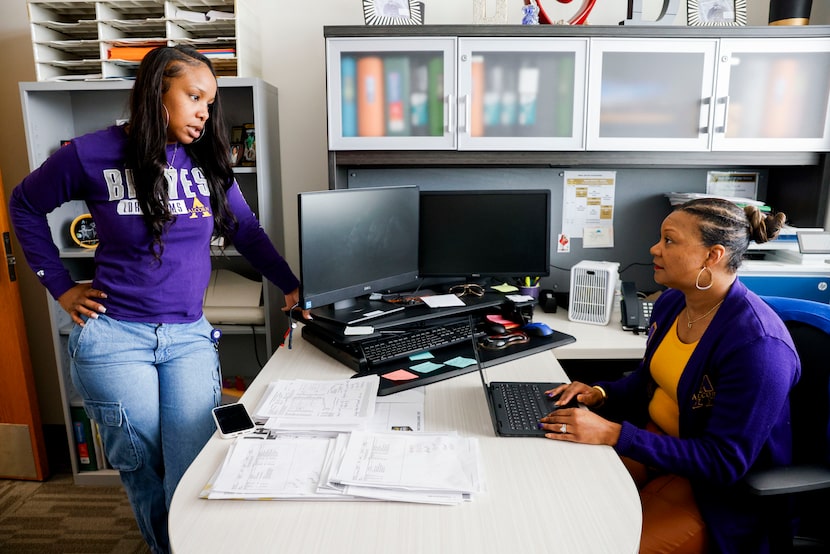
Kendall Gray (left) and Gala Davis (right), both guidance counselors, catch up and talk in Davis’ office at South Oak Cliff High School in Dallas on March 6, 2025.
Liz Rymarev / Staff Photographer
“Liberate our students”
At Bachman Lake Together, Vargas‑Gonzalez is focused on preparing children from birth to age 3 for kindergarten, at a time when roughly half of Texas children aren’t kindergarten‑ready.
The nonprofit serves as a “backbone,” she said, pulling in resources from inside and outside the neighborhood to support families, from early childhood programs to parent leadership training.
Vargas-Gonzalez was initially hired as a fundraising and communications intern in September 2025. She was surprised and proud to find a nonprofit focused on families in her own neighborhood. She could see her neighbors entering the organization’s doors, feeling safe and cared for.
“If people know that we exist, people will want to be part of the beautiful community that we have here,” she said. “Bachman Lake is right next to Preston Hollow. … It’s crazy that we still continue to be isolated from their wealth, and that gap is insane to me.”
Vargas‑Gonzalez met her boss and former mentor, Vanessa Larez Chairez, through SMU. Larez later tipped off Vargas‑Gonzalez to an internship at Commit, and that internship led to the opening at Bachman Lake Together.
Larez, Bachman Lake Together’s development manager, said the nonprofit values having team members like Vargas‑Gonzalez with personal ties to the community.
“All the things aligned,” Larez said. “Her academic background, professionally, and her being from the community and having that unique perspective.”
Bachman Lake Together strives to address the low rates of kindergarten readiness and limited early learning opportunities in the neighborhood, Larez said. It unites nonprofit providers, schools and parents to help children and families succeed.
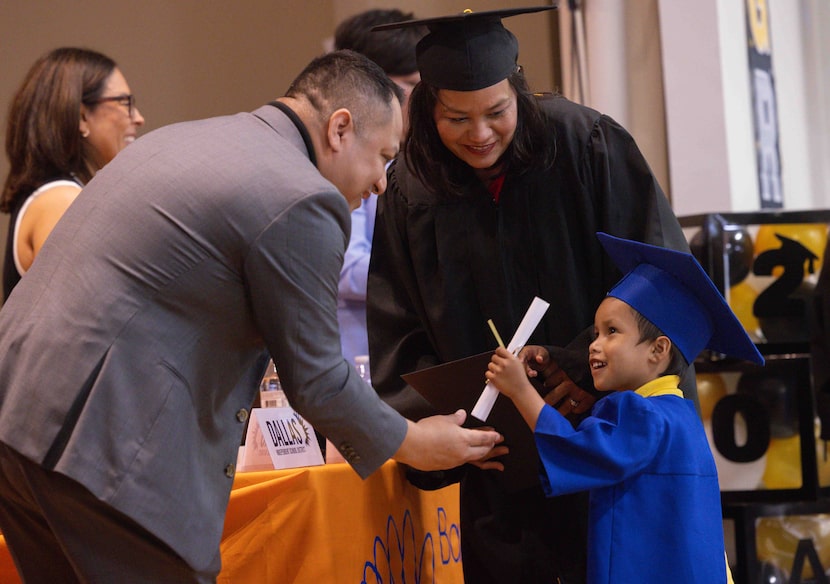
(From left) Israel Rivera, executive director of parent advocacy and support services at Dallas ISD, talks to Cecilia Coreas and her son Rafael Salmerón, 3, as they walk across the stage during the graduation ceremony from the Bachman Lake Together CAN program at the Bachman Lake Center in Dallas on Thursday, May 15, 2025.
Juan Figueroa / Staff Photographer
Vargas‑Gonzalez said service brings her joy, and as she put it, “I’m still part of the community that lives here, just in a different way, in a little bit more privileged way.”
“There had to be a reason for how I grew up,” she said. “The reason I made up for myself was that soon I will become privileged enough to give back all the resources that I took from Highland Park and SMU, and give it back over here.”
Vargas‑Gonzalez now hopes she can help cover health care and a bigger living space for her mom, grandmother and brother. She also wants others to see her experience as a call to action. She encouraged others to step up during her speech at Commit’s Dallas County Economic Mobility Summit last year.
“Don’t take my experience as a feel-good story,” she told attendees. “Take it as a reminder that more work needs to be done to liberate our students from poverty and make postsecondary education and economic mobility truly accessible for all.”
This reporting is part of the Future of North Texas, a community-funded journalism initiative supported by the Commit Partnership, Communities Foundation of Texas, The Dallas Foundation, the Dallas Mavericks, the Dallas Regional Chamber, Deedie Rose, Lisa and Charles Siegel, the McCune-Losinger Family Fund, The Meadows Foundation, the Perot Foundation, the United Way of Metropolitan Dallas and the University of Texas at Dallas. The News retains full editorial control of this coverage.