
A confusing series of events left airlines and passengers in El Paso wondering why the airspace over the city in the US state of Texas would be suddenly closed for 10 days “for special security reasons” and then reopened just hours later.
Government and airline officials, speaking on the condition of anonymity, told reporters the FAA closed the airspace over concerns that a US military laser-based counter-drone system could pose risks to air traffic. The FAA and Department of Defense had planned to discuss the issue at a meeting on February 20, but the Army proceeded without FAA approval, sources said, leading the FAA to halt flights.
The Trump administration said earlier on Wednesday that drones operated by drug cartels in Mexico had breached US airspace, prompting a temporary closure of airspace around El Paso.
The FAA had announced a 10-day closure of the airspace around El Paso. But hours later, it lifted this temporary closure, saying there was no threat to commercial aviation.
“The FAA and [Department of Defense] acted swiftly to address a cartel drone incursion,” Transportation Secretary Sean Duffy said on social media.
“The threat has been neutralized, and there is no danger to commercial travel in the region. The restrictions have been lifted and normal flights are resuming.”
It was unclear why Duffy announced a Mexican cartel drone incursion or why such an incident could lead officials to trigger a 10-day closure rather than a temporary one.
Senate Commerce Committee chair Ted Cruz, a Texas Republican, and Senator Ben Ray Lujan, a New Mexico Democrat, called for a briefing to get more answers.
“The details of what exactly occurred over El Paso are unclear,” Cruz said.
Mexico to investigate El Paso airspace closure
Mexico’s President Claudia Sheinbaum did not confirm the US reports of a cartel drone incursion.
“There is no information regarding the use of drones at the border,” Sheinbaum told her regular morning press conference on Wednesday.
She added that her government was investigating the temporary shutdown of the key border airport in El Paso.
Mexican cartels have been known to use drones to carry out surveillance and attacks in the border region. More than 27,000 drones were detected within 500 meters (1,600 feet) of the border in the last half of 2024, according to Steven Willoughby, the deputy director of the counter-drone program at the Department of Homeland Security.
El Paso politicians slam ‘unnecessary disruption’
El Paso, home to 700,000 people, is a hub for commerce and migration along the US-Mexico border. Its airport is the 71st busiest in the US.
The airspace closure caused major disruptions to the region, with commercial flights by Southwest Airlines, United Airlines and American Airlines among those affected.
“Medical evacuation flights were forced to divert to Las Cruces,” El Paso Mayor Renard Johnson said at a Wednesday morning news conference.
“All aviation operations were grounded, including emergency flights. This was a major and unnecessary disruption, one that has not occurred since 9/11.”
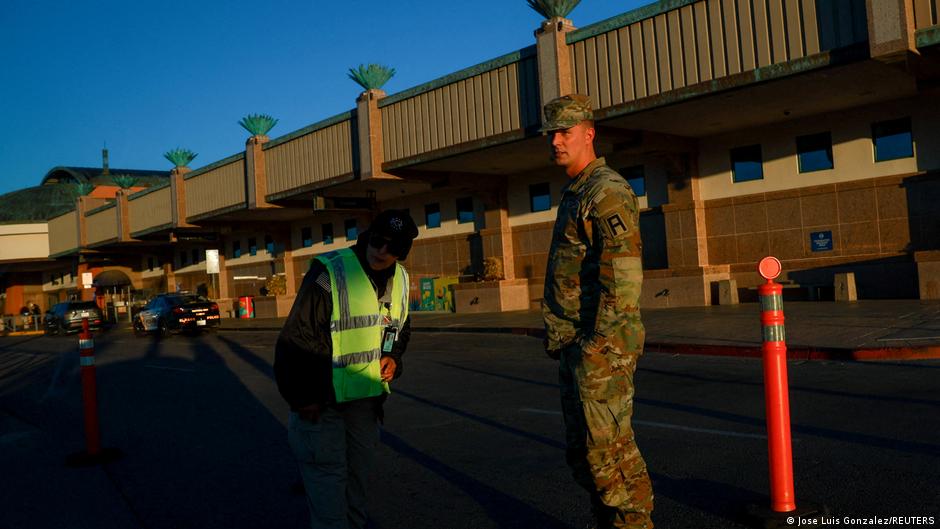
Commercial flights were able to resume once the airspace closure was liftedImage: Jose Luis Gonzalez/REUTERS
Congresswoman Veronica Escobar, a Democrat whose district includes El Paso, called on the FAA to provide further justification as to why airspace was closed so abruptly.
“I believe the FAA owes the community and the country an explanation as to why this happened so suddenly and abruptly and was lifted so suddenly and abruptly,” she said during a morning news conference.
UPDATE: This article has been updated to reflect the US government’s change of reasoning regarding why airspace over El Paso’s airport was closed and then reopened.
Edited by: Jenipher Camino Gonzalez