
Democratic primary voters will select candidates for three district judge positions in the March 3 primary. Because two of the positions have no Republican candidates, the winner of the Democratic primary will be effectively elected to the bench.
Because judges have the power to deprive people of liberty or property, they are among the most powerful positions elected by voters. But because El Paso judicial candidates generally raise small amounts of campaign contributions that they could use to communicate with voters, they often are nearly unknown to most people casting ballots.
The three district courts being contested on the Democratic ballot – the 120th, 168th and 171st district courts – handle criminal and civil cases. New district judges are paid $193,000 a year, with more experienced judges earning up to $238,500 annually.
Four incumbent district court judges – Francisco Dominguez in the 205th, Alyssa Perez in the 264th, Selena Solis in the 267th, and Monique Velarde Reyes in the 270th – are unopposed in the Democratic primary and face no Republican opponent in the fall, meaning they are effectively reelected.
Republicans will have only two candidates for district court seats in the November general election – Ben Ivey, who was appointed by Gov. Greg Abbott to fill a vacancy in the 120th District Court, and R. Wayne Pritchard, who is running for 168th District Court. Neither is opposed in the GOP primary.
CANDIDATE Q&A: 5 questions for candidates in March primary contested races
Texas is one of 13 states that elect most or all judges in partisan elections, meaning candidates are listed on the ballot with a political party affiliation. Only one Republican – Ward Koehler in 1982 – has been elected to a district judgeship in El Paso in records dating to 1900.
El Paso Matters offered interviews to all seven Democrats in contested district court primary races to discuss their history, judicial philosophy, and what voters can take away from their choice of party affiliation. Only one candidate didn’t respond.
 Chris Anchondo and Leonard “Lenny” Morales.
120th District Court
The last person elected to the 120th District Court bench was Maria Salas Mendoza, who gave up the seat when she was elected chief justice of the 8th Court of Appeals in 2024. Ivey was appointed by the governor in 2025 to fill the remainder of her term, which runs through Dec. 31, 2026.
The Democratic primary features two veteran attorneys, Chris Anchondo and Leonard “Lenny” Morales.
Anchondo said he has “that ability to show compassion and the ability to listen to people.”
“While experience does matter, it also comes down to, are you able to show humility? Are you able to show compassion? And I believe I have that. I believe I’ve demonstrated that throughout my career and I feel that that’s what separates me,” he said.
Morales said legal experience and temperament are key characteristics for a judge.
“By temperament, it means that you’re not going to fly off the handle, you’re not going to make snap judgments, you’re not going to get angry and do something that you need to take back later,” he said.
He said legal experience – he’s been an attorney 10 years longer than Anchondo – should be a key difference for voters. “I know I’ve seen many more trials and courtrooms than he has over the years,” Morales said.
Morales is an El Paso native who graduated from the New Mexico Military Institute, the University of Houston and Temple University law school. He served as an Army attorney after graduating from law school, and has had a private practice in El Paso since 2003.
He primarily focuses on criminal defense, and has handled a number of high-profile cases. He represented the man convicted of the 2019 killing of El Paso County Sheriff’s Deputy Peter Herrera, as well as a man acquitted earlier this year in a 1994 triple homicide.
Anchondo has been an attorney for 18 years, practicing both civil and criminal law. He said he’s had more than 100 jury trials as a criminal defense lawyer.
He was born and raised in El Paso and graduated from the University of Texas at El Paso and Penn State law school. He said a good judge sees those appearing in his or her court as people, and listens to what they want.
“People coming into court are not used to being in court. They’re not lawyers. It’s generally a very agitating, very emotional and very anxious experience for most people. And so there’s got to be a human portion to being up there and having basically an effect on everybody’s life depending on the outcome,” Anchondo said.
He said he’s seeking the Democratic nomination because he’s always identified with the party and its values. “I think they stand on due process, and they stand on the Constitution, and they stand on equal protection for everyone,” he said.
Morales said he is running as a Democrat because he views himself as a liberal in the mold of former President John F. Kennedy.
“Someone that is looking forward, someone that’s looking to treat people fairly, to interpret the law fairly, to not put your foot on the scale one way or the other, to call balls and strikes as it were,” he said.
Anchondo so far has funded his campaign largely through a personal $19,000 loan, along with $2,500 donations from attorneys Daniel Anchondo and David Leeper. Morales reported spending about $3,300 from his personal funds.
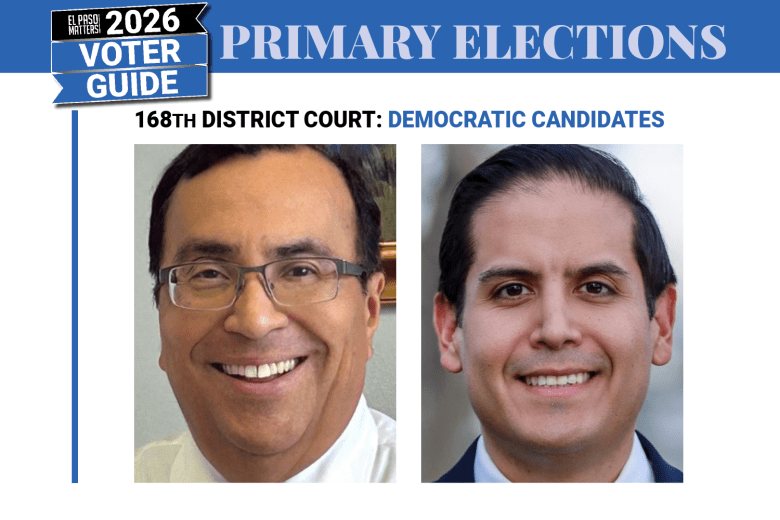 Robert Perez and Bernardo Cruz.
168th District Court
The longtime incumbent on the 168th District Court bench, Marcos Lizarraga, opted to run for a county court at law seat rather than seek re-election.
Three attorneys are seeking the Democratic nomination – Bernardo Cruz, Robert Perez and Enrique Holguin. Holguin told El Paso Matters he isn’t actively campaigning for the seat and didn’t respond to an interview request.
Cruz, who was born in El Paso and grew up in Ciudad Juárez, said he was “a border kid.” He attended El Paso Catholic schools and graduated from UTEP. He worked as a banker before deciding to go to law school at the University of Seattle.
He graduated from law school in 2016, and his initial legal work was with farmworkers in Washington state. His interest in civil rights work brought him back to El Paso in 2018 as an attorney for the American Civil Liberties Union. Since 2023, he has been an assistant county attorney.
Cruz said his experience in civil law, rather than criminal, makes him the best choice for this judgeship, which handles both types of cases.
“Most general judges primarily focus on criminal law experience. And for me, I’ve been focused on civil litigation only. I think I’m prepared to really study and work as hard as possible to learn any new area of law,” he said.
Perez grew up in El Paso and graduated from UTEP and the University of Michigan Law School, long regarded as one of the nation’s premier law schools. He’s been an attorney for 39 years, starting with a two-year tenure as a law clerk for U.S. District Judge Lucius Bunton.
He has handled both civil and criminal cases across the country, and estimates he’s had jury trials during his career.
Perez said he would bring far more experience to the bench than Cruz. He said that will allow him to reduce the case backlog in the 168th District Court that began with the COVID-19 pandemic and continues.
He said he will use a lesson from Bunton, a federal judge from 1979 to 2000: “One of the main things that I learned from him is that good lawyers work things out amongst themselves, if they can, and the court’s there to facilitate that process and at times to push them, because justice delayed is justice denied.
Perez said Bunton demonstrated many of the qualities in a good judge. He said Bunton treated everyone – from jurors to attorneys to parties in the case – with respect.
“First and foremost, I think the judge needs to respect the position that he’s in. Just because you’re a judge doesn’t mean that it automatically comes with any kind of special prestige,” he said.
Cruz said a good judge is someone whose life has led them to interact with a wide range of people.
“I think looking for someone who’s had the type of experience where you think they’ve had access to people from all types of backgrounds, who know the difficulties of the justice system for all populations,” Cruz said. “And I think who’ve performed and acted in a way where you would feel comfortable knowing that, yes, this person has a valid set of values that are close to their heart and that they actually act upon them in a professional way.”
He said he is running as a Democrat because the party best aligns with his values.
“I think that I try to live my life upon certain values – respect for everyone, you treat people with dignity, you work hard, try to use common sense when you can. And I think the party, the Democratic group, to me, at least tries to live up to those values. I don’t see my values reflected in the other major party,” Cruz said.
Perez said he’s running as a Democrat for both practical and personal reasons. He said you can only get elected to a judgeship in El Paso while running as a Democrat. And he said that while he has some conservative positions, he said values from his childhood draw him to the Democratic Party.
“My parents always taught me to treat everybody with respect and to work hard and to never doubt yourself. So I grew up with work ethic and understanding that you need to treat people fairly no matter who they are. And in that respect, I bring that as a Democrat,” he said.
Cruz has raised $29,000 in contributions to his campaign, more than any other candidate for a contested district judge race. He also has loaned his campaign $16,000. His top donations include $2,550 from engineer Diana Ramirez, $2,500 from hotelier Karim Hagar, and $2,000 each from candy store manager Miguel Gonzalez and Jorge Saad, a product manager.
Perez has reported raising only $1,500 from himself. He said he intends to raise more money.
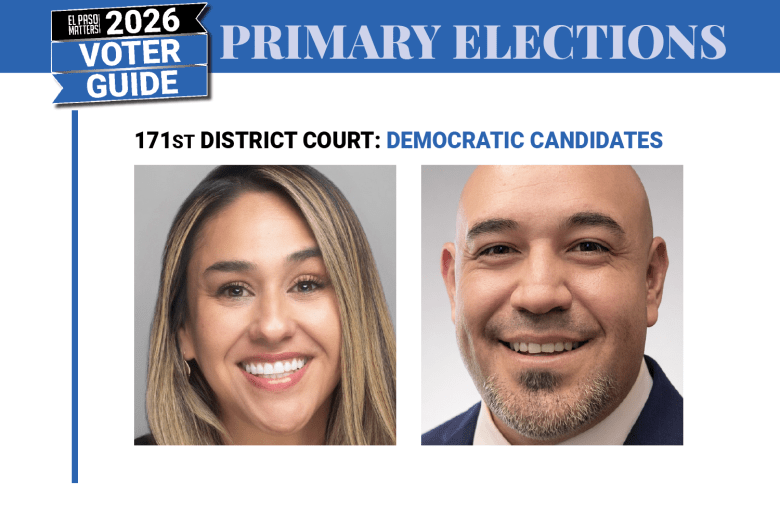 Amanda Enriquez and Alex Cuellar.
171st District Court
Two prosecutors in the District Attorney’s Office are seeking the Democratic nomination for the judgeship held by Bonnie Rangel since 2015. She decided not to seek reelection shortly before the filing deadline in December.
Amanda Enriquez and Alex Cuellar are both experienced prosecutors. Cuellar also is currently a member of the El Paso Independent School District Board of Trustees.
Enriquez said her experience as both a prosecutor and defense attorney, and her experience as a manager, make her the better choice in this election.
“I think my experience having been able to advocate for both sides, more importantly, not only as a public defender and a prosecutor, but running a courtroom is not just dealing with the cases and making rulings, it’s managing the courtroom, managing a docket. I’m your only candidate that has managerial or leadership or supervisory experience,” she said.
Enriquez grew up as a “proud farmer’s daughter” in Canutillo and graduated from UTEP and the Charlotte School of Law in North Carolina. After law school she worked for her uncle’s law firm until she was hired by El Paso District Attorney Jaime Esparza in 2012.
She supported James Montoya in the 2020 Democratic primary to succeed Esparza, and was not retained as a prosecutor by Yvonne Rosales, who defeated Montoya. She was a critic of Rosales – who resigned in 2022 as she faced a court effort to remove her from office – before and after the election.
WHO’S RUNNING? Republicans look to challenge El Paso Democratic stronghold in 2026 elections
She joined the county Public Defender’s Office in 2021 and was promoted to trial team chief. She returned to the DA’s Office in 2025 after Montoya’s election, where she heads the division handling misdemeanor prosecutions.
Cuellar said his experience as an attorney and as an elected official make him the best choice in this race. He said his actions as a board member since 2023 brought change to El Paso’s largest school district, especially in the wake of the controversial decision to close a number of schools.
“It’s the first progressive board that El Paso Independent School District has had in its 140 year history,” he said.
Cuellar grew up in Central El Paso and graduated from UTEP, where he participated in ROTC, and from Washburn School of Law in Kansas.
He returned to El Paso after graduating from law school and worked as a criminal investigator for the Public Defender’s Office from 2010 to 2013 before being hired as a prosecutor in the District Attorney’s Office in 2013. He also worked in the County Attorney’s Office from 2019 to 2023 before returning to the DA’s Office in 2023 as principal attorney in the border prosecution unit.
Cuellar said the most important quality for a judge is being present.
“And I say that in the sense that we have to have working judges in our community, judges that show up early in the morning and leave later in the evening,” he said.
Enriquez said good judges prioritize due process in their courts.
“I think what makes a good judge is a strong advocate (for due process) in the courtroom, somebody who’s comfortable in the courtroom, who has seen both sides. Not only a strong advocate, but they’ve got to have a good temperament,” she said.
Enriquez said she has always supported Democratic candidates and is “horrified” at what she sees as the Trump administration turning its back on the rule of law and due process.
“Due process is not like a technicality. It’s a constitutional promise that we all have, whether we are a citizen or not a citizen, that should be honored and upheld in every court,” she said.
Cuellar said he has a long history of voting as a Democrat. While in law school he worked for Kansas Gov. Kathleen Sebelius, a Democrat who went on to become secretary of Health and Human Services in the Obama administration.
“I am a strong Democrat in terms of community caretaking. It needs to be a safe place to live, and in order for it to be a safe place to live, there has to be rule, law and order,” he said.
Esparza and Montoya, who employed both candidates as prosecutors, have endorsed Enriquez.
Cuellar reported raising a little over $12,000 in his campaign finance report, and spending about $10,000 of his own money. His top donations include $2,500 from attorney Michael Williams and $2,000 from attorney Daniella Labinotti.
Enriquez reported raising just about $34,000, loaning her campaign $10,000 and spending $5,000 of her personal funds in the campaign. Her top donations include $2,500 from Labinotti and $2,000 from the political action committee for the El Paso Association of Firefighters Local 51.
Load more posts
Something went wrong. Please refresh the page and/or try again.
Related