
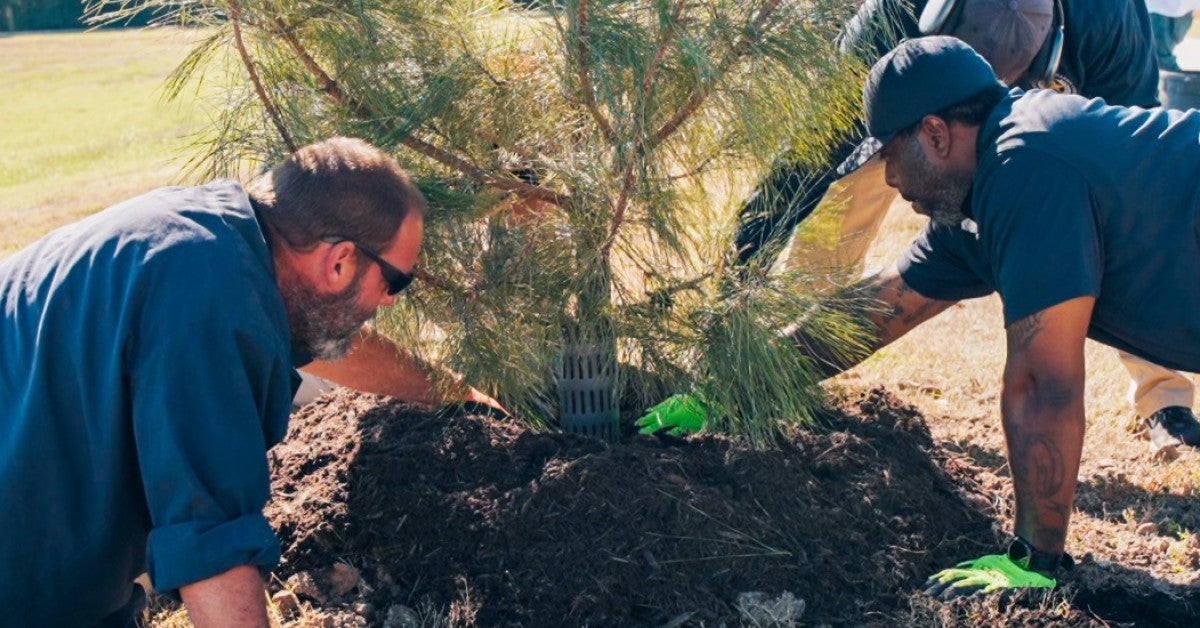
Trees For Houston celebrated its 1 millionth tree planted last week, a milestone for the four-decade old nonprofit. Now, it’s charting a path to the next million — and in much less time.
Trees For Houston leaders said this week they’re ramping up efforts to help cover and cool neighborhoods across the metro area, aiming to combat development that continues to threaten the region’s tree canopy.
The next phase of the organization will require rethinking policy, deepening community partnerships and executing a long-term vision to keep pace with Houston’s expected growth, Executive Director Barry Ward said. Trees For Houston has dramatically scaled up its operations over the past several years, with the annual rate of trees planted rising from about 20,000 to more than 90,000 in the 2024-25 season.
“Planting a tree is kind of like building a house in a microcosm,” Ward said. “It takes planning, consensus-building, follow-up and maintenance. At the rate we’re going, we’ll plant the next million in about 14 or 15 years, at a sustainable level of 70,000 to 75,000 trees a year. The challenge is turning that into 150,000 trees a year and changing expectations.”
As one of the region’s largest nonprofits dedicated to greening the region and neighboring counties, Trees For Houston partners with public and private landowners to deliver, plant and maintain trees. Most of its trees are distributed to homeowners and organizations for their use — the nonprofit counts those as planted trees in its tally — while other trees are spread across parks, schools and other outdoor spaces.
The work counters the loss of trees stemming from continued residential, commercial and industrial development that follows Houston’s rapid growth.
A Kinder Institute analysis of tree canopy data from 2011 to 2021 showed that the vast majority of neighborhoods across Harris County lost tree canopy during that time. Harris County and parts of Fort Bend County combined to lose about 7,200 acres of tree canopy between 2016 and 2022, according to TreeCanopy.US, a collaboration of the Arbor Day Foundation, U.S. Department of Agriculture Forest Service and PlanIT Geo.
Grassroots expansion
Originally founded in the early 1980s, Trees For Houston operated on a relatively small scale for much of its existence.
But at the turn of the decade, local philanthropists and corporate sponsors increased their support of the organization, more than doubling its budget. Over the past four years, the nonprofit averaged more than 80,000 trees planted.
For Ward, physically planting tens of thousands of trees annually is the “easy part” of his job. Rather, the biggest challenges are often logistical: finding locations, receiving permission to plant, ensuring water source availability and creating a tree maintenance plan.
“Consensus-building and building relationships with virtually every neighborhood in the city are required,” Ward said. “The grassroots component simply can’t be removed if you want to be successful. We have to find the place, account for all the infrastructure, and get all the communities and individuals who have a vested interest in that area aligned.”
To expand its reach beyond public land, Trees For Houston distributes tens of thousands of trees annually to residents to plant in their own yards. The distribution model relies on homeowners and organizations willing to shoulder the cost of picking up, planting, watering and tending to trees — responsibilities that many have been willing to pick up.
“If we want to have an effect on the urban canopy in Houston, we have to include private property ownership,” Ward said. “We cannot get enough trees in the ground just by planting in the city right-of-way.”
‘Holding the line’ on canopy
Despite the work of Trees For Houston and other nonprofit and government entities, maintaining Houston’s tree canopy remains an uphill battle.
In addition to development, neighborhoods across Houston are losing trees due to storms, natural causes, excessive heat and poor soil, among other reasons. Several parts of the region — including Acres Home, Spring Branch, and the city of Houston’s northeast side — have lost tree canopy at above-average rates. Much of Alief and Gulfton, meanwhile, have relatively minimal cover.
“At our current rate, which I consider a bare minimum, we’re really just holding the line,” Ward said. “Cities do not naturally replicate their urban canopy.”
Still, Ward said he sees successes to build upon and opportunities for improvement.
Major greenspace projects like Discovery Green, the Cyvia and Melvyn Wolff Prairie at Memorial Park, and the addition of trees along highway embankments exemplify the potential for retaining canopy on a large scale, Ward said.
Ward added that he’s encouraged by the willingness of homeowners and organizations to plant trees on their property. In its 2023-24 season, the organization gave away about 65,000 trees at 127 events.
While he acknowledged the importance of development on Houston’s economy, Ward said local governments could tweak regulations to require builders to plant or preserve more trees without imposing excessive costs.
“Without willpower, money and vision, we will just be toeing the line,” Ward said. “Unless we change policy, code and culture, that’s all we’re ever going to do.”