
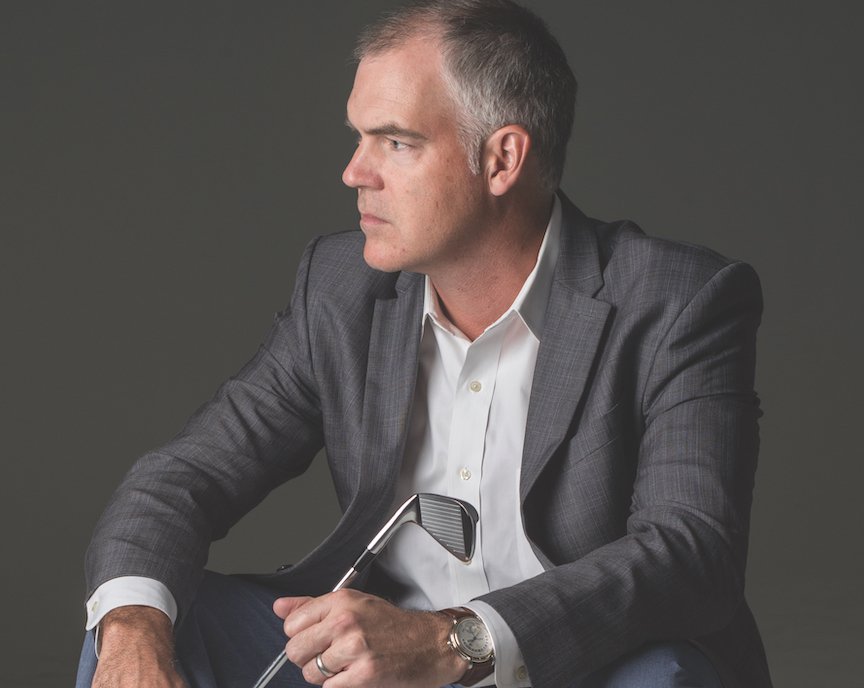
Christopher Griffin was a latecomer to golf, but like one who comes to faith later in life, he discovered a love for the game that was indeed full of flame.
It wasn’t the chase of the handicap that motivated him. It was golf’s story. Its past, its places, and the craftsmanship. The aesthetics and tradition meant more than the score, though he is more than capable of efficiently slapping the ball around the course.
“I was in my mid-30s,” Griffin says. “Most of my rounds, once it really grabbed me, were walking solo rounds, twilight nines. I was very lucky to be at a beautiful public course up in the north of Seattle for most of those rounds. And I just fell in love with the entire experience, really, as much as anything.”
Griffin is a self-described “very aesthetically minded” person. He grew up around a lot of art. A lot of books, he says. And over a period of time, he began to notice something that bothered him as engineers had taken over the club design business over the last generation of play.
It was with that mindset that he had a revelation.
“At some point I realized I was looking in the golf stores, and there wasn’t a single club that appealed to me in any way whatsoever,” Griffin says. “There was no engineering claim that could be made to entice me to play something that looked the way these clubs looked.”
“This is such a beautiful game. It’s played in such a beautiful setting, and yet you look in people’s bags, and it’s just one abomination after another.”
When Griffin began browsing the used racks of old golf clubs, he said it felt like walking through an art gallery, filled with vintage Top Flites, Hogans, Wilsons, and MacGregors. He quickly fell in love with the aesthetics of those classic designs.
“I made a decision that that’s what I was going to play,” he says.
With that began research into what would eventually become Precision53 — P53 — Griffin’s golf club design and manufacturing business based in Fort Worth. It was founded in 2014 and began selling privately to clients since 2000.
His company was founded on two principles — manufactured in America with American steel, and every club is designed as a high-end product and a piece of functional art.
“Those are two things that you just don’t find in the golf industry anymore,” he says. He adds that his is the only golf equipment company in the world “committed to forging its irons in the United States.”
Forged from certified U.S. steel, P53’s irons were the first in over two decades to achieve this.
“We invested in our own tooling and dies and sourced 100% certified U.S. steel for this project. We paid a very high price in both capital and time to do things the right way.”
To borrow a phrase, which I’m sure you’ve heard of, he had a vison to make American irons great again. And he plans to do it inspired by whom we consider America’s greatest golfer, with all due respect to Mr. Jack and Mr. Tiger.
P53 is an homage to the perseverance and persistence of Fort Worth’s Ben Hogan and one of golf history’s greatest seasons, 1953, when the Hawk won the Masters, U.S. Open, and British Open. All only four years after suffering life-threatening injuries in a car accident in West Texas.
“P53 is a tip of the cap to the man,” Griffin says. “I have always appreciated his perseverance in the face of just unbelievable hardship and the unbelievable lack of faith of others. And he prevailed.”
Griffin is an interesting guy.
Raised in Memphis, Griffin earned an English degree with a minor in chemistry from Mississippi College before completing a master’s in English literature at Baylor University. He later added a master of humanities in philosophy from the University of Dallas. After marrying, he settled in Dallas, then moved to Austin in 2003, where he earned an MBA in private equity finance and entrepreneurship from the Red McCombs School of Business at the University of Texas.
Following a series of finance-related roles, Griffin was recruited to the West Coast, where he spent six years at Microsoft working in the venture capital arena. In 2012, he returned Texas.
Griffin had piddled around in college with golf but never seriously. He only picked up the game later because his father-in-law was a player.
“There is no doubt he was drawn here by Ben Hogan and his love for his clubs,” says Marty Leonard, who is leasing Griffin space in the former Nike facility. Leonard’s father, Marvin, founded Colonial Country Club in Fort Worth and was one of Hogan’s closest friends and supporters. “I was so taken by Griffin’s vision and his beautiful golf clubs,” Leonard says. “No one is more passionate than him.”
“My father-in-law had picked up the game after a 30-year hiatus, and that’s what got me into the game. He would come to visit, and to entertain him or while we were there [we’d play golf]. I went down to the big box store and bought whatever set of clubs was on sale on the wall.
“Surprisingly to me, I fell in love with the game.”
Griffin is exacting about what qualifies as a forged iron. P53 clubs are produced using a single billet of U.S.-certified steel sourced from mini steel mills in the Midwest, rather than multipiece constructions that rely on screws, internal weights, or assembled components.
That billet is sent to a family-owned partner forge in the Pacific Northwest, where the irons are shaped using a massive gravity-hammer forge — larger, Griffin notes, than anything commonly seen in even the most revered Japanese forging operations.
The process requires custom tooling and dies designed specifically for P53, a level of investment and control he believes is essential to true forging, even if the broader industry applies the term far more loosely.
“The industry clearly disagrees with me on that, and there’s no regulatory body to enforce it,” he says.
Unlike many manufacturers that contract overseas production and work from preexisting blanks, P53 controls the process from the raw steel forward. After forging in the Pacific Northwest, every head is shipped to Texas, where all machining, grinding, and finishing are completed in-house.
The approach is slower, more expensive, and intentionally uncompromising. For Griffin, however, it is the only way to produce an iron that reflects the integrity, craftsmanship, and performance standards he believes modern golf equipment has largely abandoned.
Each club costs in the four-figure range. He’s very private about how many clients he has. He says the figure is in the hundreds not the thousands.
But suffice to say, he’s very selective about whom he sells to.
“These are exceptionally interesting people from all over the world, mostly in the United States from all different walks of life,” Griffin says. “The attribute that holds us together is sort of a mutual appreciation of some aspect of what I’m trying to do. For some, that’s American manufacturing. For others, it’s the quality of the product. For others, it’s the experience of coming down and spending time with us and getting to know and understand the process.
“But in every case, there’s some identification where someone wants something more than what the industry typically offers.”
Each client — individually — is invited to Fort Worth for a club fitting and conversation about the manufacturing process. Fitting and education take about a day. The next day they play golf at Griffin’s home club.
“It’s ostensibly a testing scenario of fitting with real balls, real pens, second shots on sidehill lies.”
Typically, it takes a hundred days or so to deliver the clubs.
Griffin started this business with Jeff Sheets, a golf club designer. “He was a great set of guardrails for me because he had seen so much in terms of experience.”
In January, P53 acquired all the assets related to club machining, refinishing, and chroming of The Iron Factory, a more than 50-year-old company for top-tier, hand-worked club restoration and chroming.
Griffin leases space at Leonard Golf Links in West Fort Worth. It’s the same facility Nike used before leaving the golf club business in 2016. Marty Leonard has a small investment in the company, she says.
“I think he accomplished what he wants in terms of actually designing and getting a club made that he’s satisfied with because he’s a perfectionist, no question,” says Leonard.
A perfectionist, just like Hogan.
“I think he would like it,” Leonard says of what Hogan would think of Griffin’s enterprise. She knew Hogan well, noting, of course of the mercurial Hawk, with a laugh, “You don’t know about Hogan for sure.”
“But [Griffin] is just about as precise as he was and wanting it to be just exactly almost perfect. I’m encouraged and anxious for him to get the clubs in more people’s hands where people can actually try ’em out.”
As I’m listening to Griffin’s story, it suddenly dawns on me that this unique golf innovator is somewhat like another from yesteryear.
Marvin Leonard had tried to play golf in his early 20s but found it took too long to play. He reasoned that even as a bachelor, he was too busy with an upstart business in downtown Fort Worth to mess with chasing a white ball around a golf course.
A doctor convinced him to change his mind some years later when Leonard was in his early 30s. He needed exercise and recreation, the doctor told him.
Golf became an obsession for Marvin Leonard. Rather than equipment, it was bent grass greens. He was told bent grass, which he discovered in California, could never survive in Texas.
When I suggest the parallel, Griffin almost breaks down. He turns his head slightly from the computer screen so as not to reveal tears welling up.
When he’s able to compose himself, he says to me:
“The thing that I continue to hear about Mr. Marvin was his vision,” Griffin says. “I’m sure Marty would agree, I don’t hold a candle to Mr. Marvin. But what I did appreciate was that he would often do things that would leave others scratching their heads, but he saw something that a lot of people didn’t see.”