
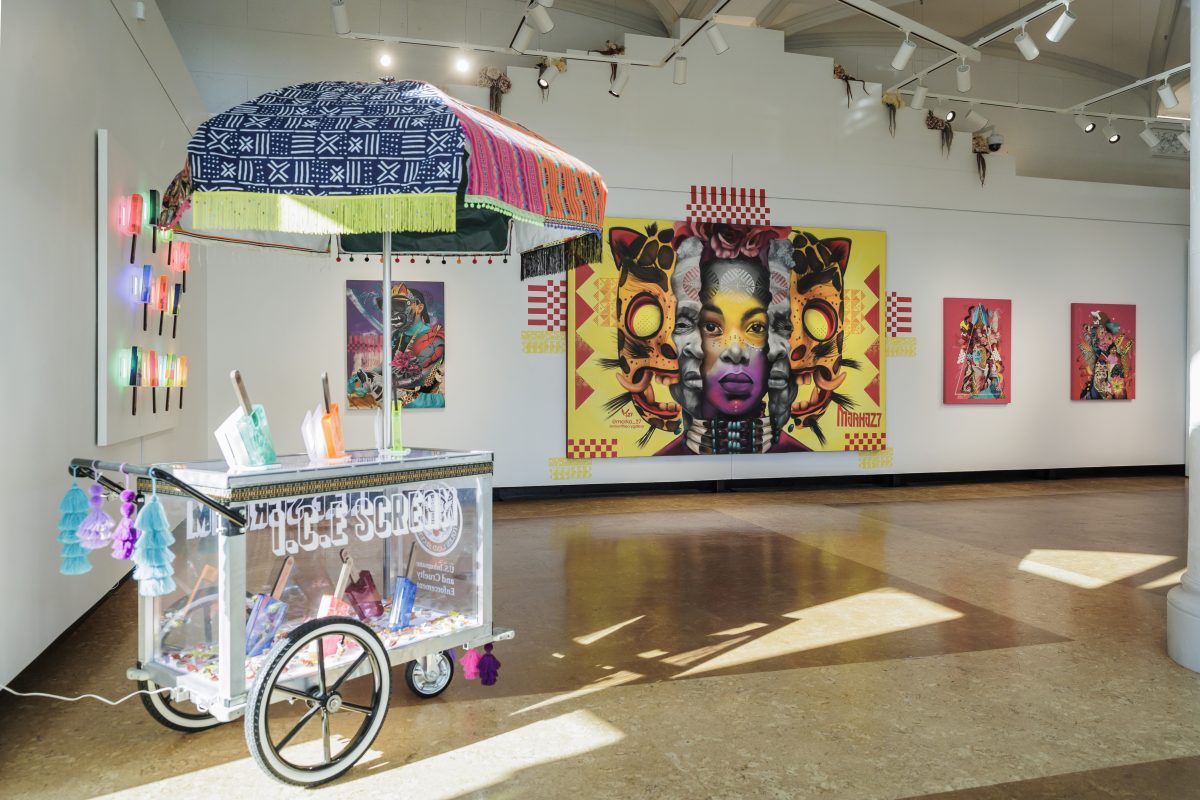
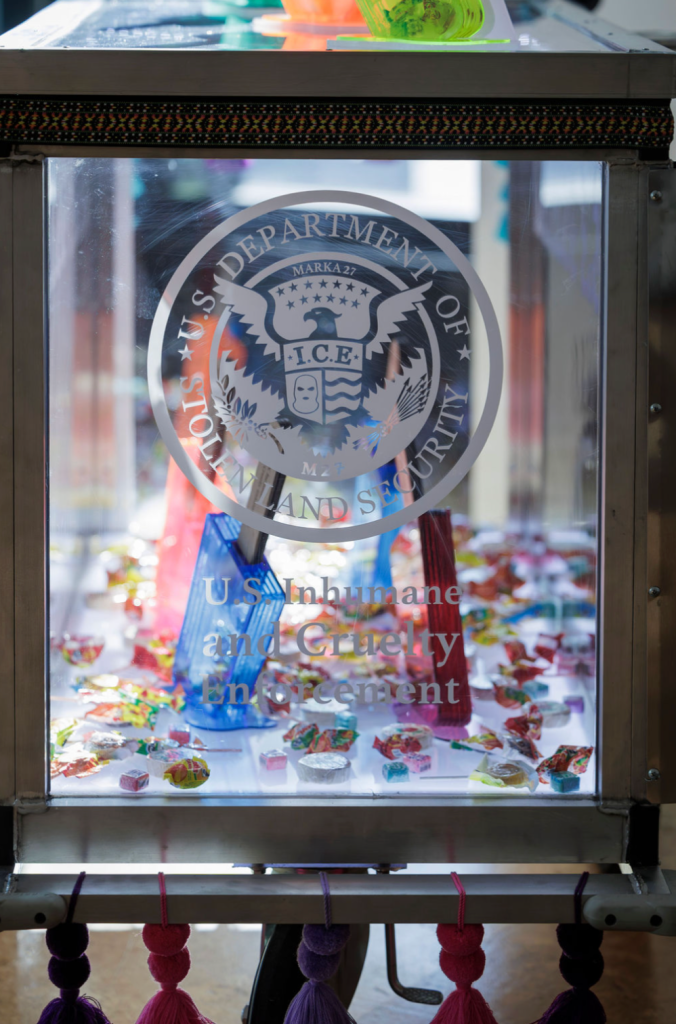
 A piece from the removed installation centers on ICE.
After only a week of display, the University of North Texas has canceled an installation from prominent and award-winning street artist Victor “Marka27” Quiñonez. The collection, titled Ni de Aquí, Ni de Allá (Not From Here, Not From There), is inspired by ICE and Quiñonez’s personal experiences as an undocumented citizen in East Dallas. The exhibit was covered up by the school without notification, and the contract was terminated with little explanation, Quiñonez says.
“I created Ni de Aquí, Ni de Allá to honor the in-between spaces so many of us live in,” reads an official statement from the artist. “To have the work installed, welcomed, and then suddenly hidden behind covered windows without explanation feels like being told, once again, that our stories are too uncomfortable to be seen.”
Ni de Aquí, Ni de Allá is a nationally touring solo exhibition organized by Boston University Art Galleries. It was on its second stop at UNT’s College of Visual Arts and Design (CVAD), and was scheduled to remain on show from Feb. 3 until May 1.
According to Quiñonez’s statement, he received a “brief and vague email” from the university stating that his installation was being removed and that the contract was ending. He says that, prior to the university’s contact, he had been tipped off by students that the gallery’s windows had been covered.
“I didn’t hear it from the institution first. I heard it from students. That matters,” he said. “The work is about visibility, about claiming space. Covering it does not erase the truth it carries. It only proves why it is necessary.”
The Art Work
Quiñonez grew up in the Dallas area after crossing the border with his family at age 4. In his childhood, his father was deported three different times, leaving his mother to support their family until his father could make the treacherous trip over the border again. The artist’s vibrant work paints the somber realities of living without citizenship through the unknowing eyes of children.
His work is a rainbow fusion of Mexican culture in the Yucatan Peninsula. A child of undocumented day laborers in the United States, the collection reflects the street art he grew up sketching on building sides. Large-scale paintings with the sleeping bodies of immigrant children on the backs of their parents, washed in striking purples, give light to the challenging reality of an undocumented childhood and the sacrifices parents make to bring their children to the United States.
Melting neon paletas are reminiscent of the sticky melts that dripped down his young hands in the hot Texas summers as his family looked for work each day. The exhibit, charged with emotion and heartbreak, is a pointed attack on the Trump administration’s mass deportation efforts. Like the jokes on the sticks inside of real paletas, one of the sculpture popsicles is engraved with Quiñonez’s own version of the ICE insignia, reading “Inhumane and Cruelty Enforcement” in a seal bearing the words “Department of Stolen Land Security.”
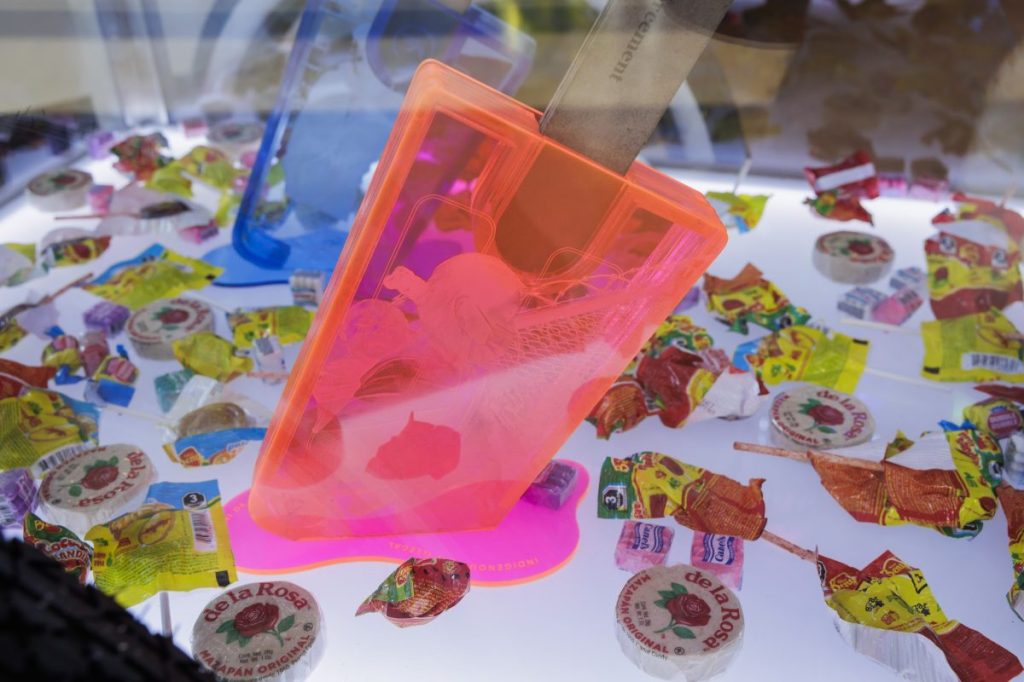 The paletas of Quiñonez’s childhood are an integral piece of Ni de Aquí, Ni de Allá (Not From Here, Not From There).
“I wanted to recreate [a] nostalgic feeling,” Quiñonez told the Observer in an interview before the gallery opened. “I did that because I wanted people to think about what’s happening with these communities and what it is that ICE is really doing and what their job is right now… the only crime they committed was being here illegally, which is a misdemeanor. It’s no reason for you to put somebody in a detention center.”
Quiñonez, who is now based in Brooklyn, gained citizenship four years ago at the age of 37, waiting until the first term of President Donald Trump ended before completing his application. A prior arrest in Dallas, resulting in a 30-day sentence for graffiti vandalism in the ‘90s, prevented the artist from attaining citizenship earlier.
“There’s both a joyous a rebellious experience,” he said about the exhibition. “There’s some pain, but at the same time, there’s a lot of culture being celebrated… I think the biggest message is that this is a humanitarian issue. It’s not an immigrant issue.”
How This Happened
In 67 words, the university notified the artist of the installation’s closure.
“I am writing to let you know that the university has terminated the art loan agreement with Boston University Art Galleries for ‘Ni de Aquí, Ni de Allá,’” reads a portion of the email sent by curator and director of CVAD, Stefanie Dlugosz-Acton. The email, obtained by the Observer, further reads, “The university is making arrangements to return the exhibit to Boston University. Any activities associated with the exhibition are no longer necessary.”
The email did not include a reason for the installation’s removal, but many concerned students on Reddit have described the action as censorship. This isn’t the first time the university has been criticized for removing politically charged art pieces. In March of 2025, part of a pro-Palestinian exhibit was removed after a team of five Republican state lawmakers complained to school officials in a letter. Following pressure from the university, a student artist elected to remove a piece included in The Perceptions: Observations & Reflections of the Western Muslim. The school also canceled a guest lecture about Palestinian children and the politics of genocide following the complaints from lawmakers.
The Denton Record-Chronicle, which broke the story, reports that the installation did not violate the university’s policies on art exhibits.
“Decisions regarding works of art exhibited in UNT facilities shall be consistent with the First Amendment of the U.S. Constitution, the State of Texas Constitution, the principles of academic freedom and academic responsibility, and applicable UNT System Regents Rules, UNT System Regulations, and campus policies,” reads the formal policy.
Quiñonez’s team has requested reasoning for the installation’s removal.
“We are calling on the university to publicly clarify its reasoning and decision-making process,” his official statement reads. “When work addressing identity and migration is removed without explanation, it raises serious concerns about censorship and the narrowing of discourse within academic institutions that are meant to protect intellectual and creative freedom.”
The removal reflects a nationwide cultural shift amid a growing concern about attacks on art.
“This moment underscores the fragile state of cultural expression in the current media and global landscape,” reads the press release. “Across the country and internationally, conversations around migration, identity, race, and belonging are increasingly politicized. Silencing artistic voices that address these realities does not neutralize them. It amplifies the tension between institutions and the communities they serve.”
The Observer contacted UNT’s CVAD for an official statement and will update this story when it receives a response.