
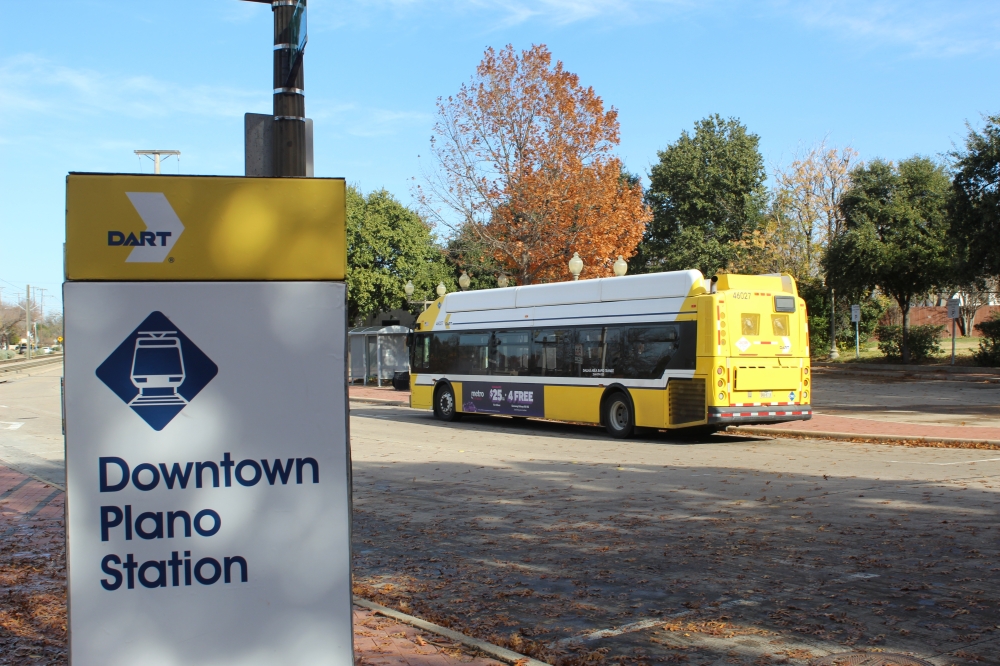
As Plano heads toward a May special election that could determine its future with the Dallas Area Rapid Transit Agency, plans for the city’s alternative public transit service are still under review.
After calling the election in November, Plano officials said they would create an alternate system in Plano using microtransit, an on-demand transit service that uses shuttles or small vehicles to provide flexible rides within specific zones, to ensure continuity of transit service for Plano residents.
However, Plano City Council tabled a vote Feb. 9 to select Via Transportation as the city’s vendor for the system due to progress in negotiations with DART. Plano City Council is now set to consider approving a contract for the alternative system at its Feb. 23 meeting.
Andrew Fortune, Plano’s director of government relations and policy, spoke to Community Impact to answer some questions about the city’s plan.
This interview has been edited for length and clarity.
Can you explain why the city is currently considering microtransit as an alternative?
Microtransit can actually be a very helpful tool to gather real data and to see the patterns of movement for people. Should the citizens decide that they wish to leave the partnership with DART, there may be some changes in how people move and where they’re going [and] what they’re doing, and so microtransit offers, certainly within this initial time frame, an opportunity to establish that. The vendors we are speaking with are able to run fixed route bus systems, so I think in a future scenario where the data [makes] that make sense, that’s absolutely something [to consider]. What we wanted to avoid was arbitrarily placing buses in places that weren’t going to work for folks.
Is Plano still committed to having an alternative transit program in place prior to the election, despite City Council tabling a decision Feb. 9 due to progress in DART negotiations?
We’ve identified from the onset of this entire kind of conversation that we’ve had with DART over the years that there are still service needs that we feel could be better met in the city of Plano, whether it be [with] DART and we have a solution [or] we can find a way forward with an alternative. Depending on the outcome of the vote, the service could serve as a complement to the existing DART system or it could also serve as a system that provides that continuity of service should voters decide to part ways with DART to ensure that no one is left stranded who relies on transit.
At the last Collin County Connects Committee meeting, there was some uncertainty regarding alternative paratransit services. Can you clarify the city’s plan?
Our direction that we’ve received from the City Council has been continuity of service, particularly for those who rely the most on public transit. … We’re very open to partnerships, particularly in the area of our paratransit riders. We really believe in Plano that regardless of what happens with the vote that those particularly in the paratransit community need to be put first. We will be educating the community immediately once we have those details solidified so that people can have a bit more peace of mind about their scheduling and what their transit would look like.
What is the anticipated range for rider fares for potential microtransit and paratransit services?
[We] certainly can’t get into the pricing details yet. … Our instruction to the vendors has been [to] go see what DART is doing now and come back to us and show us how you are going to be able to make a continuity of service for our residents and those who rely most on it with that in mind. That absolutely includes looking at pricing and looking at those structures. We are sensitive to if a rider coming from North Plano is picked up by the new system and dropped off in one trip from their home to [the] Cityline Rally Point that they will have to look at a DART charge at that point, and so we’re factoring that in to ensure that it isn’t overly burdensome to our residents.
How would Plano’s alternative transit system be funded?
The initial $4 million that was set aside was part of the general revenue fund that the city has. In the last budget process, we were still not sure where this road was going to take us, and we wanted to plan and be prepared. … Going forward, I believe that it will be something that will be funded largely in part by sales tax revenue.
When is the city expecting to have the alternative service in place by?
We want to get education started ASAP. Once a contract is executed and started, the vendor will immediately begin reaching into our community in Plano and educating particularly those communities that are most transit reliant.