
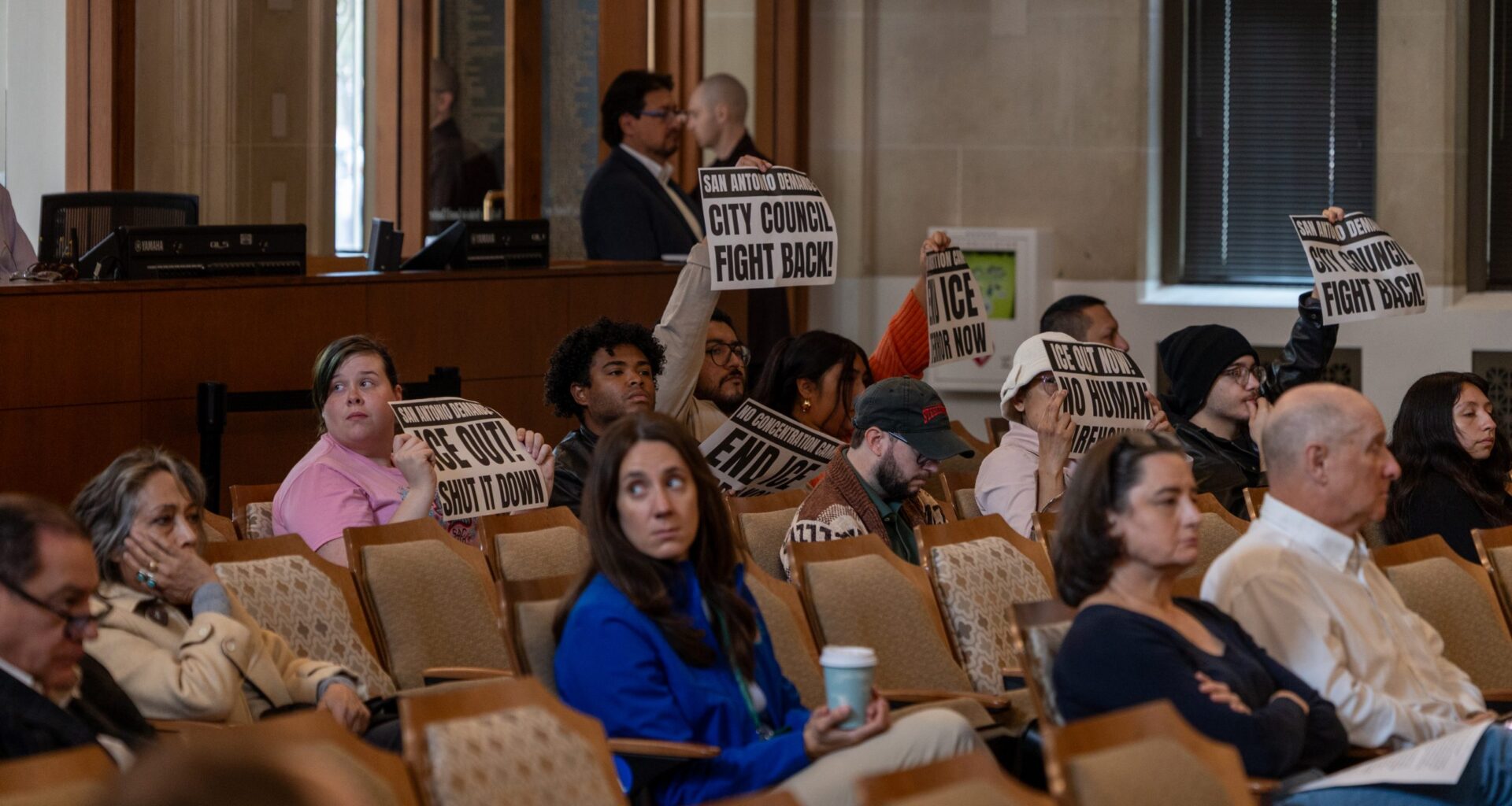
San Antonio City Council on Thursday approved a resolution directing city staff to evaluate a wide range of policy options related to federal immigration enforcement activity —including a newly purchased immigration detention facility on the city’s East Side — and to identify where the city can assert influence, increase transparency or limit involvement within the bounds of state and federal law.
The resolution, brought forward by council members from Districts 2, 4, 5 and 6, does not block federal enforcement or the operation of a detention facility. Instead, it instructs city staff to inventory existing practices, assess potential new actions and outline legal risks tied to proposals aimed at protecting residents, clarifying city cooperation with Immigration and Customs Enforcement, and increasing accountability for detention-related activity.
District 2 Councilman Jalen McKee-Rodriguez said the intent behind the resolution was to test the legal boundaries of what the city can do.
“My request of staff is that we get as close to each of these requests as legally possible,” he said. “We find that line, and we push right on it.”
City attorneys and staff told council the request spans four categories — actions the city has already taken, actions it proposes to take, actions it does not recommend due to legal risk, and actions that require further evaluation — with each carrying different timelines and constraints.
First Assistant City Attorney Elizabeth Provencio walked the council through that framework, emphasizing that San Antonio’s options are shaped by federal supremacy, Texas law, particularly Senate Bill 4, and the city’s past enforcement history with the state. SB 4, is a 2017 law that is commonly referred to as the state’s anti-sanctuary city law. City officials have previously emphasized that SB 4 places restrictions on what local governments can do when it comes to cooperating or resisting federal immigration enforcement efforts.
In recent months, large-scale federal operations have drawn protests in major cities, notably Minneapolis, where two U.S. citizens — Renee Good and Alex Pretti — were killed during aggressive enforcement. Those national developments have heightened concerns locally now that a detention facility is expected to operate in San Antonio.
 Elizabeth Provencio, first assistant city attorney, presents an overview of legal options related to federal immigration enforcement during a City Council meeting Thursday. Credit: Diego Medel / San Antonio Report
Provencio outlined actions the city has already taken, including maintaining a legal referral network for residents with legal immigration status, supporting the Office of Immigrant Affairs and training city staff on how to respond if federal immigration agents enter city facilities.
She also pointed to “know your rights” education conducted by third-party organizations supported by the city and an economic impact report on migrants in San Antonio and Bexar County, published in December 2025 and funded through a grant from the American Immigration Council.
Provencio presented proposed actions the city could do without requiring further review or facing legal risks, those included community reporting efforts to log alleged rights violations, tracking and documenting ICE requests for assistance from the San Antonio Police Department and the cost to the city, as well as gathering data on ICE activity.
The city said they were working on linking to the ICE statistics dashboard for the public to view. The city noted that data on ICE activity is regional and may not be current, the data referenced is reported on the ICE website and is updated by region. Data at ice.gov/statistics was last updated on Dec. 31, 2024.
Provencio added that a tracking system for potential rights violations would only serve as a repository for the information that could be publicly available but would not have an enforcement component.
“The difficulty is it would purely be intake,” she said. “There’s not a mechanism for us to be able to act on that. We just want to be sure that everybody’s expectations are in line. If that is in fact something you want us to proceed with doing.”
City staff cautioned council against several proposals raised by community members and advocates, citing high legal risk. Among them were expanding legal referral services to residents without legal immigration status, creating a justice fund to support civil rights litigation for undocumented residents, and directing city staff including SAPD officers to provide “know your rights” advisements themselves.
These actions, Provencio said, could trigger legal action under SB 4, certain federal grants also include immigration requirements that could affect city funding, she added.
She also flagged a proposal to prohibit federal law enforcement officers from wearing masks as legally risky, noting similar policies are already being challenged in court elsewhere.
Other elements of the resolution, Provencio said, would return to council at a later date following further evaluation, should the council move the resolution further. Those include exploring whether the city could discourage future private, for-profit detention facilities, examining whether the city can avoid contracting with vendors that also provide services to ICE detention centers, and reviewing procurement standards to incorporate civil rights or community impact considerations.
City staff were also asked to assess whether San Antonio could impose a moratorium on non-municipal detention facilities, evaluate environmental compliance at detention sites, and examine the city’s legal exposure related to detention operations — all steps that Provencio said would require careful legal analysis.
Throughout the discussion, city officials repeatedly emphasized that none of the contemplated actions would prevent the enforcement of federal immigration law.
City Manager Erik Walsh described the resolution as a way of “setting the public’s standard” while acknowledging legal and operational limits. Walsh told council that within 30 days, staff would provide a timeline outlining how long it would take to evaluate the proposed actions and report back.
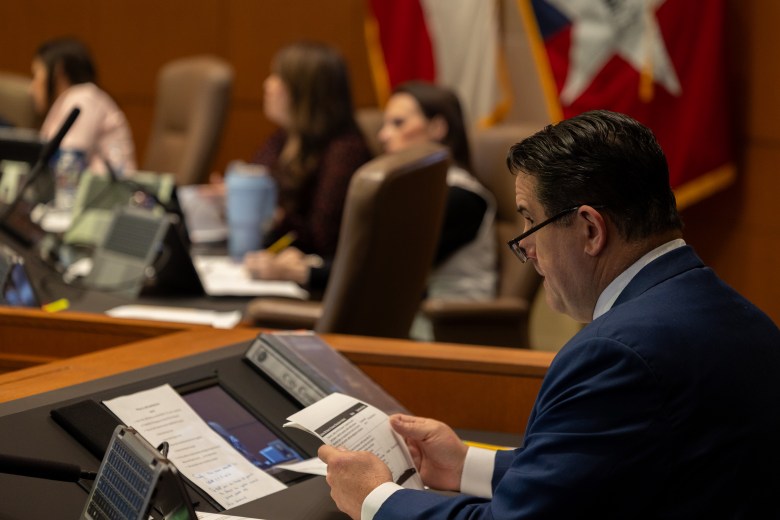 City Manager Erik Walsh reviews a presentation outlining the city’s plan to evaluate legal options related to federal immigration enforcement during a San Antonio City Council meeting. Credit: Diego Medel / San Antonio Report
Public comment on the resolution was lengthy and emotional, with residents repeatedly urging council to take stronger action to block the detention facility. Several speakers referred to the potential Eastside detention site as a “concentration camp,” called for denying utilities, and accused the city of enabling harm.
City officials pushed back on some of those suggestions, saying state law prohibits cities from withholding basic services or discriminating against property owners in their area of operation.
Council members largely expressed support for exploring every legally permissible option, though they differed sharply on how far the city should go.
McKee-Rodriguez argued that if there is a shortage of first responders in the city — a topic that was a point of debate in the past budget cycle — we should not be sending them to assist ICE officials. At a previous meeting covering SAPD cooperation with ICE, officials stated that the city’s police force had only been asked to assist ICE operations twice within the past year.
Other members, including Councilman Marc Whyte (D10) and Councilwoman Misty Spears (D9), warned against any actions that could interfere with federal enforcement or expose the city to costly litigation and funding losses. Spears argued immigration enforcement decisions belong in the courts, not with the city council after listing seven names of individuals across the U.S. that she alleges were killed by illegal immigrants.
Several council members and Mayor Gina Ortiz Jones framed the limits discussed Thursday as a consequence of federal and state policy choices, noting that broader changes to immigration enforcement would ultimately require action beyond City Hall.
Multiple speakers urged residents to stay engaged in the upcoming primary elections as debates over immigration policy continue at the state and federal level.
Ultimately, council voted 9-2 to approve the resolution, with Whyte and Spears voting against it. City staff are expected to return with updates and a proposed timeline on March 5, during the upcoming City Manager’s Report.