
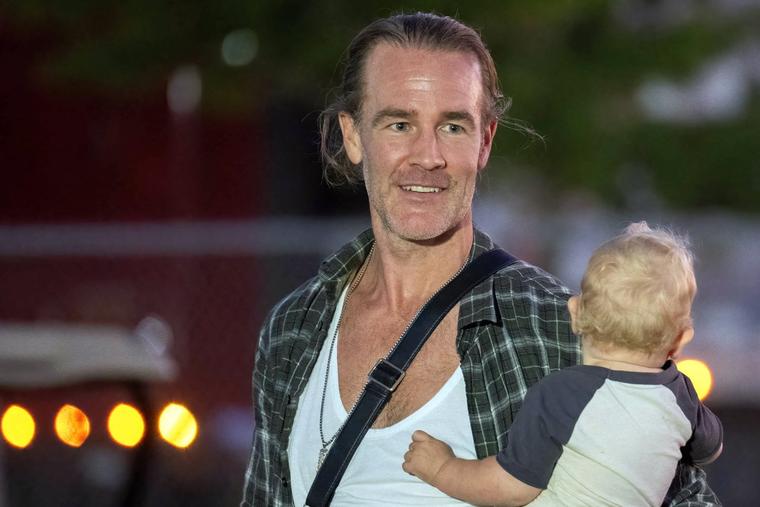
James Van Der Beek, who died Feb. 11, left a remarkable last testament on finding his identity and purpose in God during his long battle with cancer.
Who am I? What is the purpose of life? These questions, as articulated by the late James Van Der Beek as he came “nose-to-nose with death,” speak not only to a deep wound of how we self-identify in the world, but to its answer.
In a social media post that has been making the rounds since his Feb. 11 death from colorectal cancer at 48, Van Der Beek says of his illness, which he said had stripped him of his ability to be present as a husband and father: “I was faced with the question: If I am just a too-skinny, weak guy, alone in an apartment with cancer, what am I?”
Van Der Beek, a TV star of my generation, was known for his titular role in the teen drama Dawson’s Creek, as well as the lead in the football flick Varsity Blues, among others. I hadn’t followed his life and career after these early successes, but I have since discovered he had taken a path that was unconventional for many successful mainstream actors. At the time of his death, he was living on a Texas ranch with his wife and six young children, and had embraced Christianity.
In an Instragram video posted March 8, 2025 (his birthday), Van Der Beek expressed his desire to share what he had learned during what he described as “the hardest year of my life.”
“When I was younger, I used to define myself as an actor, right? Which was never really all that fulfilling.”
“Then I became a husband, and that was much better. And then I became a father, and that was the ultimate. I could define myself then as a loving, capable, strong, supportive husband, father, provider, steward of the land we’re so lucky to live on. And for a long time, that felt like a really good definition to the question: Who am I? What am I?”
This changed following his cancer diagnosis, when he had to look his “own mortality in the eye.”
“And all of those definitions that I cared so deeply about were stripped from me,” he said. “I was away for treatment, so I could no longer be a husband who was helpful to my wife. I could no longer be a father who could pick up his kids and put them to bed and be there for them. I could not be a provider because I wasn’t working. I couldn’t even be a steward of the land because at times I was too weak to prune all the trees during the window that you’re supposed to prune them.”
In meditating on these existential questions which had been challenged by his illness, he found the answer: “I am worthy of God’s love, simply because I exist.”
“And if I’m worthy of God’s love, shouldn’t I also be worthy of my own? And the same is true for you.”
Answer to the World’s Identity Crisis
Van Der Beek’s description of suffering is reminiscent of the trials of Job in the Old Testament. Although Van Der Beek didn’t lose his wife and children, as did his biblical counterpart, he was nonetheless stripped of his identity — at least, insofar as one’s identity is defined by worldly standards.
Every day, notably of late in the news and on social media, we witness the effects of what can happen when people cling to worldly identities outside of Christ. We see it in young people trying to find their place in the ever-expanding LGBTQ+ acronym, or those who mutilate their bodies to align with a perceived identity. Family relationships are broken apart by differing political affiliations. At times, even violence is deemed justifiable to defend one’s chosen political or ideological belief.
And is it any wonder that so many in this generation, which has rationalized the murder of its unborn children, are trying to justify their existence, their worthiness of love, by clinging to any ideological identity that will take them?
Even outside these extremes, however, there is the danger of assigning too much importance to how we identify with our career, our mission, or even our vocational state in life. Yes, the abilities of a journalist, academic, musician, doctor, etc., are gifts from God. However, they not only fail to define us, they can also be taken away, just as they were for Job.
For Van Der Beek, navigating this crisis of identity, which extended beyond his career as an actor to his role as a husband and father, meant keeping his eyes fixed on God.
“Before cancer, God was something I tried to fit into my life as much as possible,” Van Der Beek told NBC’s Today show in an interview following his diagnosis. “After cancer, I feel like a connection to God, whatever that is, is kind of the whole point of this exercise on this planet.”
The particulars of Van Der Beek’s Christian affiliation are not public, although the attentive (and providentially aware) Catholic will observe that his fight with cancer ended on the feast of Our Lady of Lourdes, patroness of the sick. It would therefore be fitting that he is remembered, not only as a successful actor, but as someone who confronted sickness and death as we all should: with our eyes fixed on Christ.