
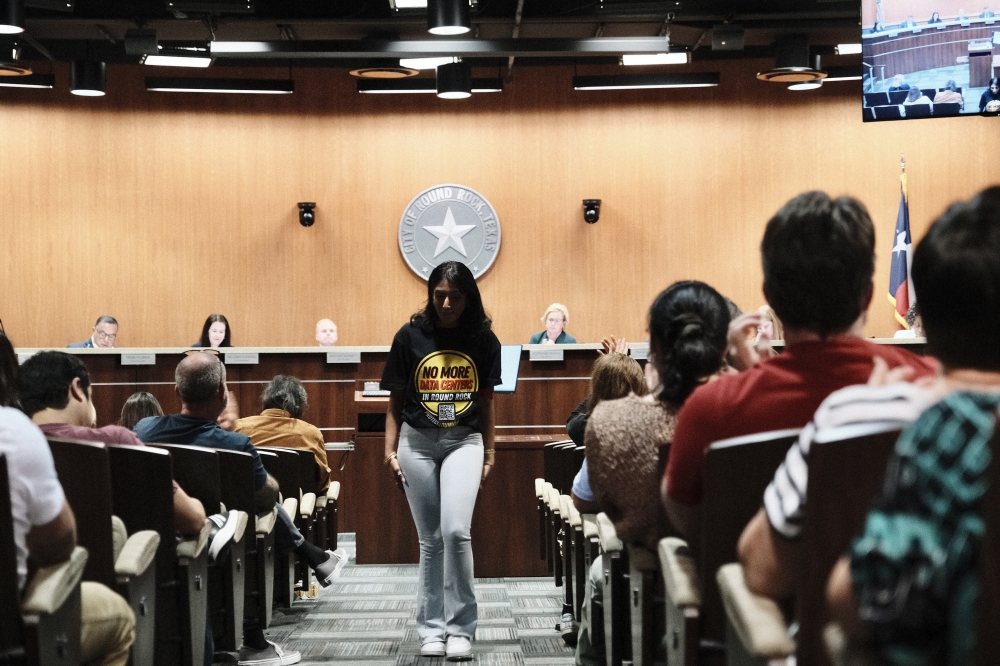
Round Rock City Council unanimously approved a rezoning request that will allow a Skybox data center to be built near East Old Settlers Boulevard and North A.W. Grimes Boulevard.
The ordinance passed on second reading, rezoning approximately 29.69 acres from a light industrial designation to a planned unit development and establishing project-specific development standards for the site.
Some context
The property has been zoned light industrial since 2023, but has remained undeveloped.
Because “data center” is not a defined use in Round Rock’s zoning code, the developer was required to seek approval through a planned unit development, or PUD, to allow the use and establish customized requirements.
City officials framed the project within a broader surge of data center development across Central Texas.
Planning and Development Services Director Brad Dushkin said one existing Round Rock data center generates property tax revenue equivalent to about 600 single-family homes while occupying a footprint similar to about 100 homes.
“It only uses the water amount of 15 single-family homes, but provides the city with property tax revenue equivalent to 600 single-family homes,” Dushkin said.
Officials said commercial properties make up about 8% of taxable parcels in Round Rock, but account for nearly half of the city’s property tax revenue, helping stabilize the tax base.
City staff also emphasized the city’s water supply position during the discussion.
“We’re in very good shape,” Executive Director of Public Works Michael Thane said, noting the city has multiple water sources and long-term infrastructure planning in place.
Mayor Craig Morgan added that the city plans water infrastructure based on industrial land-use assumptions.
“If they use 2 million gallons a year, that is way less than what we’ve planned for for a site of 30 acres,” Thane said.
Planning and Zoning Commission members recommended approval of the request in November.
The details
Under the approved PUD, the site is divided into three parcel areas:
Parcel Area 1: Data center or light industrialParcel Area 2: Electric substation or light industrialParcel Area 3: Open spaceThe ordinance limits development to:One primary data center buildingA maximum of 250,000 square feetA maximum height of 60 feetA cap of 75 megawatts of grid-connected powerDushkin said those caps were added after neighborhood meetings between the first and second reading.
“We wanted to actually add something concrete here into the PUD so that we all had something to point to for maximums,” he said.
The facility must use a closed-loop cooling system designed to significantly reduce water consumption compared to evaporative systems.
The PUD also:
Prohibits vehicular access to Chandler View TrailRequires an 80-foot development setback along the southern property lineEstablishes a 25-foot landscaped buffer with an 8-foot masonry compatibility wallRequires two rows of evergreen treesRestricts loading docks from facing south toward nearby homesLimits generator use to emergency and reliability purposesSkybox Chief Development Officer Haynes Strader said the project was designed to be a more compatible long-term use for the property compared to other industrial alternatives.
“Significantly reduced traffic and enhanced tax base make the data center a more compatible long-term outcome for this site,” Strader said.
The site backs up to the Chandler Creek neighborhood, prompting sustained public interest and debate in recent months. Concerns raised during previous hearings centered on neighborhood compatibility, noise, electric demand, air quality and long-term impacts.
Those opposed
Public comment stretched for hours, with more than a dozen speakers largely echoing similar concerns about noise, electric demand, air quality and long-term impacts to surrounding neighborhoods.
Joshua Phillips, who said he organized a petition after the Dec. 4 hearing, told council members he collected more than 3,000 signatures opposing the rezoning.
“Most people are saying we don’t see this data center offering anything of value to the residents,” Phillips said.
While acknowledging the projected tax revenue, he questioned the facility’s employment and community benefits and raised concerns about potential impacts to home values.
Adrian Shelley, director of Public Citizen’s Texas division, warned that low-frequency “infrasound” generated by large facilities would not be covered under city noise ordinances. He also argued that growing power demand from data centers statewide contributes to rising electricity costs.
“You can be sure that all of the additional demand from the hundreds of data centers that are being proposed across the state are contributing to that,” Shelley said.
Several residents also raised concerns about diesel backup generators, even if used only during outages or testing.
Kim Hollowell, who lives in the Oak Creek neighborhood, said families in the area already face respiratory challenges and questioned the long-term air quality effects.
“We’re being asked to trade our air quality and quality of life,” she said.
Speakers repeatedly emphasized that while the property is zoned for light industrial use, they believe a large-scale data center adjacent to residential neighborhoods is not compatible with the surrounding community.
City officials responded during the hearing, noting that industrial development is permitted under existing zoning and that alternative uses, such as warehouse distribution, could generate truck traffic and additional service demands.
What’s next?
With zoning finalized, the project will move into the city’s site development review process, where detailed plans for building placement, drainage, utilities and access will be evaluated before construction can begin.
“>