
Houston criminal defense lawyer Randy Schaffer’s new memoir, “Tales As Old As Crime: Laughter and Pain In The Criminal Injustice System” (IUniverse Publishing), is a deep dive into his 50-year career as one of America’s best criminal defense advocates.
Acknowledged for his mastery in criminal trial and appellate practice, Schaffer has won seemingly hopeless cases through tireless investigation of facts, grit and the courage to stand up to biased judges. He also has a penchant for representing underdogs.
After graduating at the top of his class from The University of Texas Law School in 1973, Schaffer was hired by Richard “Racehorse” Haynes.
While working for Haynes, Schaffer won “not guilty” verdicts in six of seven murder cases he tried. His batting average in these cases was near perfect – especially given that his client in the seventh case was convicted of the lesser offense of involuntary manslaughter and received a seven-year prison sentence instead of a possible life sentence for a murder conviction.
One of his cases roiled Houston’s Jewish community and became headline news in Houston and beyond.
On June 8, 1984, Bernard and Odette Port, husband and wife, were low-profile members of Houston’s Jewish community. That day, their lives would be ripped asunder. Bernard’s 17-year-old son (Odette’s stepson), David Port, was arrested for the savage murder of Debra Sue Schatz, a 23-year-old mail carrier.
Bernard initially cooperated with police. David was missing; Bernard was worried. But as police continued to pressure the couple, Bernard realized they needed the best lawyer they could hire. The Ports believed Halakha (Jewish law) shielded them from testifying against David. Police and prosecutors recognized no such privilege.
The Ports hired Schaffer.
Though a lifelong member of Congregation Beth Israel, Schaffer was unfamiliar with Halakha. So, he consulted his rabbi at the time, Rabbi Sam Karff, z”l of Congregation Beth Israel.
“He opened the Talmud, a huge book of Jewish law, to Sanhedrin 27b, which provides [that] a father shouldn’t testify against a child or a child against a father,” Schaffer writes. “So, we had Jewish law on our side. But we couldn’t change the venue to Israel.”
Prosecutors subpoenaed the Ports to testify before a grand jury. They refused, and they were adamant that Halakha forbade parents testifying against even an adult child.
For Odette, the prospect of testifying against her stepson was horrific. A Holocaust survivor, during her childhood in Greece, she had witnessed how Nazis pitted Jewish parents and children against each other to exterminate as many Jews as possible.
She “was traumatized by the experience of people informing on others – collaborating and cooperating with the Nazis,” said Rabbi Shaul Osadchey, who had met with the Ports at their home on the night of David’s arrest.
“That left an indelible impression on her. Collaborating with the Nazis meant the person you were speaking about wound up dead or in prison. She was reliving what she had experienced as a child.”
In an interview with the JHV, Rabbi Osadchey recalled explaining another dictum of Halakha to the Ports. “The law of the land is the law,” or “Dina d’malchuta dina,” as stated in tractate Bava Kama (113a) of the Talmud. Prosecutors argued Halakha was preempted by Texas law and provides no parent-child privilege.
This did not deter Schaffer, who filed motions to protect the Ports from testifying, citing the U.S. and Texas Constitutions’ provisions protecting the free exercise of religious beliefs. Schaffer asked courts to recognize a parent-child privilege based on Halakha and the free exercise of their deeply held religious beliefs.
The Ports’ plight became a hot news item. The Houston Chronicle, the Houston Post, The New York Times and local television stations provided detailed coverage of the controversy.
Some prominent members of Houston’s Jewish community feared publicity from the case could spark antisemitism.
Schaffer learned a civil district judge – a prominent member of the Jewish community – had called Judge William Hatten, who was presiding over the Ports’ hearing, and “encouraged him to deny the motion because it ‘made Jews look bad’ and, in any event, the Ports aren’t ‘real Jews’ because they don’t belong to a synagogue.” Schaffer confronted the judge who denied making the call.
Schaffer had been present in Hatten’s chambers during the call and Hatten had told him about it. “He then sought to justify the call. I told him to mind his own damn business and stay the hell out of my case,” Schaffer writes.
Concerns about antisemitism were not unwarranted. On the second morning of the Ports’ hearing, the trial judge noted a swastika had been painted on his barn overnight.
Rabbi Jack Segal, z”l, senior rabbi of Congregation Beth Yeshurun, testified as an expert witness for the prosecution. He opined Halakha did not shield the Ports.
Judge Hatten ordered Bernard and Odette to testify before the grand jury. They refused and were jailed. Bernard was in jail for two months, and then testified. Odette spent four months in jail. She was released after expiration of the grand jury’s term. Texas law states punishment for contempt terminates with the expiration of a grand jury’s term.
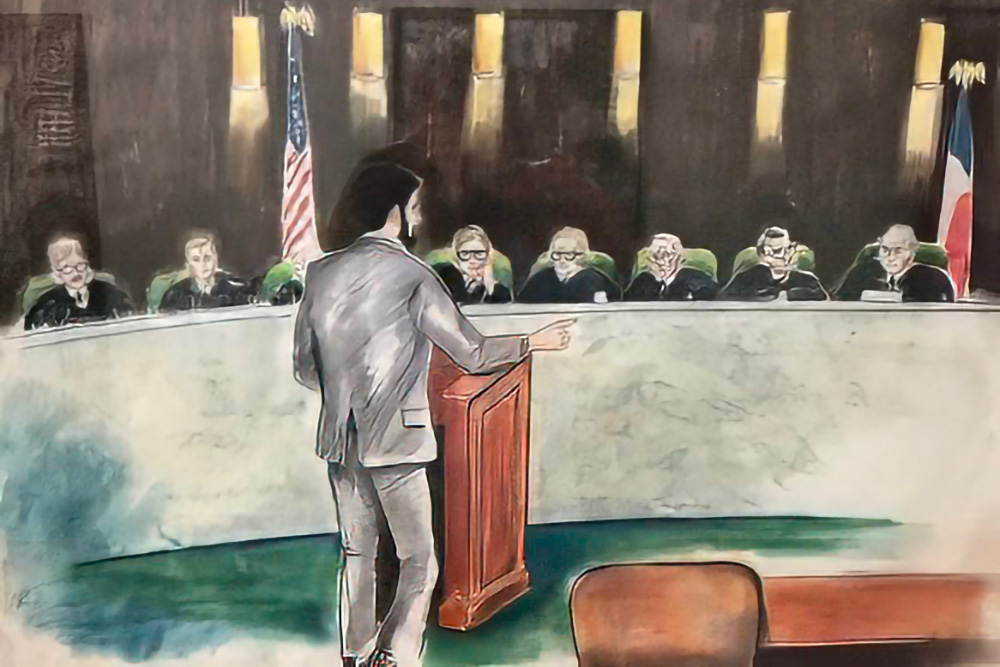
Schaffer argued the Ports’ case before the Texas Court of Criminal Appeals, a Houston federal district court in the federal Fifth Circuit Court of Appeals in New Orleans. None of the courts ruled in the Ports’ favor.
David Port was convicted of murder, sentenced to 75 years and was paroled in June 2014 after serving half his sentence.
The Ports’ case inspired Rosellen Brown, bestselling author and one-time Houstonian, to write “Before and After,” a saga similar to the case but set in a small New England town. Meryl Streep and Liam Neeson starred in a film of the same name.
Schaffer’s memoir recalls his odyssey through the highs and lows of the criminal justice system. His victories include liberating Randall Dale Adams from a life sentence for capital murder after spending 12 years in prison. Adams’ ordeal is the subject of an award-winning documentary, “The Thin Blue Line.” Schaffer’s advocacy for Adams brought him national fame and elevated him to the top tier of America’s criminal defense lawyers.
Schaffer has no plans to retire. “I will retire when prosecutors no longer try to convict the innocent, keep them in prison, suppress favorable evidence and use false testimony – because there won’t be anything left for me to do,” he writes.